This is the easiest Hamentaschen recipe. It’s a quick, 2-ingredient version of the delicious Purim cookie with filling.
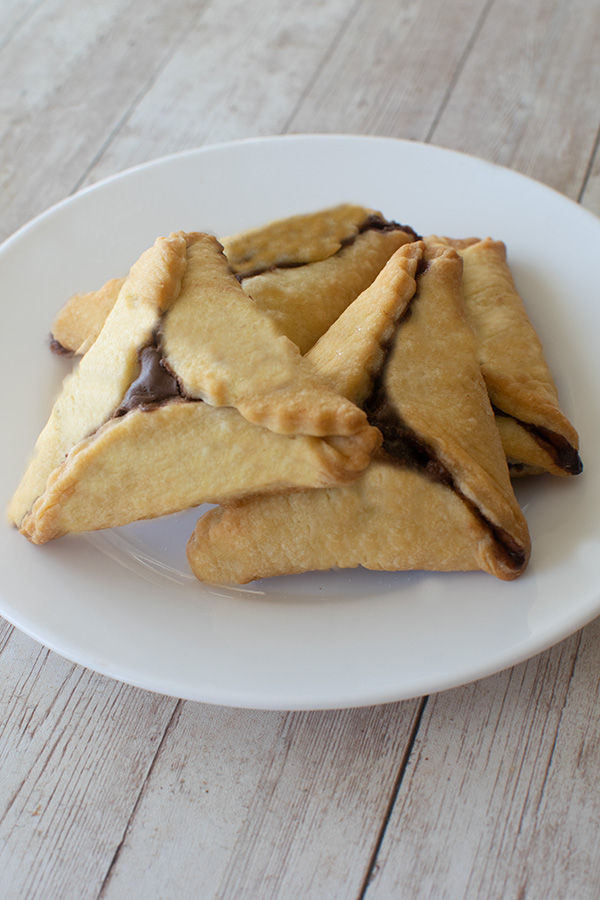
Hamantaschen (or hamentaschen) is one of the best parts of Purim, but why wait for the holiday? Just make the delicious dough from this Easy Hamantaschen recipe, add your favorite filling, fold, bake and voila!! A tasty pleasure for everyone…any time!
Want to make hamantaschen with homemade dough? Try: Hamantaschen for Purim.
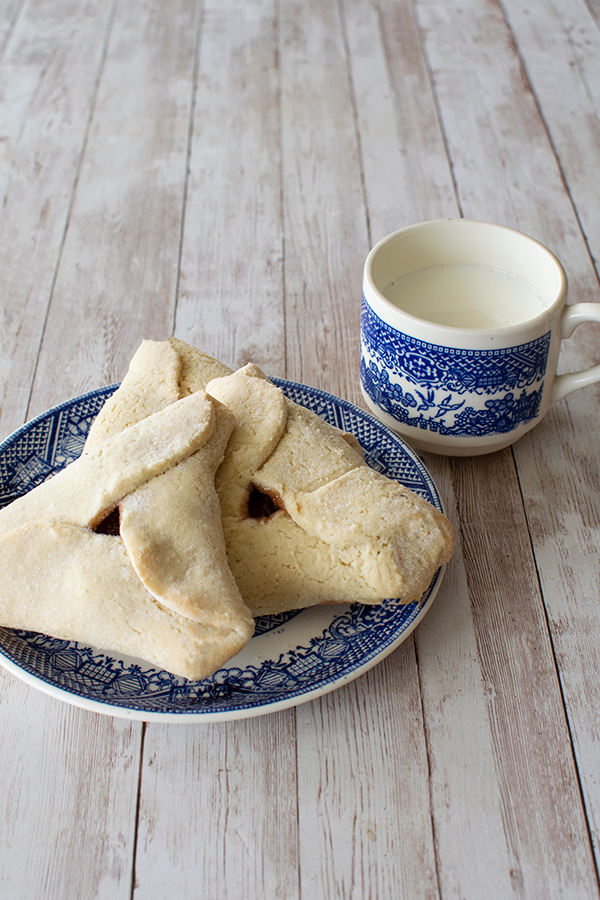
While you can certainly go out to the store for your baked goods, there is nothing as satisfying as when you serve something YOU made and people love it.
General FAQs and information about baking:
Why do recipes have salt in the ingredients of baked goods?
Even though salt tends to make foods, well, salty, it actually plays other roles in baking as well.
For example, the right amount of salt balances flavors in baked goods; it can bring out the sweetness of sugar and, at the same time, prevent them from tasting overly sweet. It also can help dull the bitterness of cocoa.
Salt prevents baked goods from tasting bland, while it balances the richness of the fats. It also helps develop flavor in yeast breads and works with proteins to strengthen gluten and make it more elastic.
Salt also slows down yeast fermentation because it prevents the yeast from eating up the sugars too quickly, which otherwise would cause the dough to rise too fast and then ultimately collapse, causing bread to come out flat instead of fluffy.
Salt helps baked goods stay a little fresher for a little longer and helps delay mold from growing on them.
Some types of salt in baking:
Kosher salt—called “kosher” because it is used in the process of making meat kosher for observant Jewish consumption. The grains are large.
Table salt—this is what we use to flavor our food at the table. The grains are much smaller than those of kosher salt.*
Sea salt—like table salt, but processed differently*
Flaky salt—flakes of salt that are used for decoration and add a salty taste to the already-baked good.
*A lot of recipes call specifically for sea salt. There is no difference in the baking process or taste between sea salt and table salt, and both contain approximately 40% sodium. However, while table salt is usually mined from underground salt deposits, is heavily processed, and often contains the nutrient iodine, sea salt is made by evaporating water from the ocean, sea, or lakes with saltwater and may contain very small amounts of some minerals.
Can I substitute honey for granulated sugar in baking?
The short answer to this question is yes.
However, there are some things to consider, because the substitution is not 1:1.
Honey is denser and contains more fructose than white granulated sugar, so it is sweeter. Also, honey contains almost 20% liquid, so adjustments must be made for these differences.
First of all, the glucose and fructose in honey make it sweeter than granulated sugar, so you would use only ¾ of the amount of sugar in the recipe’s ingredients. Second, since honey already contains liquid, you should reduce the amount of liquid that the recipe calls for by 25% to maintain consistency.
Honey is also naturally acidic, whereas granulated sugar is not, so in order to neutralize the acidity you will be adding to your baking, you can add ¼ teaspoon of baking soda per cup of honey to the ingredients.
Lastly, since honey contains simple sugars that caramelize and burn at lower temperatures than granulated sugar does, you should lower the temperature by 25 degrees from that required in the recipe. This is to help prevent the outside from baking quicker than the inside of your baked goods.
Note:
There are a few additional things to note about substituting honey for sugar, though. First, if you use honey rather than granulated sugar for baked goods that are supposed to be crispy, they will come out softer. Second, you cannot “cream” if you replace granulated sugar with honey, so recipes that are meant to come out light because of creaming butter with sugar will come out denser. Lastly, honey is still a sugar, and it has approximately 30% more calories than granulated sugar does (but this will be somewhat compensated by the fact that you will be reducing the quantity of honey versus sugar in the recipe).
What is the difference between baking soda and baking powder?
Baking soda and baking powder are both synthetic leavens that help baked goods rise, but there is a difference between them.
Baking soda is pure sodium bicarbonate, which needs another ingredient that is acidic in order to be activated. When the baking soda touches the acid, it creates a carbon dioxide gas, which helps the baked good rise. Baking soda is between 3 and 4 times stronger than baking powder, and if too much baking soda is used, your baked good will end up with a metallic flavor.
Baking powder is baking soda that is already mixed with an acid and a stabilizer and will be activated by moisture and heat. Nowadays, baking powder is called double-acting because it activates twice—once when it gets wet (when you mix the ingredients together) and again when it heats in the oven.
Replacing one with the other can be tricky and it’s not recommended. However, if you have no choice, then do solid research for substituting one for the other for the baked good you are preparing so you don’t ruin it.
Why do recipes with yeast say to make a mixture of the yeast, warm water, and sugar and set aside until it bubbles?
Most dough recipes that include yeast will give instructions to mix the yeast with warm water and sugar and set aside until it bubbles before using it. This is NOT part of the recipe but rather a short process called “proofing” to ensure that your yeast is alive because if it is not, your dough will not rise.
In order to proof your yeast, you need to let the yeast, warm water, and sugar mixture sit for 5-10 minutes to see if it develops foamy bubbles. If it does, your yeast is alive. Otherwise, it should not be used.
The water for proofing must be warm in order to activate the yeast because if it is too cold, nothing will happen, and if it is too hot, it will kill the yeast. Warm is between 105 and 110 degrees Fahrenheit (or 40 and 43 degrees Celsius). I usually just put my finger in the water, and if it is comfortably warm, I use it.
The sugar is used in proofing because yeast eats the sugar and releases gas (carbon dioxide), which is what causes the bubbles. If there are no bubbles, either the water was too hot or too cold, or the yeast is simply dead.
Note: If you are CERTAIN that your yeast is alive, then this process is unnecessary.
What do eggs do in baking?
Eggs are made up of two parts: the whites and the yolks (the yellow).
Egg whites are made up of protein that sets when heated and helps baked goods hold their structure. The yolks are made up of fats and vitamins and help ingredients bond.
Eggs also help baked goods rise as well as keep them moist.
It is important to have the right amount of eggs when baking, because if there are too many eggs in a recipe, this can cause a rubbery, dense texture, and if there are too few eggs, this can cause a crumbly, dry texture.
The different parts of the egg will provide different textures to baked goods; using the entire egg in baking will provide moisture and help the baked good rise evenly, using extra yolks will create richer, denser textures, and extra whites will add fluffiness but may create a drier texture.
What if I don’t want to use eggs in my baking?
There is food science that one can research to replace eggs in baking, but the substitutions will change from item to item.
Should I sift flour before I use it?
Unless you are concerned about bugs or clumps from moisture, the need to sift depends on your recipe.
For example, you don’t need to sift for dense baking like muffins or quick breads, where lumps won’t ruin the texture. But you should sift for recipes that rely on air bubbles, such as sponge or angel cakes or soufflés. You also should sift your flour if you are making baked goods with a high fat content, such as brownies, because it is important that the fat be absorbed throughout all of the flour, and having flour clumps could prevent this.
Sifting the baking powder and/or baking soda together with the flour and salt before mixing in the other ingredients may be able to help prevent cakes from coming out lopsided, where one side may be somewhat higher than the other.
What is the difference between butter and margarine?
Butter is a dairy product that is made by churning heavy cream until the fats separate from the milk (i.e., buttermilk). Margarine, however, is made from vegetable oil. Butter generally has a lower melting point than margarine as well as a lower water content (and the soft tub margarines have a higher water content than bar margarines).
Using butter in baking cookies can create a crisper, more flaky cookie, while cookies will come out softer and more cakey when made with margarine. It is also generally believed to be better to “cream” using butter rather than margarine.
Using butter adds a kind of toasted nut flavor to baked goods, while margarine doesn’t add flavor (however, sometimes with margarine, one might have a waxy feel on the roof of one’s mouth after eating something with a high margarine content).
If one wants to make a dairy-free baked good that calls for butter, a dairy-free margarine is a good substitute.
What is the difference between dairy-free margarine and vegan butter?
Vegan butter and margarine have similarities. In fact, all vegan butter is a type of dairy-free margarine. The difference between them is in the content and the baking performance.
Vegan butter is made from fats such as coconut oil, shea butter, or cocoa butter, and behaves like butter in that it creates more flaky and crisp textures and has a toasted nutty flavor, while margarine is typically made with the less expensive vegetable oils.
What is the difference in using oil vs butter or margarine?
Both margarine and butter are solid fats at room temperature, and both contain more saturated fats than oil.
While margarine and butter will change from a solid to a liquid when heated, they will change back to solids when cooled again. Oil stays liquid at all temperatures. Oil also coats flour better in the preparation process before baking.
Butter “creams” better than margarine, but one cannot cream oil at all.
When converting a recipe from butter or margarine to oil, the general conversion rate is 1 to ¾ (although if you are doing more than one batch, you might need to reduce the oil because I have found that baked goods come out oily in this case).
And when converting from oil to margarine or butter, typically the ratio is 1 to 1¼.
What is the difference between real vanilla extract and imitation vanilla?
Real vanilla is made from soaking vanilla beans in alcohol, imitation vanilla is synthetic and real vanilla costs quite a bit more than imitation. Whether or not there will be a taste difference in your baking depends on the baked good, so do some research before you decide. I personally always use the imitation as long as I have a really good brand because it’s not worth it to me to spend the extra money.
Baking and Dessert Pantry Essentials
I never know when someone in my family is going to want a dessert at home, to bring to a friend’s house, or need for an event, so I like to make sure I can bake anything with very short notice. To that end, I keep a variety of supplies and ingredients in the house that will allow me to do just that.
I can’t tell you how many times I was glad to have whatever I needed within reach for the last-minute visitor or for when one of my kids went to a friend or had a school event without much prior notice.
I have slowly collected things over the years as I needed them (or if I found a good sale) and like to keep more than one of the smaller items in case I don’t want to wash dishes in the middle of baking.
My basic “equipment” includes:
- a stand mixer, which I use mostly for dough and sometimes for whipping
- a hand mixer (for things that aren’t dough and I don’t want to mix manually)
- a kitchen scale
- different sizes and shapes of baking pans, including loaf pans
- mixing bowls (or just large bowls—I have plastic, glass, and metal)
- cookie sheets
- pie dishes
- dry measuring cups
- liquid measuring cups
- measuring spoons
- whisks
- rubber spatulas (really good for when you don’t want to leave anything in the bowl)
- rolling pins
- a baking mat for rolling out dough
- baking strips
- a good supply of baking (or parchment) paper (also round for layer cakes)
I can certainly get by without a lot of the above, but it makes baking so much simpler when I just have whatever I need at my fingertips.
Note: The measuring cups and spoons should match as far as the measurements are concerned. Not all cups are properly marked, and this can throw your measurements off.
In addition to the equipment, there are the baking ingredients that I try to keep in the house at all times:
- flour
- white granulated sugar
- brown sugar (light/dark—I usually keep dark)
- confectioners’ sugar (powdered sugar)
- salt
- baking powder
- baking soda
- cocoa powder
- ground cinnamon
- ground nutmeg
- ground ginger
- ground cloves
- baking chocolate
- chocolate chips
- instant dry yeast
- vanilla and/or vanilla sugar
- cooking oil/cooking spray
- margarine or butter
- eggs
- honey
- instant coffee
- various extracts (real or imitation)
I also make sure that I have the following on hand to be able to make a variety of fillings, frostings, and toppings:
- whipping cream
- powdered pudding mix
- powdered sugar
- a good chocolate spread
Then, there is the following to make last-minute quick desserts:
- packaged pie dough or ready-made pie crusts
- puff pastry dough
Lastly, it’s not a bad idea to keep fun toppings, such as chopped walnuts, raisins, and the oh-so-important container of sprinkles.
About Purim and Hamentaschen
What is Purim?
Purim is a Jewish holiday which commemorates the saving of the Jewish people from Haman (Hamen) – the vizier of the Persian king, Xerxes (Ahashverosh) – by Queen Esther and her uncle Mordechai.
The king’s first wife – Vashti (who had inherited the crown and made him king) disobeyed him and he was beside himself with anger. His advisors told him to get rid of her, with the explanation that everyone’s wife would feel it’s ok to disobey their husbands if she was allowed to get away with it. He agreed and complied.
Sometime after this, maidens were brought from far and wide for the king to choose a new queen. He chose a nice Jewish girl, Esther (although she kept her religion to herself).
Esther’s uncle, Mordechai (who had adopted her after the death of her parents) had accompanied her to the palace and would sit by the gates to hear of news of Esther’s well-being.
One day, Mordechai overheard two of the kings eunichs plotting to kill him and told Esther who told the king. The eunuchs were found guilty, were hanged, and the king had the incident recorded in his chronicles.
In the meantime, Haman, a sociopathic narcissist, was a promoted by the king and everyone was commanded to bow down to him.
Nonetheless, Mordechai refused, which caused Haman to become overcome with rage and hatred. So, he went to the king with a plot to murder all Jews (men, women, young, old) in revenge.
Haman told the king that there were a people who were dispersed among his nations, whose traditions were different from those of everyone else’s, and who didn’t follow the king’s laws. He told the king that he shouldn’t have to be tolerated and, if it please the king, they should be annihilated. The king told him to do as he saw fit.
A date was set and notifications were sent to all the provinces.
When Mordechai found out, he put on mourning clothes (a sack) and when Esther was told about this, she sent clothes to him via a messenger. He refused them and sent back a message telling her about the decree and insisted that she plead with the king on behalf of her people.
Esther really didn’t want to do this, because everyone – including the queen – had to be invited to see the king or risk death. Mordechai responded that she shouldn’t think that her position would protect her and that maybe this was the reason she became queen in the first place (from God).
Esther responded that everyone should fast for three days, night and day, and that she and her maidens will also fast and then afterward she will go to the king … “If I perish, I perish.”
When she went to the king, he was happy to see her and extended his golden sceptor toward her. He asked her what she wanted from him. “What is it you desire, Queen Esther, and what do you request? Up to half of the kingdom and it will be given to you.”
Esther’s request was that the king and Haman come to a banquet that she had prepared. The king agreed and ordered that Haman be quickly brought and there, again, the king asked: “What is it you desire, Queen Esther, and what do you request? Up to half of the kingdom and it will be given to you.”
Esther told the king that she would like him and Haman to come to another banquet the next day.
Of course, Haman was thrilled at the invitation. However, when he left to go home and saw Mordechai sitting at the gate, who still didn’t stand and bow for him, his joy dissipated and he was furious.
Haman went home and told his friends and his wife that nothing he had attained was worth anything to him as long as he had to see Mordechai disrespecting him. They suggested he build a tall gallows and ask the king to hang Mordechai on it. He liked the idea and built the gallows.
That night, the king couldn’t sleep and asked that his chronicles be read to him and he was reminded of how Mordechai saved his life from the eunichs. “What was done for him?” he asked. “Not a thing,” was the reply.
So, the king asked who was in the courtyard and lo and behold, there was Haman on his way to ask the king’s permission to hang Mordechai!
The king had him called to him and asked, “What should be done for the man whom the king desires to honor.”
Haman, narcissist that he was, thought: Who would the king want to honor more than me? So, he recommended that the king’s clothes and the king’s horse with a royal crown on it’s head to be given to the most noble official who will dress the man and ride him through the town square and call out: “This is what shall be done for the man whom the king desires to honor.”
So, the king told Haman himself to quickly do just as he mentioned…for Mordechai the Jew!
The next evening, the king and Haman went to Esther’s banquet and again the king asked her: “What is it you desire, Queen Esther, and what do you request? Up to half of the kingdom and it will be given to you.”
This time she replied that her desire is her life and her request, the lives of her people. She proceeded to tell the that they had been sold out to be annhiliated.
“Who dared to do this?” he asked.
She told him: “This wicked Haman!”
The king got up and went out into the garden in his wrath and when he came back he saw that Haman had fallen on Esther’s sofa to beg for his life and said: “Can it be that he would actually assault the queen while I’m in the house?”
One of the eunuchs who were in attendance overheard and told the king: “Also, there is the tall gallows that Haman prepared which to hang Mordechai – who spoke good of the king – by his house.”
The king replied: “Hang him on it!”
The rest of the story is that the Jews got to fight back on the days they were supposed to be slaughtered and they won.
Every year, Jews celebrate their victory and on Purim, in the morning, they give out packages of treats and baked goods to their neighbors and friends and in the afternoon they have a festive meal to celebrate.
What about hamantaschen?
Hamentaschen (spelled a variety of ways) is a favored type of cookie that is made from a circle of dough with filling and folded into a triangle.
“Tasch” is yiddish for pocket, so the word hamantashen actually means, Haman’s (Hamen’s) pockets. Some people say that the triangle actually represents the three-cornered hat that Haman supposedly wore, and in Hebrew, they called these treats, Haman’s ears (Oznei Haman).
There are several ideas about how hamentaschen got its name, but it doesn’t really matter…All that matters is the they are really good!
How to fold Hamentaschen:
Cut out circle from dough (this is a 3″ diameter circle)
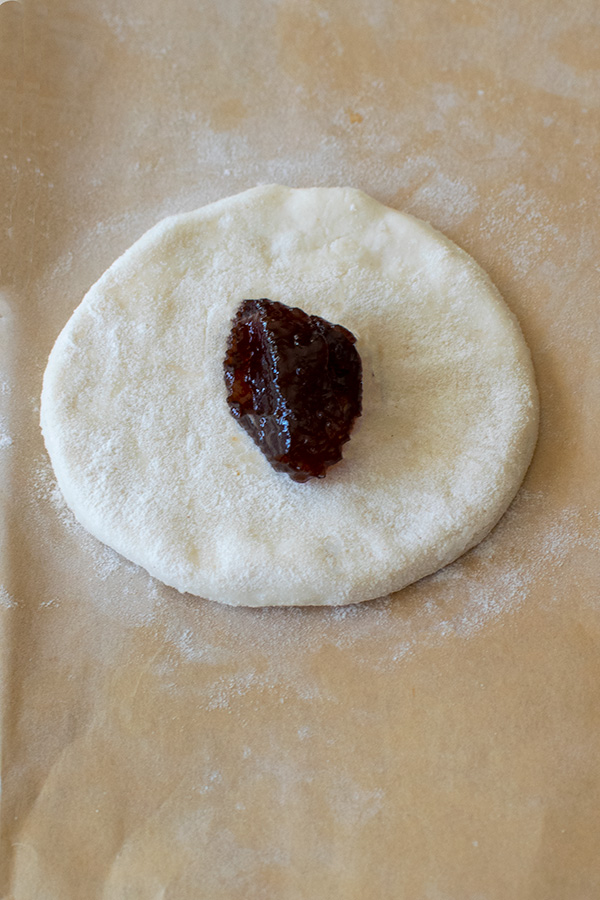
Fold over 1/3 of the circle from the edge toward the middle (how far you fold in is determined by how much filling you want showing.
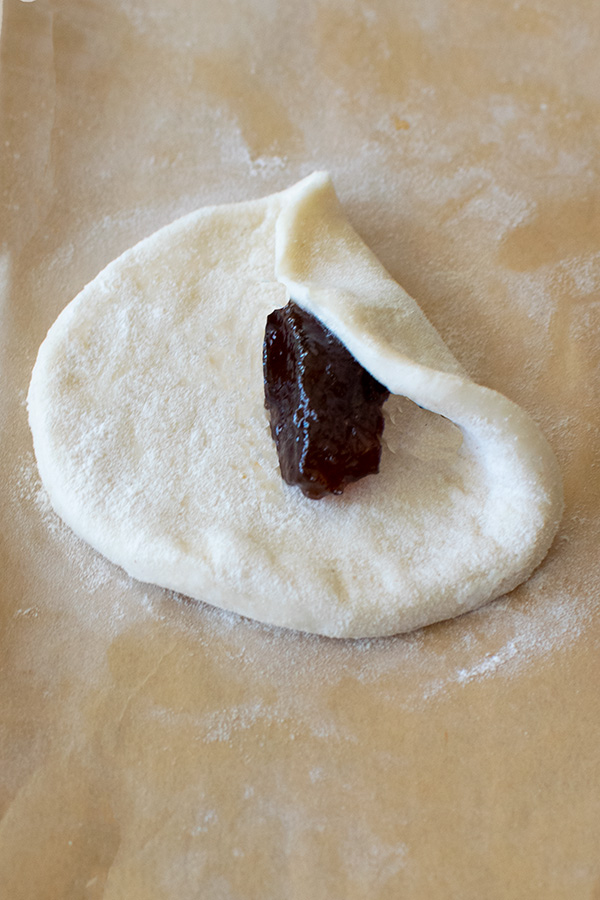
Then fold over another 1/3 from the edge toward the middle
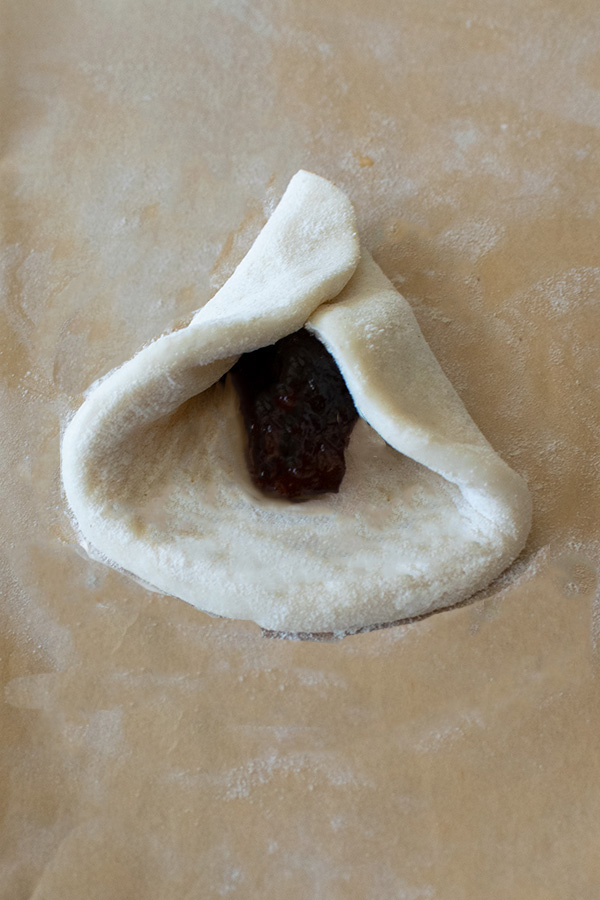
Then fold the last 1/3 toward the middle and tuck one side under, so each fold has one side exposed and one side under another.
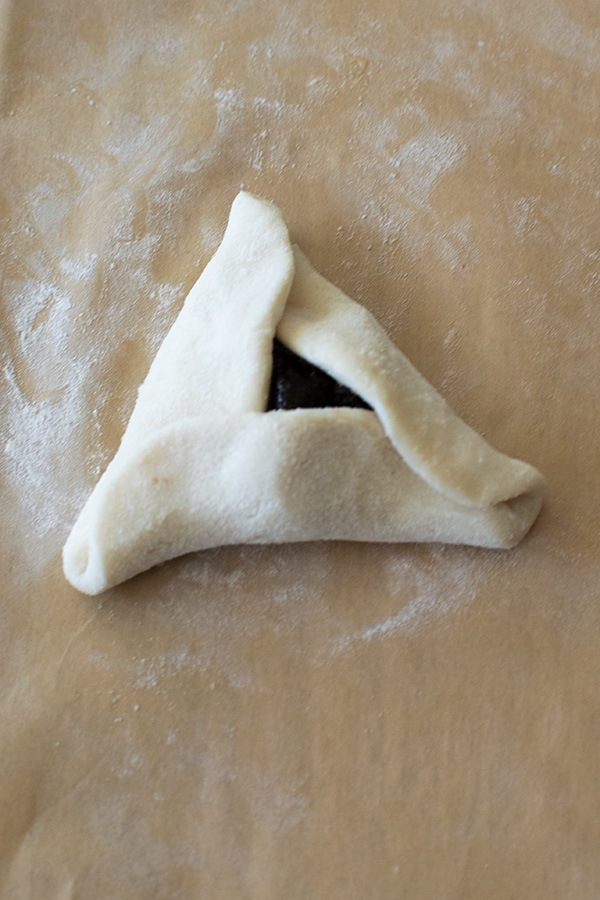
…and voila! That’s it!
Easiest Hamantaschen
Delicious and easy, 2-ingredient hamantaschen (hamentaschen).
Ingredients
- Approximately 1 pound of chilled ready-made pie dough, preferably sweet (* see notes). Use dairy free dough if desired.
- 1 cup filling of choice
Instructions
- Roll out pie dough (rectangle shape, approximately 16" x 10" or so and 1/8" thick - a little more is fine) onto a mat or table where it won't stick and won't slide around either.
- Cut out circles. The larger the circle, the larger each piece will be, but less of them. *
- Put a dab of filling in the middle of the circle (the smaller the circle, the less filling you use).
- Fold 1/3 of the circle toward the middle (you can cover the middle or let a little of the filling show).
- Then fold in another third toward the middle.
- Fold the last third toward the middle and carefully tuck one end under the 1/3 next it so that each 1/3 has one side showing and one side tucked under the 1/2 next to it.
- Lay each hamentaschen a greased or lined cookie sheet, leaving around 1" space between each
- Place in an oven that has been preheated to 350°.
- Bake for approximately 15 minutes or until the dough has slightly browned.
Notes
* Quantity is based on circles with a diameter of 2.5 inches.
Nutrition Information:
Yield:
25Serving Size:
1Amount Per Serving: Calories: 122Total Fat: 7gSaturated Fat: 3gTrans Fat: 0gUnsaturated Fat: 4gCholesterol: 0mgSodium: 112mgCarbohydrates: 14gFiber: 0gSugar: 0gProtein: 1g