This Banana Quick Bread recipe is a one-bowl easy banana bread recipe that’s delicious and moist, and dairy-free (made with oil, not butter).
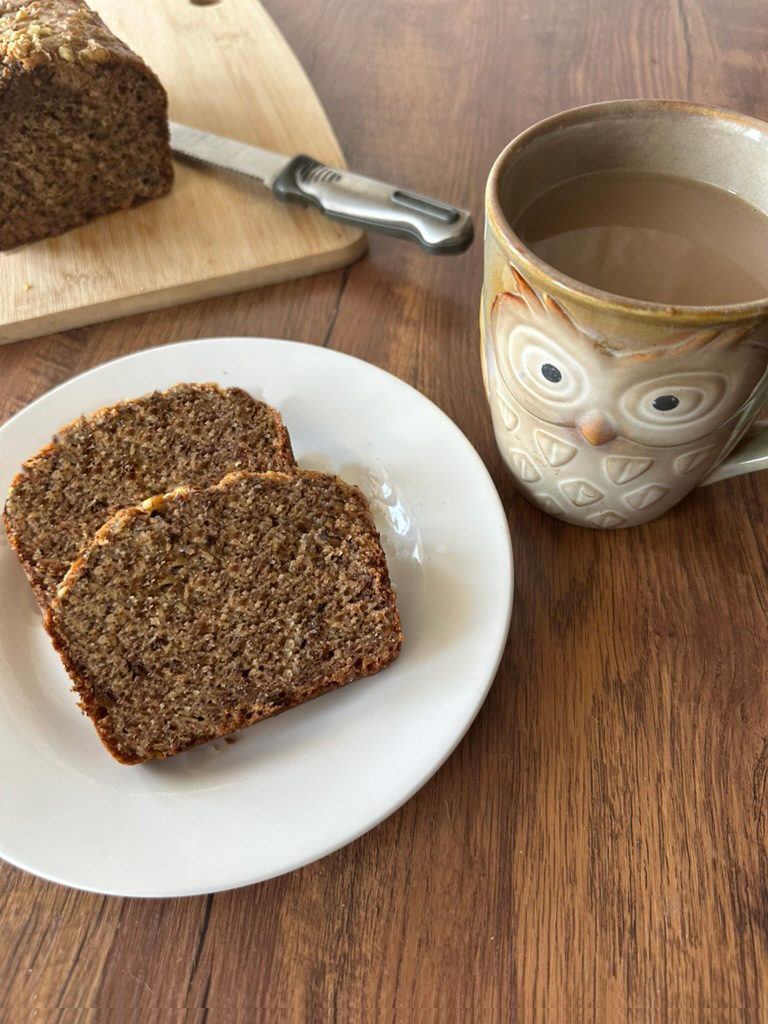
Banana Quick Bread is a perfect dessert or snack. It keeps and freezes well, so make ahead and have any time!
Don’t want nuts? Just leave them off the top!
Want to try more baked goods with banana? You won’t be sorry!
And bananas have health benefits!
General information regarding cooking:
The following information may not particularly pertain to this recipe but rather answers general useful questions related to cooking.
What are the different oils used in cooking?
“High-heat” oils have neutral flavors and have been processed in order to handle high temperatures and are good for sautéing, searing, and frying. These include canola oil, vegetable oil, avocado oil, and grapeseed oil, each with its own “best for” with chefs.
Some oils have their own flavor and are good for sautéing and roasting and add a little extra to the dish. These include extra virgin olive oil, coconut oil, and peanut oil. Extra virgin olive oil works well with roasting or sautéing, but not for deep frying.
Coconut oil is good in dishes where a slightly coconut flavor enhances the dish, and peanut oil is good for deep frying and will add a subtle nutty taste and smell. Many Asian dishes call for peanut oil in the ingredients.
Then there are oils that are not used with heat but rather for dressing up foods, such as sesame oil, flaxseed oil, and walnut oil, among others.
What does it mean when recipes say “to taste” about an ingredient?
When recipes say “to taste,” it means that you can put in as little or as much as you like to your own taste. Some recipes have many ingredients that a cook can adjust to their own taste when cooking (not so much when baking though).
The best way to calculate what your taste is with a recipe that you are not yet familiar with is to first taste the dish and then add the “to taste” ingredient GRADUALLY, a little at a time—a splash of this or a pinch of that—until the dish is just the way you like it. Make sure to stir the ingredient after each time you add it so that the flavor will distribute evenly and become part of the dish. Then taste again. Repeat until you reach your personal preference.
Note: If you plan on using the recipe again, it is highly recommended to make a note of what and how much you added so that you can refer to it next time.
What does it mean when a recipe says that an ingredient is “optional”?
If an ingredient is “optional,” it means that you can add it in or not based on your own preference. An optional ingredient can be flavor related (i.e., salty, sweet, spicy, etc.), appearance related (garnish), or even something like nuts or chocolate chips in baking.
What does “savory” mean?
“Savory” refers to foods that are not sweet, such as foods that taste salty, spicy, or herbal.
What cooking measurement expressions mean:
Drop – ¹/₆₄ teaspoon (or less—it’s however a literal drop comes out)
Smidgen – ¹/₃₂ teaspoon
Pinch – ¹⁄₁₆ teaspoon (what you can grab between your finger and thumb)
Dash – ⅛ teaspoon (what comes out when you shake out of a shaker or bottle)
Tad – ¼ teaspoon
Dollop—a glob on a spoon (like with mayonnaise or ice cream)
Scant—a scant cup is almost a cup, just below the line.
Heaping—above the line of the spoon (teaspoon, tablespoon)*
Some useful cooking terms:
Sauté: Cooking quickly in a small amount of oil or fat in a frying pan on a relatively high heat that causes a slight browning of the food on the outside.
Sear: Browning the outside of meat at a high temperature.
Sweat: Cooking vegetables (often onions) in a little oil or fat on a low heat until they become soft and translucent (no browning).
Simmer: Heating liquid to just below the boiling point (has slow bubbles).
Boil: Cooking food submerged in water hot enough to have rapid, rolling bubbles.
Poach: Cooking in a liquid, or partially submerged, on low heat.
Roast: Cooking with consistent dry heat in an enclosed space, over 400 degrees Fahrenheit.
Bake: Cooking with dry heat in an enclosed space, under 400 degrees Fahrenheit.
Broil: Cooking with intense heat from above.
Grill: Cooking with heat from below, typically over a flame or coals.
Braise: Cooking already-seared meat in a small amount of liquid in a covered pot.
Blanch: Quickly submerging food into boiling water and then immediately into ice water to stop the cooking.
Steam: Cooking with vapor from hot simmering water from below.
Shred: Creating long, thin strips (not necessarily uniform) of vegetables, like in coleslaw.
Grate: Scraping food against a surface with rough, tiny holes that break it down into very small, fine pieces.
Zest: The scrapings of the colorful outer skin of a citrus fruit.
Mince: Cutting into the smallest pieces possible.
Dice: Cutting into small cubes.
Chop: Cutting into small (bite-size) pieces.
Julienne: Cutting into long, thin strips (like matchsticks).
Glaze: a thin liquid with high-sugar or high-fat coating applied to food or baked goods that gives a shiny look and adds flavor.
Fold in: To gently combine a light ingredient into a heavier one.
Al dente: Cooking rice or pasta to the point before it gets soft (is slightly firm).
Emulsify: Forcing two liquids together that don’t normally combine (like oil and vinegar) into a smooth sauce or dressing.
Deglaze: Adding a liquid to a hot pan after searing meat to loosen the browned bits (called fond) that got stuck.
Slurry: A mixture of liquid and dry starch, such as cornstarch or potato starch, into a paste that is used to thicken sauces and soups. One can use flour to make a slurry as well.
Roux: (pronounced “roo”) is a cooked mixture of fat and flour.
Tips for baking
Preparing the batter
As obvious as that may sound (except to people like me), following instructions when baking is important.
It seems that all too often, bloggers will add extra steps or add extra ingredients, unnecessarily complicating the recipes.
Nonetheless, sometimes what seems unnecessary can be helpful.
That noted, the best way to start, unless directed otherwise, is by putting the dry ingredients in the bowl first and combining them together, and then adding the wet ingredients.
I haven’t found that it matters much what order ingredients are put in the bowl when it comes to dough, however, with batter, it can make a difference, and it is a good practice to add the wet ingredients, one at a time, blending lightly in between, mixing slowly and thoroughly.
Dumping all of the ingredients in before mixing can leave flour clumps, which may not dissolve while baking and mixing too quickly will add air bubbles, which can create air gaps in the cake
Flour clumps, especially the larger ones, may not bake into your cake, and you may find them in your slices. If you have them, remove as many as you can before baking. Using a strainer helps. (Yes, this has happened to me.)
If you find you do have a lot of little air bubbles, gently tap the side of the bowl with your fingers before you pour into the pan (you can do this with the pan if you didn’t notice the bubbles until you already poured the batter).
The tapping will pop them (you can actually see this). You may not get rid of them all, but the bigger ones are more important to pop. The bubbles seem to be more of a problem with thinner batter and with thicker batter.
The batter
Before you pour the batter into the pan(s), make sure to coat well with something to help prevent your final products from sticking.
There are various ways to do this, depending on your preference. You can use some type of fat, such as oil or cooking spray, margarine, or butter, with or without sprinkling flour as well. Or you can use baking paper.
My personal preference is to place baking paper on the bottom of the pan(s) and then coat with cooking spray, or vice versa. Baking paper can come in individual sheets or in rolls. For round pans, you can buy a suitable size that will fit right on the bottom of the pan. OR you can place the pan on top of the baking paper, trace around the bottom of the pan, and cut to size.
If you use baking paper, you might find that it won’t stay at the bottom of the pan properly while you are trying to pour the batter in, and there are a couple of tricks I use to help. One is to cut the paper so it fits in the pan like a lining, and the other is to wet it so it sticks (the latter is quicker, so I normally use that one).
When making cupcakes or muffins, you can coat or you can use cupcake paper. I have found that with some brands, however, while the paper won’t stick to the pan, it will stick to the cupcake, so you might want to lightly spray the paper before you pour in the batter.
If you are making a layer cake, separate the batter equally into both pans. The best way to do this is to weigh the pans with batter to make sure they are even. Personally, I just eyeball it (which is probably not the best idea unless you have a good eye).
Baking
Ovens often vary in how they spread heat, something that can cause uneven baking. This can cause a variety of problems in baking, such as lopsided cakes, raw middles, over-baked sides, etc.
One way to help prevent this is to turn your pan around on the shelf in the middle of baking to help ensure it will bake more evenly.
Another reason for uneven baking, where the item comes out fine on the top and burnt on the bottom, is if a crumb or a piece of something is at the bottom and will burn as you bake.
If your cake comes out lopsided, one way to fix that is to slice off the uneven part before putting on the frosting. I hate losing cake, so when it does this, I will slice approximately halfway through the higher part and flip it over onto the lower part before adding the frosting.
To help prevent lopsidedness in the first place, this method is often used: take a strip of aluminum foil that is around 4-6 inches longer than the circumference or perimeter of your pan and lay the wet paper towel on it, then fold the foil over the paper towel lengthwise so it is just a bit less wide than the height of the pan.
Wrap the foil around the pan and slide one end in the other (crimp it a bit if you need to so it will hold). This will create a moisture barrier for baking (I have read that some people put a pan of water in the oven when baking – I haven’t tried that yet).
I found all of that a little tedious, so I bought cake strips. These are absorbable cotton belts, around 2″ wide, and come in a few different lengths to be wrapped around and secured on round cake tins. These are soaked (but not dripping) when you wrap them around the pan.
If you need to use them for a larger rectangular pan, you can just attach a number of them together.
Cooling
You know your baked good is ready when a toothpick can slide cleanly and easily in and out of the baked item (or when the top is a little firm and springy), it can be removed from the oven.
Leave to cool for 10-15 minutes.
If you are going to remove the item from the pan, run a knife around the sides between the cake and the pan. Place a plate or cooling rack over the top and flip.
If you want the top side to remain on the top, you will flip the item over twice (once to remove it from the pan and once to get it back).
For cupcakes and muffins, I recommend using cupcake paper, and after you have used the knife to loosen them from the cup, you should be able to just pop them out carefully using the same knife.
Baking and Dessert Pantry Essentials
I never know when someone in my family is going to want a dessert at home, to bring to a friend’s house, or need for an event, so I like to make sure I can bake anything with very short notice. To that end, I keep a variety of supplies and ingredients in the house that will allow me to do just that.
I can’t tell you how many times I was glad to have whatever I needed within reach for the last-minute visitor or for when one of my kids went to a friend or had a school event without much prior notice.
I have slowly collected things over the years as I needed them (or if I found a good sale) and like to keep more than one of the smaller items in case I don’t want to wash dishes in the middle of baking.
My basic “equipment” includes:
- a stand mixer, which I use mostly for dough and sometimes for whipping
- a hand mixer (for things that aren’t dough and I don’t want to mix manually)
- a kitchen scale
- different sizes and shapes of baking pans, including loaf pans
- mixing bowls (or just large bowls—I have plastic, glass, and metal)
- cookie sheets
- pie dishes
- dry measuring cups
- liquid measuring cups
- measuring spoons
- whisks
- rubber spatulas (really good for when you don’t want to leave anything in the bowl)
- rolling pins
- a baking mat for rolling out dough
- baking strips
- a good supply of baking (or parchment) paper (also round for layer cakes)
I can certainly get by without a lot of the above, but it makes baking so much simpler when I just have whatever I need at my fingertips.
Note: The measuring cups and spoons should match as far as the measurements are concerned. Not all cups are properly marked, and this can throw your measurements off.
In addition to the equipment, there are the baking ingredients that I try to keep in the house at all times:
- flour
- white granulated sugar
- brown sugar (light/dark—I usually keep dark)
- confectioners’ sugar (powdered sugar)
- salt
- baking powder
- baking soda
- cocoa powder
- ground cinnamon
- ground nutmeg
- ground ginger
- ground cloves
- baking chocolate
- chocolate chips
- instant dry yeast
- vanilla and/or vanilla sugar
- cooking oil/cooking spray
- margarine or butter
- eggs
- honey
- instant coffee
- various extracts (real or imitation)
I also make sure that I have the following on hand to be able to make a variety of fillings, frostings, and toppings:
- whipping cream
- powdered pudding mix
- powdered sugar
- a good chocolate spread
Then, there is the following to make last-minute quick desserts:
- packaged pie dough or ready-made pie crusts
- puff pastry dough
Lastly, it’s not a bad idea to keep fun toppings, such as chopped walnuts, raisins, and the oh-so-important container of sprinkles.
A little about quick breads
A quick bread is any bread that uses a chemical agent to leaven bread rather than a biological one, such as yeast.
Quick breads can be prepared quickly without the need to wait for them to rise.
For example, this recipe is a quick bread as it does not use yeast, but rather uses baking soda as its leavening agent.
A little about bananas
Bananas are a healthy and comparatively inexpensive fruit. The most popular type found in grocery stores starts out (and is shipped to destination countries) green but turns yellow by the ripening process. Unripe, they are not sweet but get softer and sweeter as they ripen.
Bananas normally have approximately 80-110 calories, depending on size, and are almost exclusively made up of carbohydrates and water, with only a little protein and no fat. In addition, bananas have nutrients, antioxidants, and a variety of other health benefits.
When used in baking, the overripe bananas (the kind that you would often throw out as non-edible) give the most flavor. And you can freeze bananas (even those that are ripe and flavorful enough for good eating).
Banana Quick Bread
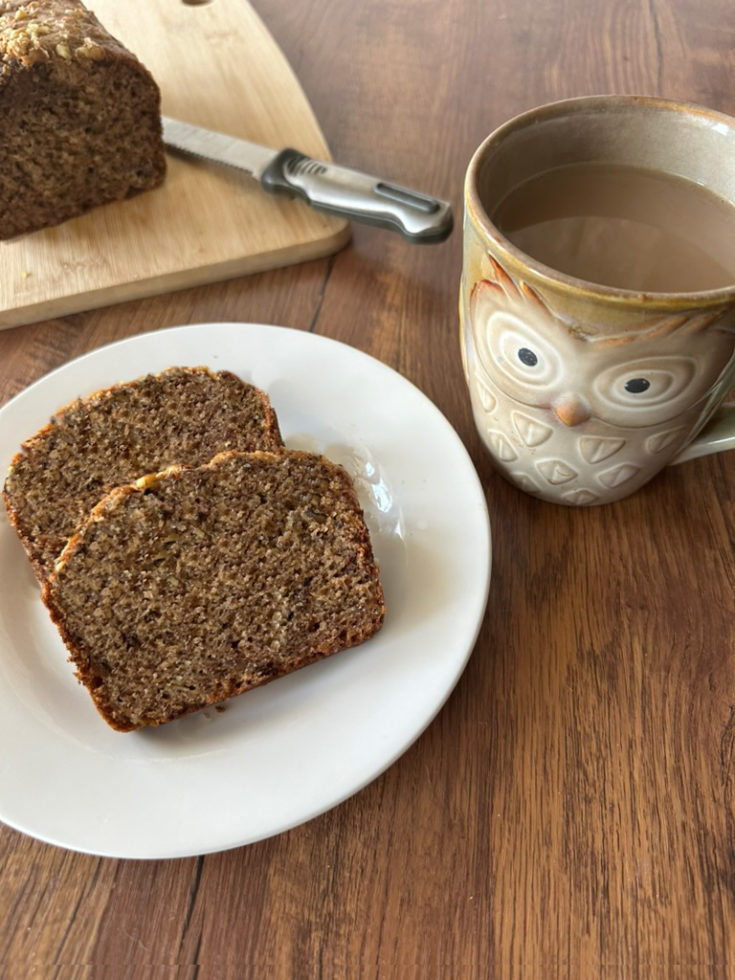
Dairy-free banana bread made with oil, not butter.
Ingredients
- 1 ½ cup all-purpose flour
- 3/4 granulated white sugar
- 1 teaspoon cinnamon
- 1 teaspoon baking soda
- ½ teaspoon salt
- 2 eggs
- ⅓ cup oil
- 1/4 cup water (if you prefer a more dense banana bread, leave out the water)
- 2 teaspoons vanilla
- 4 medium or 3 large bananas, over ripe *
- 1/4 cup chopped walnuts (optional)
Instructions
- Whisk together the flour, sugar, cinnamon, baking soda, and salt.
- Mix in the eggs, oil, and vanilla.
- Add in the bananas and blend well.
- Pour into a standard loaf pan that has been well greased.
- Top with chopped walnuts, if desired.
- Bake at 350° for approximately 50 minutes or until the toothpick test (slide a toothpick into the middle of the loaf) comes out clean. Personally, I just lightly touch the top with my fingers to see if the loaf is firm to the touch.
- Remove from oven when ready and let cool for 10-15 minutes.
- To remove the cake from the pan, slide a butter knife around the edges of the cake, between the pan and the cake, and gently turn it over onto a plate (you may have to knock the bottom). Then flip it back over onto a serving plate.
Notes
* or freeze regular ripe bananas ahead of time and defrost when ready to use. The consistency will be good for this recipe.
Nutrition Information:
Yield:
8Serving Size:
1Amount Per Serving: Calories: 173Total Fat: 9gSaturated Fat: 1gTrans Fat: 0gUnsaturated Fat: 7gCholesterol: 31mgSodium: 206mgCarbohydrates: 21gFiber: 2gSugar: 5gProtein: 3g