Potato Kugel for Passover is a simple recipe for classic potato kugel, kosher for Passover.
It’s a terrific savory dish to add to your meals during the week and on Shabbat!
It’s budget friendly and easy—one bowl, one pan, and only 4 main ingredients!
And it’s parve!
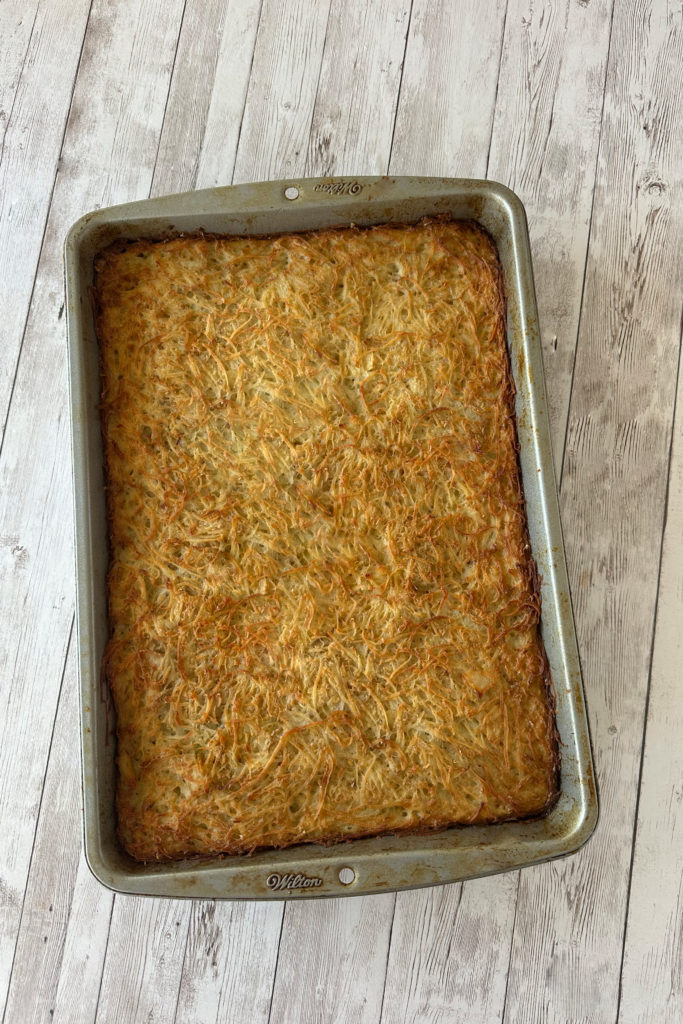
Potato kugel is basically a shredded potato casserole. It’s often found on Ashkenazi Jewish sabbath or holiday tables as part of lunch. Often, together with cholent and/or Jerusalem kugel. But, of course, on Passover, neither of those other foods can be in the house, let alone on the table!
However, this potato kugel recipe contains no matzo meal, so it can be eaten on the day of the seder!
Eating on the day of the seder
Jews who keep the laws of Passover do not eat matzo or any foods that contain anything from matzo (such as matzo meal or matzo cake meal) the entire day before the seder, which is in the evening.
Some people even have the custom of not eating such foods for two weeks before, beginning on Rosh Chodesh Nissan or even as far back as Purim, which is a month before.
Food on Passover
Torah-observant Jews do not eat chametz (the fermented products of five grains: wheat, spelt, barley, oats, and rye).
In addition, Torah-observant Ashkenazi Jews do not eat kitniyot (or kitniyos as pronounced in Ashkenazi Hebrew). These include legumes, corn, rice, and similar foods that were deemed forbidden to eat by rabbis in the medieval period and are still not eaten today. Sephardi and Mizrachi Jews do not follow this tradition.
Many observant Ashkenazi Jews will not even eat the derivatives of these kitniyot, while others do (each family holds their own traditions regarding this).
Then, there are Ashkenazim who don’t eat “gebrokts” (or gebrochts).
Gebrokts (gebrochts) means “broken” in Yiddish, and in this case refers to matzo that has absorbed liquid. Not eating gebrokts is observed by many in the Hasidic Jewish community and Ashkenazim who have taken on this tradition, where they basically don’t mix anything wet with matzo.
So, things like matzo sandwiches, fried matzo, and even matzo balls are a no-no for them.
There is a joke that sums it all up:
On Passover, we should remember people who have little to eat on this holiday. They are called Ashkenazim.
Over the years, I have learned to adapt “normal” food for Passover so that my family won’t complain about boring, tasteless, or repetitive meals.
I find that having good food and variety makes the week of Passover a very pleasant experience, and I hope this recipe will help make yours just that!
Potato kugel has nutritious ingredients!
Like the potatoes:
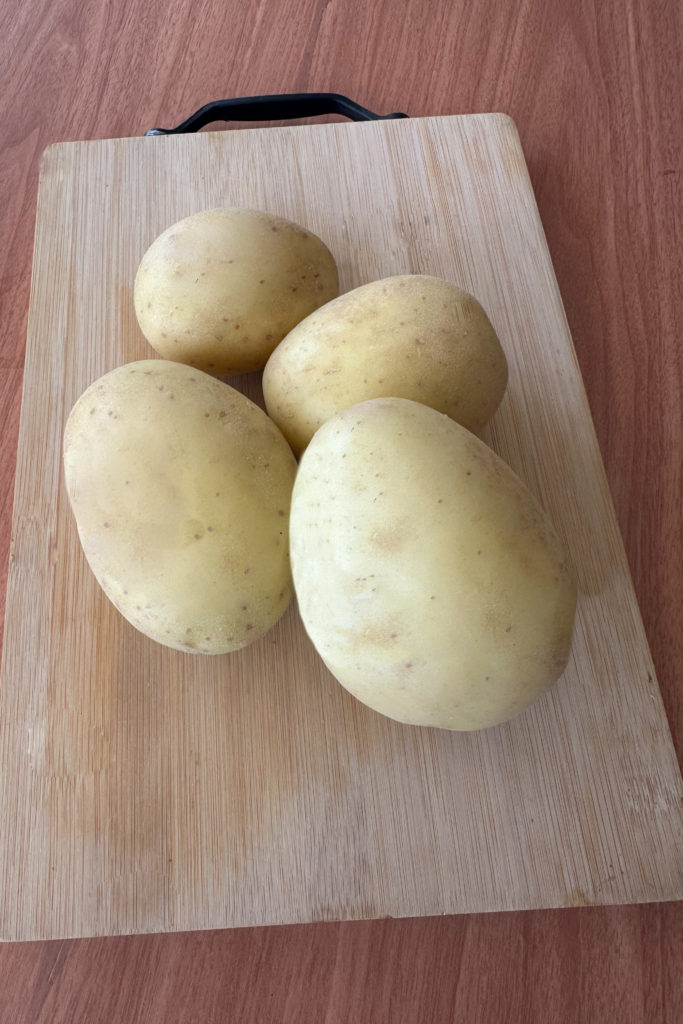
The potato is a perennial, starchy tuber, a root vegetable, that is native to the Americas.
Potatoes contain health benefits and are an excellent source of fiber, vitamins, and nutrients and provide fuel for the body.
Potatoes are gluten-free and very filling. In addition, they are a good source of antioxidants—some more than others—and they contain resistant starch. However, their nutritional content depends on the type of potato. Much of a potato’s nutrition is in the skin of the potato, and peeling them reduces their nutritional value.
Adding fattening toppings, such as sour cream or butter, adds calories and fat.
Different potatoes are considered to work best with different recipes, but overall, they can be used in a variety of delicious meals for recipes from all over the world.
There may be over a couple hundred varieties of potatoes in the United States, but there are only 7 main categories. The most popular of these are the red, white, yellow, and russet.
Fun Facts
- Potatoes were first cultivated in Peru by the Incas.
- Potatoes were introduced to Europe (Ireland) toward the end of the 16th century.
- Potatoes began to be planted in the colonies in the early 1700s.
- Potatoes are the #1 vegetable crop in the United States and 4th most consumed in the world.
- Idaho is the largest grower of potatoes.
- The potato was the first vegetable to be grown in space.
And check out info about the eggs!
A little about eggs
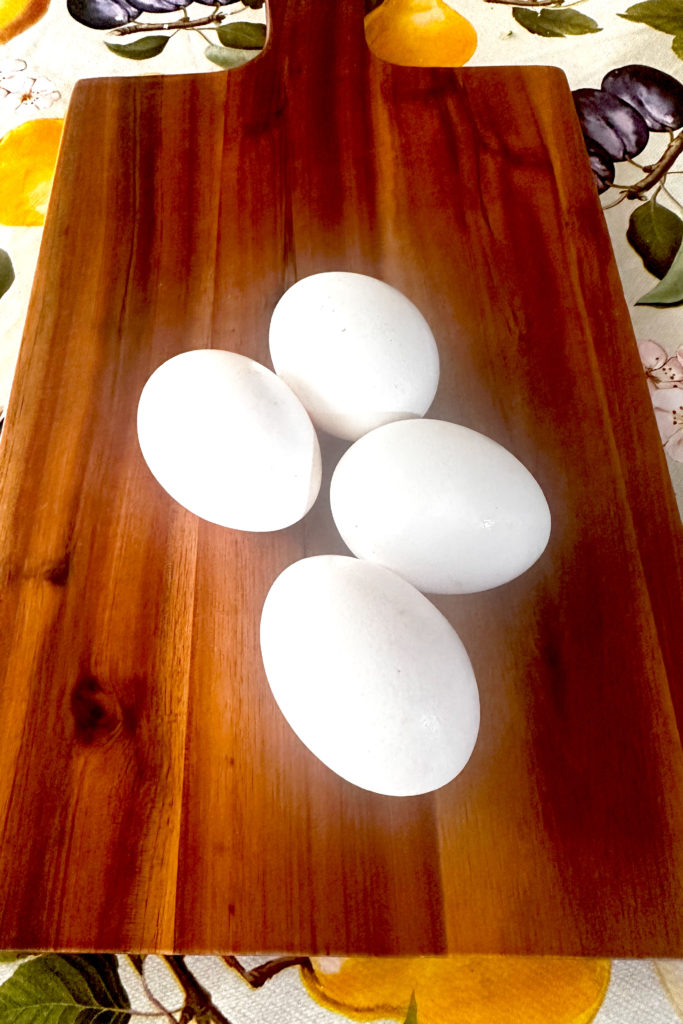
For many years eggs were considered a source of high cholesterol and a possible cause of heart disease, and people were warned against them and recommended to have only a few per week in their diets.
It is true that one large egg yolk has 200 mg of cholesterol. However, the additional nutrients that eggs contain may actually help LOWER the risk of heart disease by raising the “good” cholesterol in one’s body.
Eggs are high in protein and filling but low in calories. They have nutritional value and contain a large variety of vitamins as well as some antioxidants.
The color of the yolk depends on the diet of the hen, and different types of chickens may lay different colored eggs; white or brownish.
Egg white consists primarily of approximately 90 percent water and contains almost no fat or carbohydrates.
The yolk of a new egg is firm, but then it absorbs water from the egg white, which causes it to increase in size and become loose.
You may be surprised to know that raw egg white is sometimes used in the preparation of vaccines.
Many people believe that since eggs are found in the refrigerated section of the supermarket, and very frequently near the dairy section, they are also dairy.
Nonetheless, eggs are NOT DAIRY. You CANNOT milk a chicken!
Kosher for Passover Pantry Essentials (Suggestion)
Utensils:
- Measuring cups for liquid
- Measuring cups for solids (flour, sugar, etc.)
- Measuring spoons
- Mixing bowls
- Kitchen scale
NOTE: When using measuring cups and spoons, make sure that the measurements are comparable to one another (example: that 4 tablespoons equals 1/4 of your measuring cup). You’d be surprised to know that not all measuring cups are the same, and this can throw your measurements off.
Seasoning and flavoring:
- salt
- ground black or white pepper
- granulated garlic or garlic powder
- onion powder
- ground cinnamon
- sugar (granulated)
- brown sugar
- chicken consommé powder
- onion soup mix
- various herbs
- additional spices to adapt taste to preference
Misc:
- oil / margarine / butter / cooking spray
- potato starch as a thickening agent
- baking powder
- matzo cake meal (matzo meal, but ground into a powder)
- condiments, such as ketchup and barbecue sauce
- tomato sauce/tomato paste/canned tomatoes—diced or crushed/pasta sauce
Keeping eggs in the fridge and onions and potatoes on your shelves as well as having fresh vegetables, such as carrots, celery, bell peppers (red, green, etc), tomatoes (if you don’t want to use canned), etc. can be very useful when putting together a quick but delicious meal.
It’s also a good idea to have some ground meat or chicken (breast, ground, or in parts) in the freezer for anyone who likes meat dishes in a snap.
What is needed for THIS recipe, you ask?
But these 4 main ingredients are all you need to have on hand to make this recipe!
potatoes
onions
eggs
potato starch
Also, salt and pepper to taste and oil for greasing your pan.
Broccoli kugel for Passover is another easy and delicious kosher for Passover kugel!
Potato Kugel for Passover
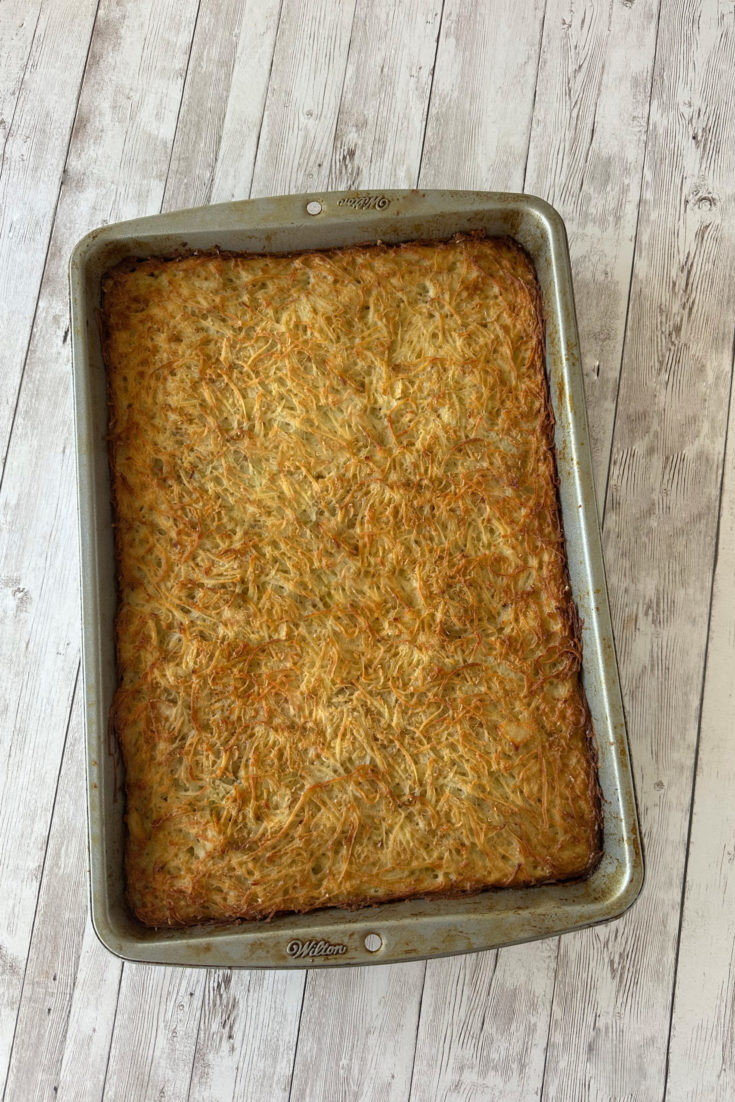
Delicious and simple potato kugel, kosher for Passover.
Ingredients
- 5 pounds of potatoes (does not need to be exact)
- 2 large onions
- 6 eggs
- 1/3 cup of potato starch
- 1 tablespoon salt or to taste
- 1 teaspoon ground black pepper or to taste
- cooking spray or cooking oil
Instructions
- Shred (small or large, your choice) or puree the potatoes (you can peel or not beforehand, your choice).*
- Peel and shred small or puree the onions.*
- Mix the potato, onion, eggs, potato starch, salt, and pepper together in a large mixing bowl.
- Line a 9"x13" baking pan or similar baking dish with baking paper, or coat well with cooking spray, or brush on oil.
- Pour in the potato and onion mixture and level.**
- Spray the top with the cooking spray or brush on oil.
- Bake in an oven that was preheated to 400°F for approximately 1 hour or until the top is a golden brown.***
Notes
*The texture is different if you shred or puree. If you like to feel the pieces of potato or onion, shred. If not, then puree. Personally, I shred the potato small and puree the onion.
** This depends on your oven. If the top is golden brown and the middle of the kugel is not yet firm, then you can cover the top or lower the heat for it to finish. If it is done and the top still looks a bit raw, then you can put it on broil for a few minutes to brown the top (just keep an eye on it so it won't burn).
***The potato and onion will leak liquid, so if you can't put the baking pan in the oven right away, then drain the excess liquid before you do.
MAKE SURE INGREDIENTS THAT REQUIRE IT ARE KOSHER FOR PASSOVER.
Nutrition Information:
Yield:
12Serving Size:
1Amount Per Serving: Calories: 227Total Fat: 3gSaturated Fat: 1gUnsaturated Fat: 2gCholesterol: 93mgSodium: 509mgCarbohydrates: 43gFiber: 5gSugar: 3gProtein: 8g