Skip to Content

Moroccan-Israeli Salmon

Sharing is caring!

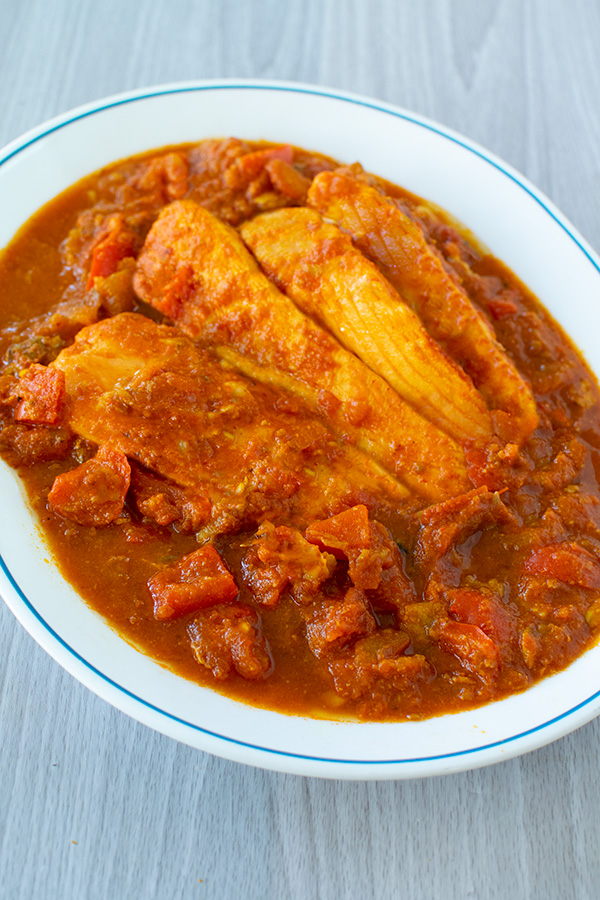
Moroccan-Israeli Salmon is an easy recipe for salmon in a delicious slightly spicy tomato and red pepper sauce.

Pieces of Israeli-Moroccan style salmon with peppers on a white plate with a blue line around the edges on a white wood background

Moroccan-Israeli Salmon is a delicious dish for any fish lover. You can make the sauce very spicy, slightly spicy, or not at all.

The dish itself normally contains quite a bit of oil, but I use minimal in this recipe, so fewer calories!!

And salmon has health benefits!

Want to try another Moroccan-Israeli dish? Try: Moroccan-Israeli Meatballs with Olives.

General information regarding cooking:

The following information may not particularly pertain to this recipe but rather answers general useful questions related to cooking.

What are the different oils used in cooking?

“High-heat” oils have neutral flavors and have been processed in order to handle high temperatures and are good for sautéing, searing, and frying. These include canola oil, vegetable oil, avocado oil, and grapeseed oil, each with its own “best for” with chefs.

Some oils have their own flavor and are good for sautéing and roasting and add a little extra to the dish. These include extra virgin olive oil, coconut oil, and peanut oil. Extra virgin olive oil works well with roasting or sautéing, but not for deep frying.

Coconut oil is good in dishes where a slightly coconut flavor enhances the dish, and peanut oil is good for deep frying and will add a subtle nutty taste and smell. Many Asian dishes call for peanut oil in the ingredients.

Then there are oils that are not used with heat but rather for dressing up foods, such as sesame oil, flaxseed oil, and walnut oil, among others.

What does it mean when recipes say “to taste” about an ingredient?

When recipes say “to taste,” it means that you can put in as little or as much as you like to your own taste. Some recipes have many ingredients that a cook can adjust to their own taste when cooking (not so much when baking though).

The best way to calculate what your taste is with a recipe that you are not yet familiar with is to first taste the dish and then add the “to taste” ingredient GRADUALLY, a little at a time—a splash of this or a pinch of that—until the dish is just the way you like it. Make sure to stir the ingredient after each time you add it so that the flavor will distribute evenly and become part of the dish. Then taste again. Repeat until you reach your personal preference.

Note: If you plan on using the recipe again, it is highly recommended to make a note of what and how much you added so that you can refer to it next time.

What does it mean when a recipe says that an ingredient is “optional”?

If an ingredient is “optional,” it means that you can add it in or not based on your own preference. An optional ingredient can be flavor related (i.e., salty, sweet, spicy, etc.), appearance related (garnish), or even something like nuts or chocolate chips in baking.

What does “savory” mean?

“Savory” refers to foods that are not sweet, such as foods that taste salty, spicy, or herbal.

What cooking measurement expressions mean:

Drop – ¹/₆₄ teaspoon (or less—it’s however a literal drop comes out)

Smidgen – ¹/₃₂ teaspoon

Pinch – ¹⁄₁₆ teaspoon (what you can grab between your finger and thumb)

Dash – ⅛ teaspoon (what comes out when you shake out of a shaker or bottle)

Tad – ¼ teaspoon

Dollop—a glob on a spoon (like with mayonnaise or ice cream)

Scant—a scant cup is almost a cup, just below the line.

Heaping—above the line of the spoon (teaspoon, tablespoon)*

Some useful cooking terms:

Sauté: Cooking quickly in a small amount of oil or fat in a frying pan on a relatively high heat that causes a slight browning of the food on the outside.

Sear: Browning the outside of meat at a high temperature.

Sweat: Cooking vegetables (often onions) in a little oil or fat on a low heat until they become soft and translucent (no browning).

Simmer: Heating liquid to just below the boiling point (has slow bubbles).

Boil: Cooking food submerged in water hot enough to have rapid, rolling bubbles.

Poach: Cooking in a liquid, or partially submerged, on low heat.

Roast: Cooking with consistent dry heat in an enclosed space, over 400 degrees Fahrenheit.

Bake: Cooking with dry heat in an enclosed space, under 400 degrees Fahrenheit.

Broil: Cooking with intense heat from above.

Grill: Cooking with heat from below, typically over a flame or coals.

Braise: Cooking already-seared meat in a small amount of liquid in a covered pot.

Blanch: Quickly submerging food into boiling water and then immediately into ice water to stop the cooking.

Steam: Cooking with vapor from hot simmering water from below.

Shred: Creating long, thin strips (not necessarily uniform) of vegetables, like in coleslaw.

Grate: Scraping food against a surface with rough, tiny holes that break it down into very small, fine pieces.

Zest: The scrapings of the colorful outer skin of a citrus fruit.

Mince: Cutting into the smallest pieces possible.

Dice: Cutting into small cubes.

Chop: Cutting into small (bite-size) pieces.

Julienne: Cutting into long, thin strips (like matchsticks).

Glaze: a thin liquid with high-sugar or high-fat coating applied to food or baked goods that gives a shiny look and adds flavor.

Fold in: To gently combine a light ingredient into a heavier one.

Al dente: Cooking rice or pasta to the point before it gets soft (is slightly firm).

Emulsify: Forcing two liquids together that don’t normally combine (like oil and vinegar) into a smooth sauce or dressing.

Deglaze: Adding a liquid to a hot pan after searing meat to loosen the browned bits (called fond) that got stuck.

Slurry: A mixture of liquid and dry starch, such as cornstarch or potato starch, into a paste that is used to thicken sauces and soups. One can use flour to make a slurry as well.

Roux: (pronounced “roo”) is acooked mixture of fat and flour.

Everyday pantry essentials (suggested)

As I learned to prepare more and more recipes, I also learned which basics and seasonings are good to have on hand to have the ability to make a dish on short notice and not have to run out to the store or borrow from a neighbor.

While I will admit that I am not always prepared when one of my kids asks for eggplant parmesan or lasagna at the drop of a hat (which they have done), I dislike having to postpone making something just because the ingredients needed to make a reasonable meal were not readily available.

So, I maintain a selection of what I consider “pantry essentials” in my refrigerator and on my shelves at all times.

Initially, many of the herbs and spices were useful to me only on occasion (having been purchased for a particular recipe), and I usually just had them around as leftovers. However, as I began to cook more of a variety, I was really glad to have them (hey, look, I already have that!). And that is how my list began.

While, of course, most of the essentials will not be needed just for any one recipe, at least some of them are needed for most recipes, and you would be surprised how many recipes can be made just with this list. So, if you keep whatever you use regularly on hand, it can really save you time and effort.

Everyone has their favorite recipes, preferred seasonings, and just whatever they like to use to cook. Your own list should certainly reflect your own cooking tastes and style.

Just to give you an idea, the list below is a comprehensive list of what I normally keep on hand (this does not necessarily include what I keep for baking, and there may be some overlap between the two lists as some items are used for both, such as brown sugar), and, of course, it reflects the meals and desserts that I like to make for my own family and guests.

Utensils:

  • Measuring cups for liquid
  • Measuring cups for solids (flour, sugar, etc.)
  • Measuring spoons
  • Mixing bowls
  • Kitchen scale

NOTE: When using measuring cups and spoons, make sure that the measurements are comparable to one another (example: that 4 tablespoons equals 1/4 of your measuring cup). You’d be surprised to know that not all measuring cups are the same, and this can throw your measurements off.

Seasoning and flavoring:

  • salt (my recipes use regular table salt)
  • ground black or white pepper
  • granulated garlic or garlic powder (I prefer granulated)
  • onion powder
  • sweet paprika and/or sweet pepper flakes (paprika is ground dried red pepper, pepper flakes are crushed dried red pepper)
  • hot paprika, hot pepper flakes, or cayenne pepper (moderately spicy dried ground chili pepper) for those occasional spicy dishes
  • ground turmeric
  • ground cumin
  • ground cinnamon
  • ground ginger
  • ground nutmeg
  • ground cloves (for pumpkin flavors)
  • sugar (granulated)
  • brown sugar
  • chicken consommé powder / beef bouillon powder (regular or vegetarian)
  • onion soup mix
  • onion flakes (substitute for fresh onion—3 tablespoons for 1 medium onion).
  • various herbs
  • additional spices to adapt taste to preference

Misc:

  • oil / margarine / butter / cooking spray
  • coconut cream as a dairy-free cream substitute
  • flavorless milk substitute as a dairy-free milk alternative
  • cornstarch as a thickening agent
  • flour
  • baking powder
  • baking soda
  • bread crumbs or cornflake crumbs (you can make these with your blender or food processor) for coating
  • condiments, such as ketchup, mustard, barbecue sauce
  • tomato sauce/tomato paste/canned tomatoes—diced or crushed/pasta sauce
  • soy sauce
  • ready-made pie crusts and dough (to just add filling)

We always have eggs in the fridge and onions, rice, and potatoes on our shelves, as well as pasta.

In addition, having some fresh vegetables in the fridge, such as carrots, celery, tomatoes, bell peppers (various colors), etc., can be very useful when putting together a quick but delicious meal.

It is also a good idea to have some ground meat or chicken (breast, ground, or in parts) in the freezer for anyone who likes meat dishes in a snap.

Weather can have an effect on some of the spices and on the chicken consommé powder, so I keep as many of the seasonings in the refrigerator or freezer as I can, and I keep everything tightly closed in containers (you will be surprised to know just how determined moths are at getting into sealed bags and how hot red pepper powder can attract little black bugs—YUCK!).

Therefore, store your items well.

Why are these pantry essentials beneficial to have on hand?

Personally, having the above ingredients in my kitchen is very advantageous, as I make a variety of dishes and use most of the items on the list regularly enough to warrant storing them. However, I do not store items for dishes that I make seasonally or only on rare occasions or those that spoil easily.

Whether or not it is workable for you depends on your cooking style, the space you have to store, and whether or not you mind running out to the store as needed. Of course, the more you cook and the more varied your recipes, the more you will use and the more you will need.

Moroccan Jews in Israel

The majority of Moroccan Jews in Israel are the descendants of Jews that immigrated to Israel from Morocco.

Before the establishment of the State of Israel, the British put a quota on the amount of Jews that could immigrate to Israel, so most of the immigration was considered “illegal.” However, many Jews risked their lives to flee their countries of origin, including Arab and Muslim countries, such as Morocco.

Because the Muslims were against the establishment of the State of Israel, after the declaration of the state and the civil war that followed, life became more difficult for the Jews of Morocco, because the Muslims would attack Jews as a result. This brought about a wave of immigrants to Israel from Morocco, as did every Arab-Israeli war that followed.

So, during the 1950s and for decades afterward, waves of Moroccan Jews immigrated to Israel.

Morocco was once the home of the largest Jewish community in the Muslim world. However, by the time of the Yom Kippur war, the majority of Morocco’s Jews had immigrated to Israel, and they brought their delicious cuisine with them.

A little about Israeli cuisine

Some people complain about cultural appropriation in cuisine when food from one country is attributed to another country.

However, national cuisine in itself is often a mingling of food from a variety of cultures, often due to a change of ruling countries and a shifting of borders.

Turkish cuisine, for example, goes back to the Ottoman Empire and was a combination of several cultures under Ottoman rule.

When people move from country to country, they will take their cultures with them, and their descendants may adapt their traditional cuisine with that of their new home, and if they don’t, others might.

Chinese food in US restaurants is quite often not really authentic Chinese but American Chinese.

Americans have created a whole variety of types and styles of pizza, and pineapple pizza was apparently created in Canada by a Greek immigrant. Yet, everyone still calls them all “pizza,” which originated in Italy.

Spaghetti is thought to be an Italian food, but many historians believe that it was brought back to Italy from China by Marco Polo.

Apparently, battered fried fish was from the Portuguese Jewish community as a Sabbath food and ended up in England via Holland during the Spanish Inquisition, yet everyone attributes the food to the British.

…and don’t get me started on Hummus.

When one lives in a melting pot, such as the US or Israel, it is just unrealistic to expect that food from a particular culture won’t mingle with that of other cultures.

That being said, “Israeli cuisine” is basically Middle Eastern (as opposed to Eastern European food) that was brought to Israel by Jews when they fled or were expelled from Muslim countries and moved to Israel mostly after the declaration of the State of Israel (collectively known as Mizrahi Jews).

Recipes were passed from generation to generation, and although decades have passed, the foods are still known by the culture they came from, and everyone seems to have their own way of making them.

That said, there are many variations of pretty much any “Israeli” recipe because of background, custom, or even just taste. When choosing a recipe, one has to know what actually constitutes a main ingredient – what makes the dish what it is – and what is left up to individual taste.

I personally find it very arrogant and quite irritating when a blogger (not naming names) will put “authentic” in the title of an “Israeli” recipe, as if all the rest of the variations are mere imitations. What’s worse is when that blogger makes the recipe with her own twist and then calls it authentic!

Adding more or less of a spice or adding a spice that is not in the recipe does not make it less authentic, but calling it “authentic” and then adding unnecessary extra ingredients above and beyond what needs to be there is misleading.

For example, “authentic” Israeli salad (what Israelis call Israeli salad) is diced tomatoes and cucumbers. Sometimes, they will add some oil, salt, and pepper, but THAT’S IT. Anything else does not have to be there, but if you leave out the cucumbers or the tomatoes, you no longer have an “Israeli salad.”

So, find the recipes you like with the ingredients you prefer, add your own twists, and בתאבון (literally translated, “with appetite”)!

Yield: 4 servings

Moroccan-Israeli Salmon

Pieces of Israeli-Moroccan style salmon with peppers on a white plate with a blue line around the edges on a white wood background

Salmon in a delicious and spicy tomato and red pepper sauce.

Prep Time 15 minutes
Cook Time 30 minutes
Total Time 45 minutes

Ingredients

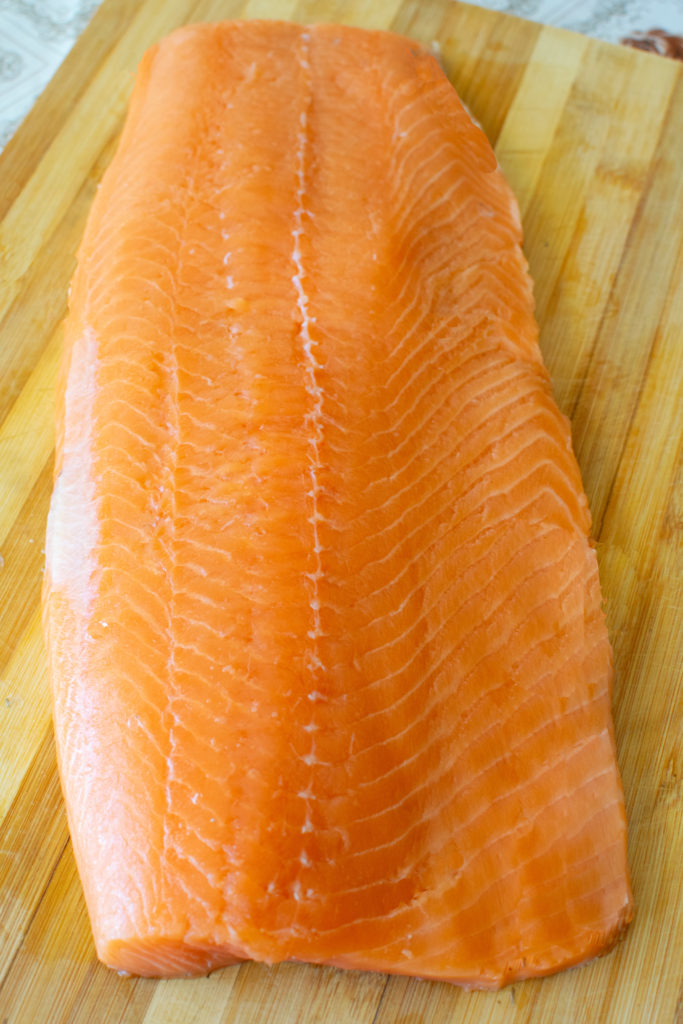
  • 2 pounds filleted salmon without skin
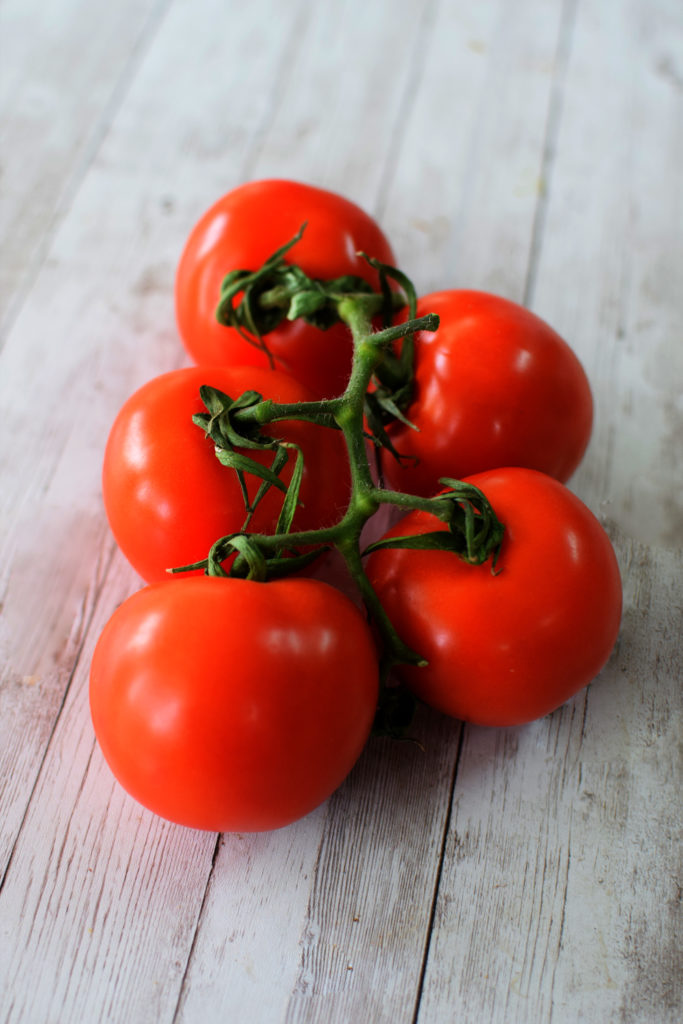
  • 1 28-ounce can diced tomatoes (or 4 - 5 medium tomatoes, chopped)
  • 1 red bell pepper
  • 1 tablespoon granulated garlic
  • 2 tablespoons tomato paste, slightly heaped
  • 2 tablespoons sweet paprika
  • 1 tablespoon chili pepper flakes or hot pepper flakes (optional for spicy)
  • 1 teaspoon turmeric
  • 1 1/2 cup water
  • 1/2 tablespoon salt (or to taste)
  • oil for frying

Instructions

    1. Coat the bottom of the pot with a thin layer of oil.
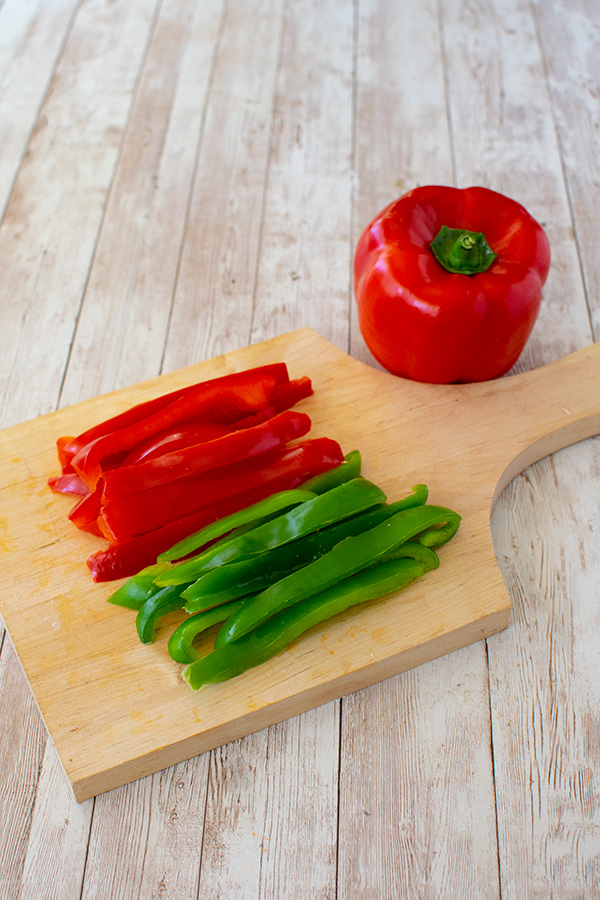
    2. Cut the sweet pepper into thin strips and lightly fry on a medium heat.
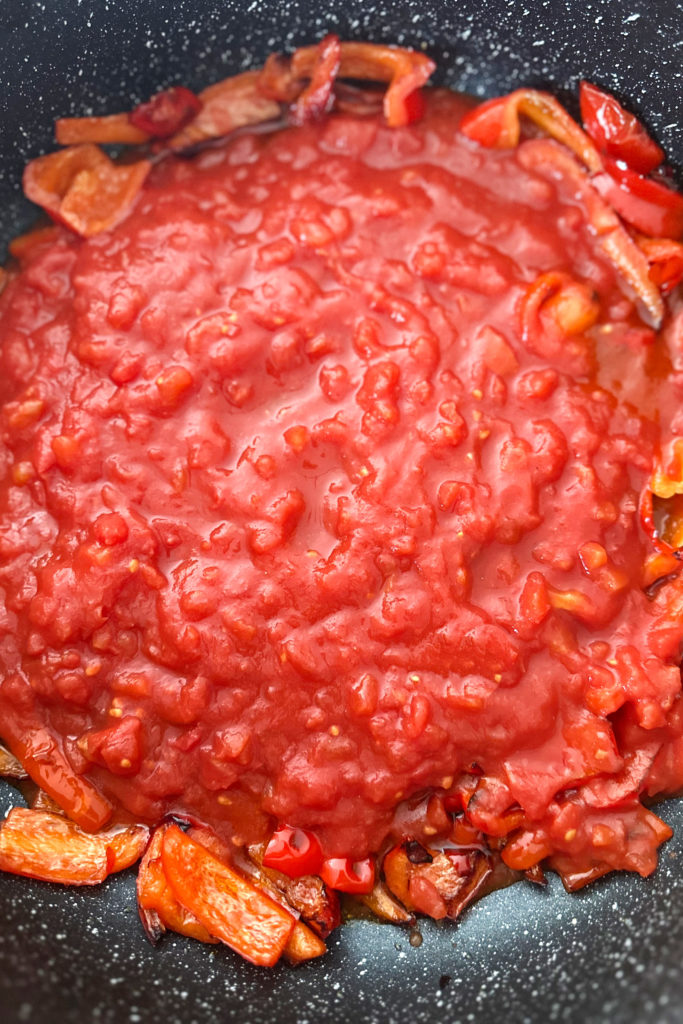
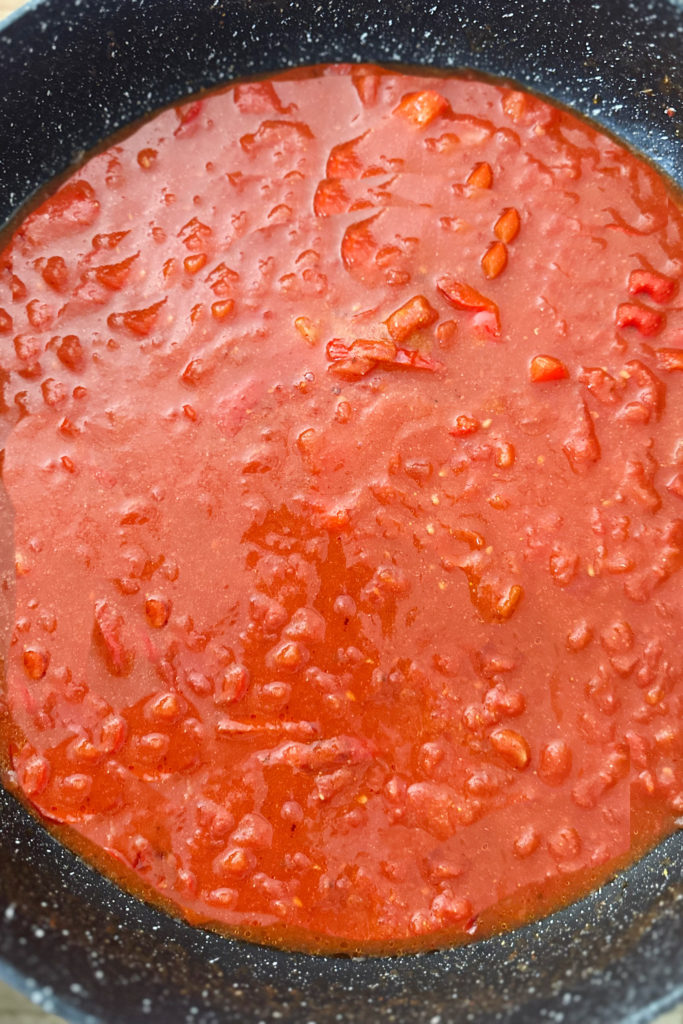
    3. Add tomatoes, granulated garlic, tomato paste, paprika, turmeric, water, salt, and chili or hot pepper flakes if desired.
    4. Cook for approximately 20 minutes or until everything has become a chunky sauce.
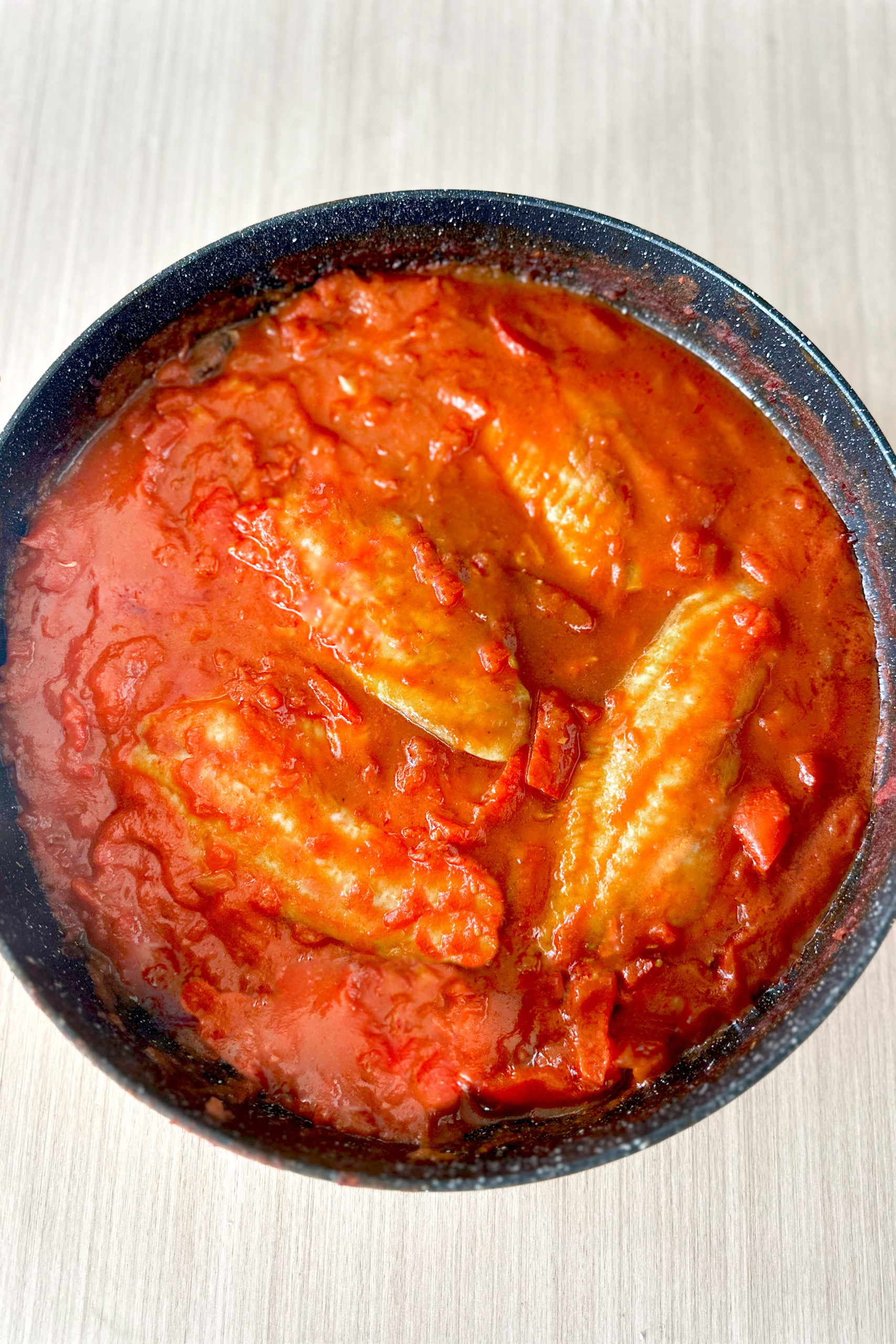
    5. Add the salmon and poach until cooked through.

Nutrition Information:

Yield:

4

Serving Size:

1

Amount Per Serving: Calories: 570Total Fat: 33gSaturated Fat: 6gTrans Fat: 0gUnsaturated Fat: 24gCholesterol: 143mgSodium: 1174mgCarbohydrates: 16gFiber: 6gSugar: 8gProtein: 53g

Sharing is caring!

Skip to Recipe