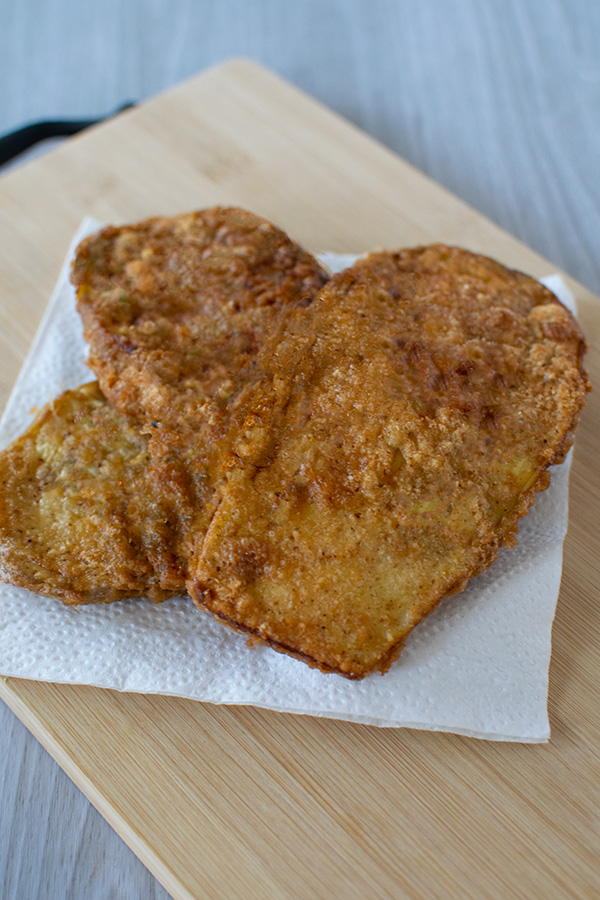
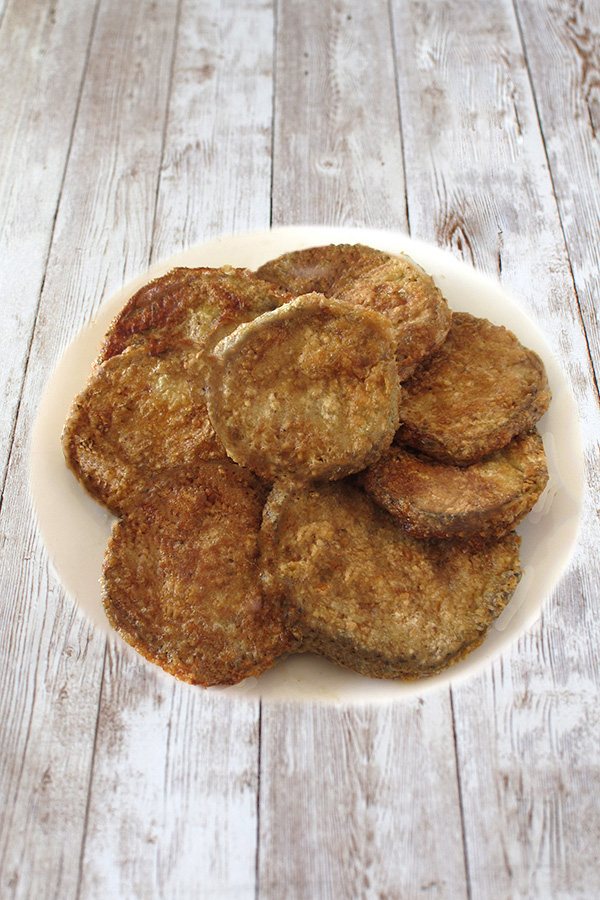
Fried Eggplant for Passover is a simple 3-ingredient recipe for dairy-free and parve, crispy, eggplant cutlets that are fried to a perfect golden brown.
Eat them as is, have them with mazto, dip them, or even make them into delicious Eggplant Parm for Passover!
They’re so good, don’t be surprised if people wrap them in a napkin and eat them right out of the pan!
It is often difficult to find dishes for the week of Passover that aren’t boring or repetitive.
This dish can be made plain, or add your favorite spices to the coating for even more flavor!
They’re great as an addition to any meal during the week or on Shabbat!
Use in a matzo sandwich or eat as is!
Have right away or make ahead of time and warm up as needed.
Tip: You can make them two ways, dip in egg and then in mazto meal, then fry or re-dip in the egg for a better coating.
This is how I make them and they don’t even make it to the table but are eaten right off the heat, warm and crispy wrapped in a napkin!
They’re so good that even when it’s not Passover, I use matzo meal to coat!
What if I want to use an oil besides regular cooking oil?
“High-heat” oils have neutral flavors and have been processed in order to handle high temperatures and are good for sautéing, searing, and frying. These include canola oil, vegetable oil, avocado oil, and grapeseed oil, each with its own “best for” with chefs.
Some oils have their own flavor and are good for sautéing and roasting and add a little extra to the dish. These include extra virgin olive oil, coconut oil, and peanut oil. Extra virgin olive oil works well with roasting or sautéing, but not for deep frying.
Coconut oil is good in dishes where a slightly coconut flavor enhances the dish, and peanut oil is good for deep frying and will add a subtle nutty taste and smell.
Food on Passover
Torah-observant Jews do not eat chametz (the fermented products of five grains: wheat, spelt, barley, oats, and rye).
In addition, Torah-observant Ashkenazi Jews do not eat kitniyot (or kitniyos as pronounced in Ashkenazi Hebrew). These include legumes, corn, rice, and similar foods that were deemed forbidden to eat by rabbis in the medieval period and are still not eaten today. Sephardi and Mizrachi Jews do not follow this tradition.
Many observant Ashkenazi Jews will not even eat the derivatives of these kitniyot, while others do (each family holds their own traditions regarding this).
Then, there are Ashkenazim who don’t eat “gebrokts” (or gebrochts).
Gebrokts (gebrochts) means “broken” in Yiddish, and in this case refers to matzo that has absorbed liquid. Not eating gebrokts is observed by many in the Hasidic Jewish community and Ashkenazim who have taken on this tradition, where they basically don’t mix anything wet with matzo.
So, things like matzo sandwiches, fried matzo, and even matzo balls are a no-no for them.
There is a joke that sums it all up:
On Passover, we should remember people who have little to eat on this holiday. They are called Ashkenazim.
Over the years, I have learned to adapt “normal” food for Passover so that my family won’t complain about boring, tasteless, or repetitive meals.
I find that having good food and variety makes the week of Passover a very pleasant experience, and I hope this recipe will help make yours just that!
A little about eggplants
The eggplant is native to India and Asia, where it can be found growing wild, and it is believed that eggplants were brought to Europe sometime during the 7th or 8th century.
Australians and Americans call the vegetable eggplant, while in England it is called an aubergine, from the French word for this vegetable.
Because of its meaty texture, eggplant is used instead of meat in some vegetarian versions of meat recipes.
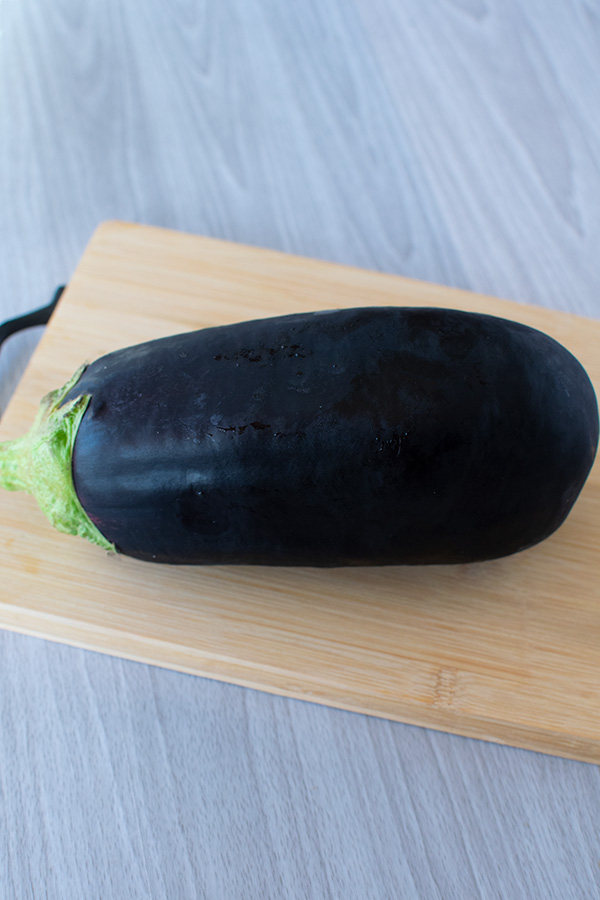
While there are a variety of types of eggplants, the one for this recipe is the large, egg-shaped (or teardrop-shaped), blackish-purple one with the meaty inside.
Eggplants have health benefits, as they contain antioxidants like vitamins A and C, which help protect your cells against damage, and are low in calories.
About cooking eggplant
Before cooking an eggplant, cut off the top part where the green is (called a calyx). The bottom tip should also be removed, but this is not imperative. The skin is perfectly fine to eat, but it must be cooked well. Otherwise it may come out chewy.
This recipe can use either peeled eggplants or eggplants with the skin (having the skin on will not ruin the recipe).
Eggplant is naturally a little bitter. If you find that to be the case, you can draw out the bitterness by sprinkling it with salt and letting it sit awhile. If you are using slices or pieces, slightly salt after cutting. I have personally never found this to be a problem when cooking with eggplants
Using salt before cooking can help prevent the eggplant from absorbing too much oil and becoming greasy if using oil with the eggplant recipe (I normally just pat the pieces with a paper towel if need be).
If you do use salt, MAKE SURE to rinse it off before cooking the eggplant, or the salt will become a part of your dish!
Personally, I have never salted my eggplants before using them (and I have used eggplants in two countries) and have never had any problem with bitterness, but if you have any concern, please do.
Fried Eggplant for Passover
Crispy eggplant cutlets, kosher for Passover.
Ingredients
- 2 large eggplants
- 6-8 eggs (start with 6 and add more if needed)***
- 2-3 cups matzo cake meal or matzo meal (start with 2 cups and add more if needed).***
- seasoning as desired*
- Vegetable oil for frying
Instructions
- Heat oil in a large frying pan on medium heat (approximately 1/4" - 1/3" high).
- Cut off the ends of the eggplant.
- Peel the eggplants (it's fine to leave the skin on, if so desired).
- Slice eggplant into 1/2" slices either lengthwise or into disks.
- Pour eggs and matzo meal or matzo cake meal into separate bowls large enough to accommodate dipping the eggplant slices.*
- Dip each slice into egg, then matzo meal or matzo cake meal, then egg again, making sure the slices are well coated.**
- Place in pan and fry one side until golden brown.
- Flip and fry on the other side until golden brown (you should be able to easily stick a fork through when they are ready).
- Remove and place on a plate covered with paper towels to drain.
Notes
MAKE SURE INGREDIENTS ARE KOSHER FOR PASSOVER.
*If seasoning, mix it into the matzo meal or matzo cake meal before dipping (note that the only difference between matzo meal and matzo cake meal is that the cake meal is more finely ground).
**Most people only use one coat of egg and do not redip after the matzo meal. I always dip twice.
***The number of eggs you will need depends on how well you coat. That is why I write 6-8. Chances are you won't need them all, but having a nice amount allows for easier coating, and starting with a smaller amount and having more at the ready to add if needed helps prevent waste.
Nutrition Information:
Yield:
4Serving Size:
1Amount Per Serving: Calories: 1211Total Fat: 58gSaturated Fat: 10gTrans Fat: 0gUnsaturated Fat: 44gCholesterol: 542mgSodium: 756mgCarbohydrates: 158gFiber: 9gSugar: 106gProtein: 22g