Shepherd’s Pie (Cottage Pie) for Passover is a simple, delicious, savory dish.
Great for any lunch or dinner during the week of Passover.
And, since it contains no matzo, you can even eat it on the day of the seder!
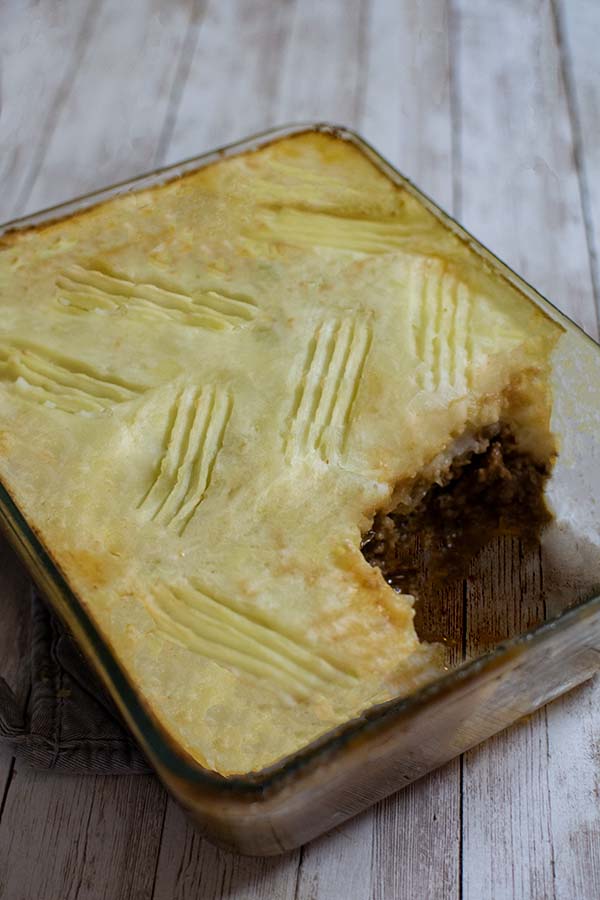
The dish is called Shepherd’s Pie when it contains lamb or mutton (from adult sheep) and Cottage Pie when it contains beef.
There seems to be some dispute over where the dish originated; Ireland or Britain, probably during the 18th century.
There does seem to be agreement on the idea that the original was made with leftovers (from Sunday dinner?), because people were poor and had to be frugal, and this way food didn’t go to waste.
Many recipes that are not kosher include Worcestershire sauc. However so for a recipe that does not include it, soy sauce can be used.
Since regular soy is not kosher for Passover, that sauce cannot be used on the holiday. However, there are kosher for Passover soy sauce substitutes that you can try if you wish.
While the recipe contains carrots, I personally do not like cooked carrots (and hate having to pick them out), so I don’t put them in when I make this dish.
Shephard’s Pie for Passover is a kosher-for-Passover version of cottage pie, as it contains ground beef and not mutton.
Also, since it also contains no matzo or matzo meal or cake meal, so it can be eaten on the day of the seder!
Eating on the day of the seder
Jews who keep the laws of Passover do not eat matzo or any foods that contain anything from matzo (such as matzo meal or matzo cake meal) the entire day before the seder, which is in the evening.
Some people even have the custom of not eating such foods for two weeks before, beginning on Rosh Chodesh Nissan or even as far back as Purim, which is a month before.
What does it mean when recipes say “to taste” about an ingredient?
When recipes say “to taste,” it means that you can put in as little or as much as you like to your own taste. Some recipes have many ingredients that a cook can adjust to their own taste when cooking (not so much when baking though).
The best way to calculate what your taste is with a recipe that you are not yet familiar with is to first taste the dish and then add the “to taste” ingredient GRADUALLY, a little at a time—a splash of this or a pinch of that—until the dish is just the way you like it.
Make sure to stir the ingredient after each time you add it so that the flavor will distribute evenly and become part of the dish. Then taste again. Repeat until you reach your personal preference.
Note: If you plan on using the recipe again, it is highly recommended to make a note of what and how much you added so that you can refer to it next time.
What does it mean when a recipe says that an ingredient is “optional”?
If an ingredient is “optional,” it means that you can add it in or not based on your own preference. An optional ingredient can be flavor related (i.e., salty, sweet, spicy, etc.), appearance related (garnish), or even something like nuts or chocolate chips in baking.
What does “savory” mean?
“Savory” refers to foods that are not sweet, such as foods that taste salty, spicy, or herbal.
Food on Passover
Torah-observant Jews do not eat chametz (the fermented products of five grains: wheat, spelt, barley, oats, and rye).
In addition, Torah-observant Ashkenazi Jews do not eat kitniyot (or kitniyos as pronounced in Ashkenazi Hebrew). These include legumes, corn, rice, and similar foods that were deemed forbidden to eat by rabbis in the medieval period and are still not eaten today. Sephardi and Mizrachi Jews do not follow this tradition.
Many observant Ashkenazi Jews will not even eat the derivatives of these kitniyot, while others do (each family holds their own traditions regarding this).
Then, there are Ashkenazim who don’t eat “gebrokts” (or gebrochts).
Gebrokts (gebrochts) means “broken” in Yiddish, and in this case refers to matzo that has absorbed liquid. Not eating gebrokts is observed by many in the Hasidic Jewish community and Ashkenazim who have taken on this tradition, where they basically don’t mix anything wet with matzo.
So, things like matzo sandwiches, fried matzo, and even matzo balls are a no-no for them.
There is a joke that sums it all up:
On Passover, we should remember people who have little to eat on this holiday. They are called Ashkenazim.
Over the years, I have learned to adapt “normal” food for Passover so that my family won’t complain about boring, tasteless, or repetitive meals.
I find that having good food and variety makes the week of Passover a very pleasant experience, and I hope this recipe will help make yours just that!
Kosher for Passover Pantry Essentials (Suggestion)
As I learned to prepare more and more recipes for Passover, I also learned which basics and seasonings are good to have on hand to have the ability to make a dish on short notice—especially during the holiday—and not have to run out to the store or borrow from a neighbor.
While I will admit that I am not always prepared when one of my kids will ask for eggplant parmesan or something at the drop of a hat (which they have done), I dislike having to postpone making something just because the ingredients needed to make a reasonable meal were not readily available.
So, I maintain a selection of what I consider “kosher for Passover pantry essentials” in my refrigerator and on my shelves during the week of Passover (some of the dry goods I keep from year to year, stored well).
While, of course, most of the essentials will not be needed just for any one recipe, at least some of them are needed for most recipes, and you would be surprised how many recipes can be made just with this list. So, if you make sure to have whatever you use regularly on hand, it can really save you time and effort.
Everyone has their favorite recipes, preferred seasoning, and just whatever they like to use to cook. Your own list should certainly reflect your own cooking tastes and style. Just make sure that everything is Kosher for Passover (or KLP—Kasher L’Pesach, in Hebrew) and if you are Ashkenazi, that list will be shorter than if you are not.
Make sure to check with a qualified rabbi if you have any questions.
Seasoning and flavoring:
- salt
- ground black or white pepper
- granulated garlic or garlic powder
- onion powder
- ground cinnamon
- sugar (granulated)
- brown sugar
- chicken consommé powder
- onion soup mix
- various herbs
- additional spices to adapt taste to preference
Misc:
- oil / margarine / butter / cooking spray
- potato starch as a thickening agent
- baking powder
- matzo cake meal (matzo meal, but ground into a powder)
- condiments, such as ketchup and barbecue sauce
- tomato sauce/tomato paste/canned tomatoes—diced or crushed/pasta sauce
- milk substitute (neutral flavor)
We always have eggs in the fridge and onions and potatoes on our shelves (if we were not Ashkenazi, I would certainly keep rice as well).
In addition, having fresh vegetables , such as carrots, celery, bell peppers (red, green, etc), tomatoes (if you don’t want to use canned), etc. can be very useful when putting together a quick but delicious meal.
It’s also a good idea to have some ground meat or chicken (breast, ground, or in parts) in the freezer for anyone who likes meat dishes in a snap.
Shepherd's Pie for Passover
Easy and delicious ground beef pie, kosher for Passover
Ingredients
- 1 pound kosher ground beef (or kosher ground lamb) *
- 2 pounds potatoes, boiled and mashed
- 1 large onion, chopped
- 8 ounces chopped carrot (or 1 can drained diced carrots, kosher for Passover, or 2-3 medium carrots, diced or chopped), optional
- 3 tablespoons mayonnaise, kosher for Passover
- 2 tbsp tomato paste, kosher for Passover
- 1 tablespoon oil, kosher for Passover
- 2 tablespoon beef bullion powder or chicken consommé powder (or to taste), kosher for Passover
- 1/2 cup water
- large splash of kosher for passover soy sauce (leave out if you don't have it)
Instructions
- Heat oil in a sauté pan on a medium heat.
- Add onion and carrots and cook until tender, mixing occasionally.
- Add ground beef or lamb and crumble or mash so there are no chunks.
- Cook until brown. If there is excess fat, pour out.
- Add tomato paste and mix well.
- Pour in water and beef or chicken consomme powder and mix well.
- Pour mixture into a suitable size baking dish.
- Add the mayonnaise to the mashed potatoes (from the ingredient list) and mix well.
- Spread the mashed potatoes evenly over the meat mixture.
- Ruffle the potatoes with a fork (optional) and place the pan or dish in an oven that has been preheated to 350°F.
- Bake for around 30 - 40 minutes or until the potatoes begin to brown a little.
Notes
* Shepherd's pie is made with lamb or mutton, cottage pie is made with beef.
Nutrition Information:
Yield:
6Serving Size:
1Amount Per Serving: Calories: 486Total Fat: 24gSaturated Fat: 7gTrans Fat: 1gUnsaturated Fat: 14gCholesterol: 88mgSodium: 313mgCarbohydrates: 38gFiber: 5gSugar: 5gProtein: 30g