Easy Perfect Matzo Balls (Kneidlach) is a terrific recipe for the best homemade classic matzo balls for your Passover chicken soup!
These kneidlach are of course dairy-free, but they’re also vegetarian (made without schmaltz), so they’re parve!
The texture of the kneidl is not hard and not full of air.
So, they’re medium-fluffy! Just like they should be!
These matzo balls are not only terrific for your soup for the seder, but they’re terrific for Shabbat and anytime during the year.
They help make THE BEST Jewish comfort soup!
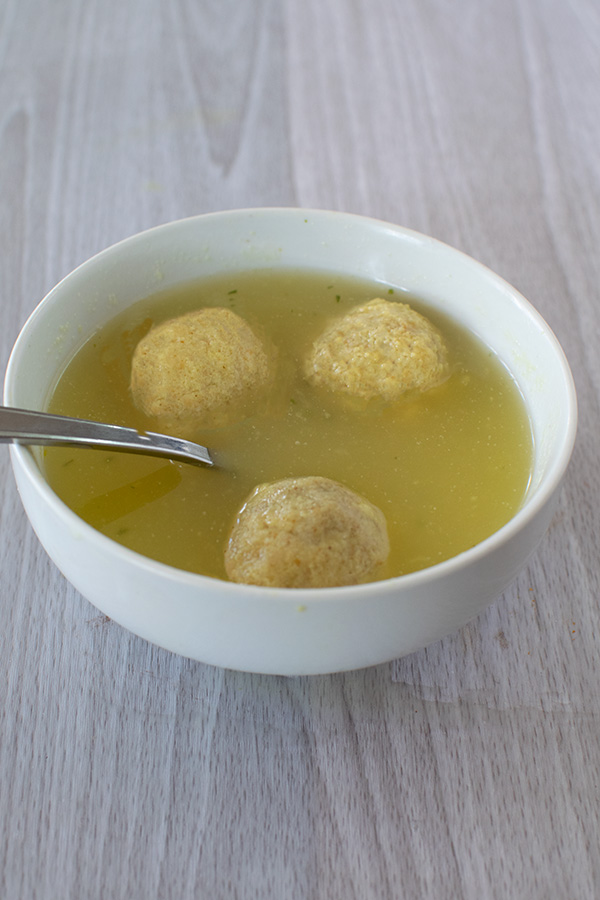
Matzo balls are an amazing addition to chicken soup any time of year.
However, matzo soup is a basic at a Jewish Ashkenazi Passover table, at the seder.
What is Passover, you ask? Passover is a holiday that was dictated by God to the Jews after their exodus from Egypt, when God freed them from slavery.
The holiday lasts 7 days in Israel and 8 everywhere else. There is a celebratory (so to speak) meal called a seder, which is held on the first night in Israel and on the first two nights everywhere else.
The seder (which means order) is actually done in a particular order with certain foods and blessings, while it retells of the exodus from Egypt as per Jewish laws that pertain to Passover.
While there are a lot of food restrictions during the week of Passover, matzo ball soup is one of the things we look forward to.
While some people describe matzo balls as Jewish dumplings, that is not correct. There is no dough and no filling. These are just balls made out of matzo, egg, and a few other ingredients for flavor and consistency.
This recipe uses baking powder, not seltzer.
By the way, while some of you might be tempted to yell, “Baking powder? That’s a leavener! Leaveners are not kosher for Passover!”
Let me now inform you that this is not so. It is the natural leaveners that leaven by fermentation that are not kosher for Passover. Baking powder is chemical and therefore just fine. Just make sure it is kosher for Passover and labeled: Kosher for Passover, P, or KP.
In fact, according to the CRC (a recognized authority on what is kosher), “Baking soda doesn’t need special Pesach certification. Baking powder does.” Note: Pesach = Passover, in Hebrew.
But, of course, always check with your own rabbinical source if you have any kosher or kosher for Passover questions.
So, back to mazto balls….
This Homemade Matzo Balls recipe is at least as good as your favorite mazto ball mix and the matzo balls come out the same kind of delicious medium-fluffy!
Unlike other homemade recipes, this recipe uses oil, not chicken fat, so these are actually vegetarian matzo balls.
Also, this matzo ball recipe calls for baking soda, not seltzer (some people insist that seltzer imust be used for fluffiness, but that is just incorrect) so no need to buy a bottle of seltzer that you may never use again. And no, baking soda is not the type of leavener that is not kosher for Passover, because it does not cause rising through fermentation but rather by a chemical reaction, so it is perfectly fine to use on Passover.
Many recipes call to chill the mixture. I don’t. But if you prefer to, DO NOT leave it in the fridge until the mixture hardens, because then your matzo balls will come out hard.
What are the different oils used in cooking?
“High-heat” oils have neutral flavors and have been processed in order to handle high temperatures and are good for sautéing, searing, and frying. These include canola oil, vegetable oil, avocado oil, and grapeseed oil, each with its own “best for” with chefs.
Some oils have their own flavor and are good for sautéing and roasting and add a little extra to the dish. These include extra virgin olive oil, coconut oil, and peanut oil. Extra virgin olive oil works well with roasting or sautéing, but not for deep frying.
Coconut oil is good in dishes where a slightly coconut flavor enhances the dish, and peanut oil is good for deep frying and will add a subtle nutty taste and smell. Many Asian dishes call for peanut oil in the ingredients.
Then there are oils that are not used with heat but rather for dressing up foods, such as sesame oil, flaxseed oil, and walnut oil, among others.
What does it mean when recipes say “to taste” about an ingredient?
When recipes say “to taste,” it means that you can put in as little or as much as you like to your own taste. Some recipes have many ingredients that a cook can adjust to their own taste when cooking (not so much when baking though).
The best way to calculate what your taste is with a recipe that you are not yet familiar with is to first taste the dish and then add the “to taste” ingredient GRADUALLY, a little at a time—a splash of this or a pinch of that—until the dish is just the way you like it. Make sure to stir the ingredient after each time you add it so that the flavor will distribute evenly and become part of the dish. Then taste again. Repeat until you reach your personal preference.
Note: If you plan on using the recipe again, it is highly recommended to make a note of what and how much you added so that you can refer to it next time.
What does it mean when a recipe says that an ingredient is “optional”
If an ingredient is “optional,” it means that you can add it in or not based on your own preference. An optional ingredient can be flavor related (i.e., salty, sweet, spicy, etc.), appearance related (garnish), or even something like nuts or chocolate chips in baking.
Food on Passover
Torah-observant Jews do not eat chametz (the fermented products of five grains: wheat, spelt, barley, oats, and rye).
In addition, Torah-observant Ashkenazi Jews do not eat kitniyot (or kitniyos as pronounced in Ashkenazi Hebrew). These include legumes, corn, rice, and similar foods that were deemed forbidden to eat by rabbis in the medieval period and are still not eaten today. Sephardi and Mizrachi Jews do not follow this tradition.
Many observant Ashkenazi Jews will not even eat the derivatives of these kitniyot, while others do (each family holds their own traditions regarding this).
Then, there are Ashkenazim who don’t eat “gebrokts” (or gebrochts).
Gebrokts (gebrochts) means “broken” in Yiddish, and in this case refers to matzo that has absorbed liquid. Not eating gebrokts is observed by many in the Hasidic Jewish community and Ashkenazim who have taken on this tradition, where they basically don’t mix anything wet with matzo.
So, things like matzo sandwiches, fried matzo, and even matzo balls are a no-no for them.
There is a joke that sums it all up:
On Passover, we should remember people who have little to eat on this holiday. They are called Ashkenazim.
Over the years, I have learned to adapt “normal” food for Passover so that my family won’t complain about boring, tasteless, or repetitive meals.
I find that having good food and variety makes the week of Passover a very pleasant experience, and I hope this recipe will help make yours just that!
Want other recipes that can be made during the week of Passover? There are tons on this site! Here are some, but just do a search for “Passover” or click on the Passover tab and enjoy!
- Roasted Eggplant for Passover
- Israeli Eggplant Salad for Passover
- Broccoli Salad for Passover
- The Best Passover Pancakes for Passover
- Mandel Bread for Passover
- Shepherd’s Pie for Passover
- French-Style Onion Soup for Passover
Kosher for Passover Pantry Essentials (Suggestion)
I maintain a selection of what I consider “kosher for Passover pantry essentials” in my refrigerator and on my shelves during the week of Passover (some of the dry goods I keep from year to year, stored well).
While, of course, most of the essentials will not be needed just for any one recipe, at least some of them are needed for most recipes, and you would be surprised how many recipes can be made just with this list. So, if you make sure to have whatever you use regularly on hand, it can really save you time and effort.
Everyone has their favorite recipes, preferred seasoning, and just whatever they like to use to cook. Your own list should certainly reflect your own cooking tastes and style. Just make sure that everything is Kosher for Passover (or KLP—Kasher L’Pesach, in Hebrew) and if you are Ashkenazi, that list will be shorter than if you are not.
Make sure to check with a qualified rabbi if you have any questions.
Utensils:
- Measuring cups for liquid
- Measuring cups for solids (flour, sugar, etc.)
- Measuring spoons
- Mixing bowls
- Kitchen scale
NOTE: When using measuring cups and spoons, make sure that the measurements are comparable to one another (example: that 4 tablespoons equals 1/4 of your measuring cup). You’d be surprised to know that not all measuring cups are the same, and this can throw your measurements off.
Seasoning and flavoring:
- salt
- ground black or white pepper
- granulated garlic or garlic powder
- onion powder
- ground cinnamon
- sugar (granulated)
- brown sugar
- chicken consommé powder
- onion soup mix
- various herbs
- additional spices to adapt taste to preference
Misc:
- oil / margarine / butter / cooking spray
- potato starch as a thickening agent
- baking powder
- matzo cake meal (matzo meal, but ground into a powder)
- condiments, such as ketchup and barbecue sauce
- tomato sauce/tomato paste/canned tomatoes—diced or crushed/pasta sauce
But what do I need for this recipe, you ask?
These are the ingredients that you need to make this recipe:
matzo meal or matzo cake meal
baking powder (no, it’s not leavener)
salt
garlic powder (or granulated garlic)
onion powder
large eggs
oil
Easy Perfect Matzo Balls (Kneidlach)
Perfect medium-fluffy matzo balls are vegetarian and parve, and absolutely delicious in soup!
Ingredients
- 1 cup matzo meal or matzo cake meal
- 2 teaspoons baking powder*
- 1/2 teaspoon salt
- 1/2 teaspoon garlic powder (or granulated garlic)
- 1/2 teaspoon onion powder
- 4 large eggs
- 1/4 cup oil
- 1/4 cup water
Instructions
- Combine matzo meal, baking powder, salt, garlic powder, onion powder together in a bowl.
- Add eggs, oil, and water. Mix well.
- Let sit for approximately 10 - 15 minutes until mixture thickens.**
- Form balls of approximately 1 inch in diameter.
- Drop into boiling chicken soup and boil for approximately 15 minutes (the balls should become around double the size).
Notes
* While baking powder is a leavener, it does not leaven through fermentation but rather though chemical reaction, so it is kosher for passover and you can find it labelled as such.
**You can chill for this amount of time if you'd like to, but DO NOT over-chill because your matzo balls will come out hard.
Nutrition Information:
Yield:
12Serving Size:
1Amount Per Serving: Calories: 153Total Fat: 11gSaturated Fat: 1gUnsaturated Fat: 9gCholesterol: 77mgSodium: 272mgCarbohydrates: 12gFiber: 0gSugar: 9gProtein: 3g