Strawberry Ice Cream for Passover is a delicious and simple, no-churn recipe for a homemade soft frozen dessert with only 5 ingredients.
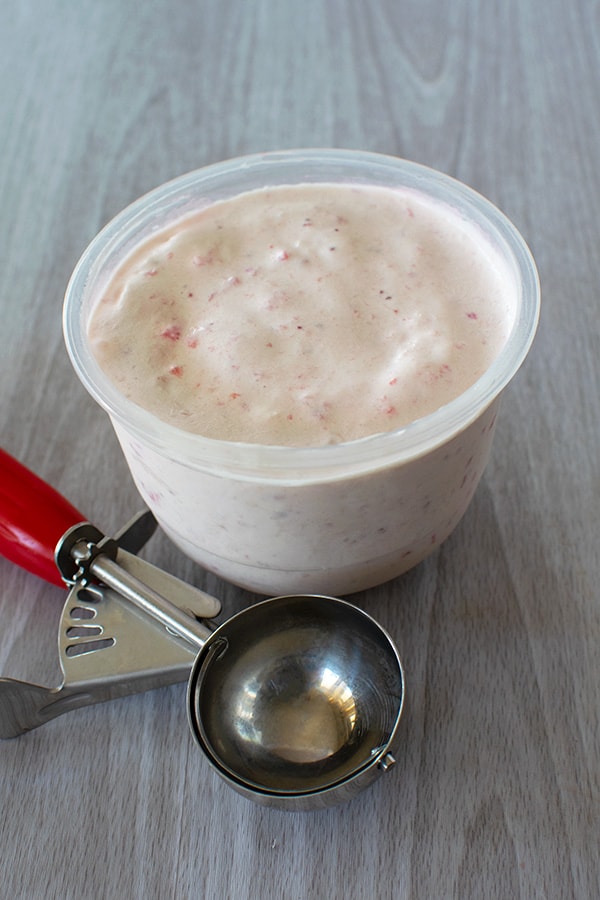
is a no-cook, no-churn soft frozen dessert that is simple to make. Just mix and freeze. And have it at the ready for a refreshing and delicious dessert any time during the holiday.
In fact, it’s perfect for the day of the seder since there is, of course, no matzo in the ingredients!
Vanilla Ice Cream for Passover
Chocolate Ice Cream for Passover
Coffee Ice Cream for Passover
And check out the history of ice cream!
Eating on the day of the seder
Jews who keep the laws of Passover do not eat matzo or any foods that contain anything from matzo (such as matzo meal or matzo cake meal) the entire day before the seder, which is in the evening.
Some people even have the custom of not eating such foods for two weeks before, beginning on Rosh Chodesh Nissan or even as far back as Purim, which is a month before.
Food on Passover
Torah-observant Jews do not eat chametz (the fermented products of five grains: wheat, spelt, barley, oats, and rye).
In addition, Torah-observant Ashkenazi Jews do not eat kitniyot (or kitniyos as pronounced in Ashkenazi Hebrew). These include legumes, corn, rice, and similar foods that were deemed forbidden to eat by rabbis in the medieval period and are still not eaten today. Sephardi and Mizrachi Jews do not follow this tradition.
Many observant Ashkenazi Jews will not even eat the derivatives of these kitniyot, while others do (each family holds their own traditions regarding this).
Then, there are Ashkenazim who don’t eat “gebrokts” (or gebrochts).
Gebrokts (gebrochts) means “broken” in Yiddish, and in this case refers to matzo that has absorbed liquid. Not eating gebrokts is observed by many in the Hasidic Jewish community and Ashkenazim who have taken on this tradition, where they basically don’t mix anything wet with matzo.
So, things like matzo sandwiches, fried matzo, and even matzo balls are a no-no for them.
There is a joke that sums it all up:
On Passover, we should remember people who have little to eat on this holiday. They are called Ashkenazim.
Over the years, I have learned to adapt “normal” food for Passover so that my family won’t complain about boring, tasteless, or repetitive meals.
I find that having good food and variety makes the week of Passover a very pleasant experience, and I hope this recipe will help make yours just that!
Baking and dessert necessities for Passover
I like to make sure I can bake anything with very short notice. To that end, I keep a variety of supplies and ingredients in the house that will allow me to do just that.
I can’t tell you how many times I was glad to have whatever I needed within reach for the last-minute visitor or for when one of my kids went to a friend or had a school event without much prior notice.
I have slowly collected things over the years as I needed them (or if I found a good sale) and like to keep more than one of the smaller items in case I don’t want to wash dishes in the middle of baking.
My basic “equipment” includes:
- a hand mixer (you probably don’t need a stand mixer for Passover)
- a small kitchen scale
- baking pans
- mixing bowls (or just large bowls)
- cookie sheets
- dry measuring cups
- liquid measuring cups
- whisks
- rubber spatulas (really good for when you don’t want to leave anything in the bowl)
- baking (or parchment) paper
While you can certainly manage without the above (such as a whisk, where you can use a fork in a pinch), if you tend to do a lot of Passover baking, these are good to have around.
In addition to the equipment, there are several basic baking ingredients that are used regularly if you are going to want to bake and may be helpful to have at the beginning of the holiday.
Just make absolutely certain that they have a Kosher for Passover certification or don’t require one. When in doubt, ask an Orthodox rabbi (there are also some Orthodox organizations that post Passover information online).
Some of the items on this list, however, are not basic but rather are only used for specific recipes. Regarding these, you might not want to invest in them in advance, but only if you need them.
Unless you have been making Passover at home and know which is which, you might want to plan ahead, at least until you get used to what your yearly baking needs are.
- matzo cake meal
- potato starch
- white sugar
- brown sugar
- powdered sugar
- salt
- baking powder (leavens chemically, so it just needs to be certified Kosher for Passover)
- baking soda (leavens chemically, so it just needs to be certified Kosher for Passover)
- cocoa powder
- ground cinnamon
- ground ginger
- ground cloves
- ground nutmeg
- baking chocolate
- chocolate chips
- vanilla/vanilla sugar
- oil
- margarine or butter
- eggs
- extracts (real or imitation)
- whipping cream (get non-dairy for dairy-free desserts)
Having other kosher for Passover spices in your pantry can also be helpful. Just make certain that everything is certified kosher for Passover.
In addition, whipping cream, powdered pudding mix, and powdered sugar can allow you to be able to make a variety of fillings, frostings, and toppings.
Lastly, it’s not a bad idea to have toppings, such as chopped walnuts, raisins, and, if you can find them kosher for Passover, especially if you have kids, the oh-so-important container of sprinkles.
While some of these can easily be found in the average grocery store that carries kosher-for-Passover items for the holiday, stores that carry only kosher foods should have all or most of it.
I always save the leftover closed items for the following years, especially if they are not easy to find, and just pack them away in a suitable place.
General information regarding cooking:
The following information may not particularly pertain to this recipe but rather answers general useful questions related to cooking.
What are the different oils used in cooking?
“High-heat” oils have neutral flavors and have been processed in order to handle high temperatures and are good for sautéing, searing, and frying. These include canola oil, vegetable oil, avocado oil, and grapeseed oil, each with its own “best for” with chefs.
Some oils have their own flavor and are good for sautéing and roasting and add a little extra to the dish. These include extra virgin olive oil, coconut oil, and peanut oil. Extra virgin olive oil works well with roasting or sautéing, but not for deep frying.
Coconut oil is good in dishes where a slightly coconut flavor enhances the dish, and peanut oil is good for deep frying and will add a subtle nutty taste and smell. Many Asian dishes call for peanut oil in the ingredients.
Then there are oils that are not used with heat but rather for dressing up foods, such as sesame oil, flaxseed oil, and walnut oil, among others.
What does it mean when recipes say “to taste” about an ingredient?
When recipes say “to taste,” it means that you can put in as little or as much as you like to your own taste. Some recipes have many ingredients that a cook can adjust to their own taste when cooking (not so much when baking though).
The best way to calculate what your taste is with a recipe that you are not yet familiar with is to first taste the dish and then add the “to taste” ingredient GRADUALLY, a little at a time—a splash of this or a pinch of that—until the dish is just the way you like it. Make sure to stir the ingredient after each time you add it so that the flavor will distribute evenly and become part of the dish. Then taste again. Repeat until you reach your personal preference.
Note: If you plan on using the recipe again, it is highly recommended to make a note of what and how much you added so that you can refer to it next time.
What does it mean when a recipe says that an ingredient is “optional”?
If an ingredient is “optional,” it means that you can add it in or not based on your own preference. An optional ingredient can be flavor related (i.e., salty, sweet, spicy, etc.), appearance related (garnish), or even something like nuts or chocolate chips in baking.
What does “savory” mean?
“Savory” refers to foods that are not sweet, such as foods that taste salty, spicy, or herbal.
What cooking measurement expressions mean:
Drop – ¹/₆₄ teaspoon (or less—it’s however a literal drop comes out)
Smidgen – ¹/₃₂ teaspoon
Pinch – ¹⁄₁₆ teaspoon (what you can grab between your finger and thumb)
Dash – ⅛ teaspoon (what comes out when you shake out of a shaker or bottle)
Tad – ¼ teaspoon
Dollop—a glob on a spoon (like with mayonnaise or ice cream)
Scant—a scant cup is almost a cup, just below the line.
Heaping—above the line of the spoon (teaspoon, tablespoon)*
Some useful cooking terms:
Sauté: Cooking quickly in a small amount of oil or fat in a frying pan on a relatively high heat that causes a slight browning of the food on the outside.
Sear: Browning the outside of meat at a high temperature.
Sweat: Cooking vegetables (often onions) in a little oil or fat on a low heat until they become soft and translucent (no browning).
Simmer: Heating liquid to just below the boiling point (has slow bubbles).
Boil: Cooking food submerged in water hot enough to have rapid, rolling bubbles.
Poach: Cooking in a liquid, or partially submerged, on low heat.
Roast: Cooking with consistent dry heat in an enclosed space, over 400 degrees Fahrenheit.
Bake: Cooking with dry heat in an enclosed space, under 400 degrees Fahrenheit.
Broil: Cooking with intense heat from above.
Grill: Cooking with heat from below, typically over a flame or coals.
Braise: Cooking already-seared meat in a small amount of liquid in a covered pot.
Blanch: Quickly submerging food into boiling water and then immediately into ice water to stop the cooking.
Steam: Cooking with vapor from hot simmering water from below.
Shred: Creating long, thin strips (not necessarily uniform) of vegetables, like in coleslaw.
Grate: Scraping food against a surface with rough, tiny holes that break it down into very small, fine pieces.
Zest: The scrapings of the colorful outer skin of a citrus fruit.
Mince: Cutting into the smallest pieces possible.
Dice: Cutting into small cubes.
Chop: Cutting into small (bite-size) pieces.
Julienne: Cutting into long, thin strips (like matchsticks).
Glaze: a thin liquid with high-sugar or high-fat coating applied to food or baked goods that gives a shiny look and adds flavor.
Fold in: To gently combine a light ingredient into a heavier one.
Al dente: Cooking rice or pasta to the point before it gets soft (is slightly firm).
Emulsify: Forcing two liquids together that don’t normally combine (like oil and vinegar) into a smooth sauce or dressing.
Deglaze: Adding a liquid to a hot pan after searing meat to loosen the browned bits (called fond) that got stuck.
Slurry: A mixture of liquid and dry starch, such as cornstarch or potato starch, into a paste that is used to thicken sauces and soups. One can use flour to make a slurry as well.
Roux: (pronounced “roo”) is a cooked mixture of fat and flour.
A little about ice cream
This recipe clearly isn’t “real” ice cream but more of a frozen dessert.
Real ice cream is made by an involved process using milk, milk protein, sugar, ice, water, and air, which turns the mixture into foam as frozen air cells.
Nowadays, we have freezers in which to store our ice cream (and frozen desserts), but before refrigeration, making ice cream took quite a bit of effort and was only served for special events or on special occasions.
Before refrigeration, ice had to be cut from frozen lakes and ponds in the winter. The ice was then stored for later use (even in the summer) in ice houses or even in holes dug in the ground.
The pot-freezer method of preparing ice cream was by making it in a large bowl, which was placed in a tub filled with crushed ice and salt to reduce the temperature of the ingredients to below the freezing point of water.
French confectioners used a method similar to the pot-freezer method but used a covered pail with a handle attached to the lid (called a sorbetiere).
The hand-cranked churn replaced the pot-freezer method and also used ice and salt for cooling. This method was quicker than the pot-freezer method and produced a smoother ice cream.
Ice cream was initially sold by small businesses until a milkman, Jacob Fussell, began making small batches of it from leftover milk and cream. Fussell opened the first ice cream factory in 1851 in Pennsylvania and moved his successful business to Baltimore in 1854.
Fussell, known today as the Father of the Ice Cream Industry, opened more factories in other cities and taught the business to others who opened their own factories. The mass production of ice cream made it more affordable and more accessible to everyone and was no longer a dessert just for the rich.
Popularity increased even more with the invention of the household freezer in the 1920s, when it became much easier to store the frozen dessert.
Ice cream is a beloved dessert, and some people will go to some extreme lengths to get their hands on the treat. For example, during World War II, American fighter pilots in the South Pacific found an ingenious way of making ice cream.
They attached 5-gallon cans to their aircraft. The cans were fitted with small propellers spun by the slipstream, which drove a stirrer, which agitated the mixture, which froze in the high altitude of the planes as they flew. B-17 crews and others found similar methods of making ice cream during the war.
Today, getting ice cream is simple and inexpensive, and the flavors are numerous. Many households have their own ice cream machines for at-home preparation.
Strawberry Ice Cream for Passover is more of a frozen dessert than “real” ice cream, but it is easy to make and delicious.
Strawberry Ice Cream for Passover
Homemade no-cook, no-churn soft strawberry ice cream, kosher for Passover
Ingredients
- 1 8-ounce container of whipping cream (or use dairy free whipping cream)
- 6-8 ounces of ripe or frozen strawberries
- 3 eggs
- 1/2 c sugar
- 1 teaspoon vanilla or to taste
Instructions
- Whip whipping cream until stiff.
- Blend strawberries in a blender.
- Add blended strawberries, eggs, sugar, and vanilla to the whipped cream.
- Whip all together well.
- Freeze for 8 hours or until stiff *
Notes
* This is a soft ice cream so it won't get hard and the freezing time depends on your freezer.
Make sure all ingredients are kosher for Passover.
Nutrition Information:
Yield:
4Serving Size:
1Amount Per Serving: Calories: 476Total Fat: 25gSaturated Fat: 15gTrans Fat: 1gUnsaturated Fat: 9gCholesterol: 207mgSodium: 76mgCarbohydrates: 58gFiber: 7gSugar: 43gProtein: 8g