Easy Oil-Based Hamantaschen is a dairy-free recipe for the traditional Purim cookie using simple pantry ingredients, made without butter or margarine. Just make the oil-based dough, fill, fold, and bake.
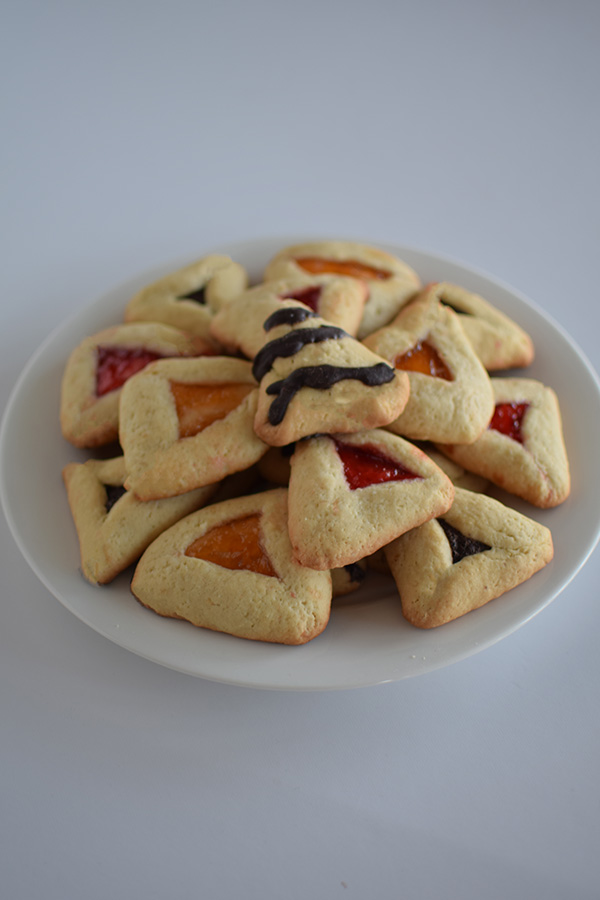
Hamantaschen are the ultimate Purim tradition, but making them with oil is a healthier option than with butter or margarine and they are dairy-free (pareve).
Whip up a batch of this simple dough, choose your favorite sweet filling, fold them (or pinch them) into shape, and bake up a batch of delicious cookies everyone will love!
About Purim and Hamentaschen
What is Purim?
Purim is a Jewish holiday that commemorates the saving of the Jewish people from Haman (Hamen)-the vizier of the Persian king, Xerxes (Ahashverosh)-by Queen Esther and her uncle Mordechai.
The king's first wife-Vashti (who had inherited the crown and made him king)-disobeyed him, and he was beside himself with anger. His advisors told him to get rid of her, with the explanation that everyone's wife would feel it's ok to disobey their husbands if she was allowed to get away with it. He agreed and complied.
Sometime after this, maidens were brought from far and wide for the king to choose a new queen. He chose a nice Jewish girl, Esther (although she kept her religion to herself).
Esther's uncle, Mordechai (who had adopted her after the death of her parents), had accompanied her to the palace and would sit by the gates to hear of news of Esther's well-being.
One day, Mordechai overheard two of the king's eunuchs plotting to kill him and told Esther, who told the king. The eunuchs were found guilty, were hanged, and the king had the incident recorded in his chronicles.
In the meantime, Haman, a sociopathic narcissist, was promoted by the king, and everyone was commanded to bow down to him.
Nonetheless, Mordechai refused, which caused Haman to become overcome with rage and hatred. So, he went to the king with a plot to murder all Jews (men, women, young, and old) in revenge.
Haman told the king that there were a people who were dispersed among his nations, whose traditions were different from those of everyone else's, and who didn't follow the king's laws. He told the king that he shouldn't have to be tolerated and, if it pleased the king, they should be annihilated. The king told him to do as he saw fit.
A date was set, and notifications were sent to all the provinces.
When Mordechai found out, he put on mourning clothes (a sack), and when Esther was told about this, she sent clothes to him via a messenger. He refused them and sent back a message telling her about the decree and insisted that she plead with the king on behalf of her people.
Esther really didn't want to do this, because everyone-including the queen-had to be invited to see the king or risk death. Mordechai responded that she shouldn't think that her position would protect her and that maybe this was the reason she became queen in the first place (from God).
Esther responded that everyone should fast for three days, night and day, and that she and her maidens will also fast and then afterward she will go to the king ... "If I perish, I perish."
When she went to the king, he was happy to see her and extended his golden scepter toward her. He asked her what she wanted from him. "What is it you desire, Queen Esther, and what do you request? Up to half of the kingdom and it will be given to you."
Esther's request was that the king and Haman come to a banquet that she had prepared. The king agreed and ordered that Haman be quickly brought, and there, again, the king asked, "What is it you desire, Queen Esther, and what do you request? Up to half of the kingdom, and it will be given to you."
Esther told the king that she would like him and Haman to come to another banquet the next day.
Of course, Haman was thrilled at the invitation. However, when he left to go home and saw Mordechai sitting at the gate, who still didn't stand and bow for him, his joy dissipated and he was furious.
Haman went home and told his friends and his wife that nothing he had attained was worth anything to him as long as he had to see Mordechai disrespecting him. They suggested he build a tall gallows and ask the king to hang Mordechai on it. He liked the idea and built the gallows.
That night, the king couldn't sleep and asked that his chronicles be read to him, and he was reminded of how Mordechai saved his life from the eunuchs. "What was done for him?" he asked. "Not a thing," was the reply.
So, the king asked who was in the courtyard, and lo and behold, there was Haman on his way to ask the king's permission to hang Mordechai!
The king had him called to him and asked, "What should be done for the man whom the king desires to honor?"
Haman, narcissist that he was, thought: Who would the king want to honor more than me? So, he recommended that the king's clothes and the king's horse with a royal crown on it's head to be given to the most noble official who will dress the man and ride him through the town square and call out: "This is what shall be done for the man whom the king desires to honor."
So, the king told Haman himself to quickly do just as he mentioned...for Mordechai the Jew!
The next evening, the king and Haman went to Esther's banquet, and again the king asked her, "What is it you desire, Queen Esther, and what do you request? Up to half of the kingdom, and it will be given to you."
This time she replied that her desire is her life and her request, the lives of her people. She proceeded to tell the that they had been sold out to be annihilated.
"Who dared to do this?" he asked.
She told him, "This wicked Haman!"
The king got up and went out into the garden in his wrath, and when he came back, he saw that Haman had fallen on Esther's sofa to beg for his life and said, "Can it be that he would actually assault the queen while I'm in the house?"
One of the eunuchs who were in attendance overheard and told the king, "Also, there is the tall gallows that Haman prepared to hang Mordechai- who spoke good of the king-by his house."
The king replied, "Hang him on it!"
The rest of the story is that the Jews got to fight back on the days they were supposed to be slaughtered, and they won.
Every year, Jews celebrate their victory, and on Purim, in the morning, they give out packages of treats and baked goods to their neighbors and friends, and in the afternoon, they have a festive meal to celebrate.
What about hamantaschen?
Hamentaschen (spelled a variety of ways) is a favored type of cookie that is made from a circle of dough with filling and folded into a triangle.
"Tasch" is yiddish for "pocket," so the word "hamantaschen" actually means "Haman's pockets." Some people say that the triangle actually represents the three-cornered hat that Haman supposedly wore, and in Hebrew, they called these treats "Haman's ears" (Oznei Haman).
There are several ideas about how hamentaschen got its name, but it doesn't really matter... All that matters is the they are really good!
How to fold Hamantaschen:
Cut out circles from the dough (this is a 3" diameter circle).
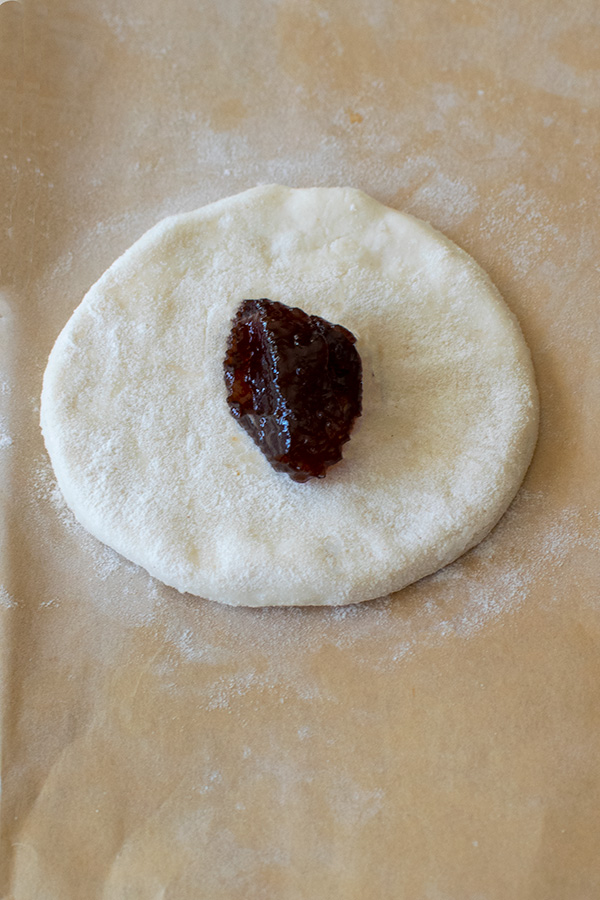
Fold over ⅓ of the circle from the edge toward the middle (how far you fold in is determined by how much filling you want showing).
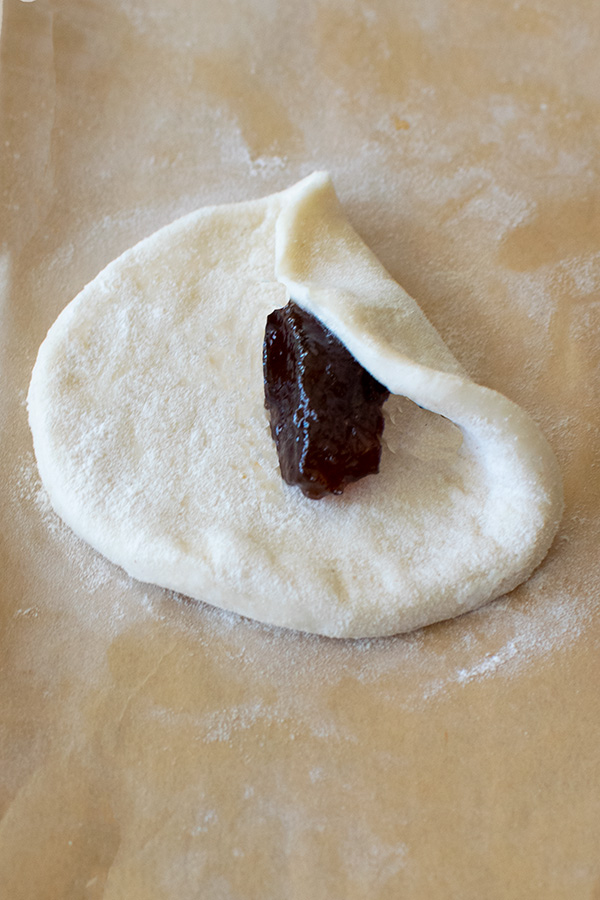
Then fold over another ⅓ from the edge toward the middle.
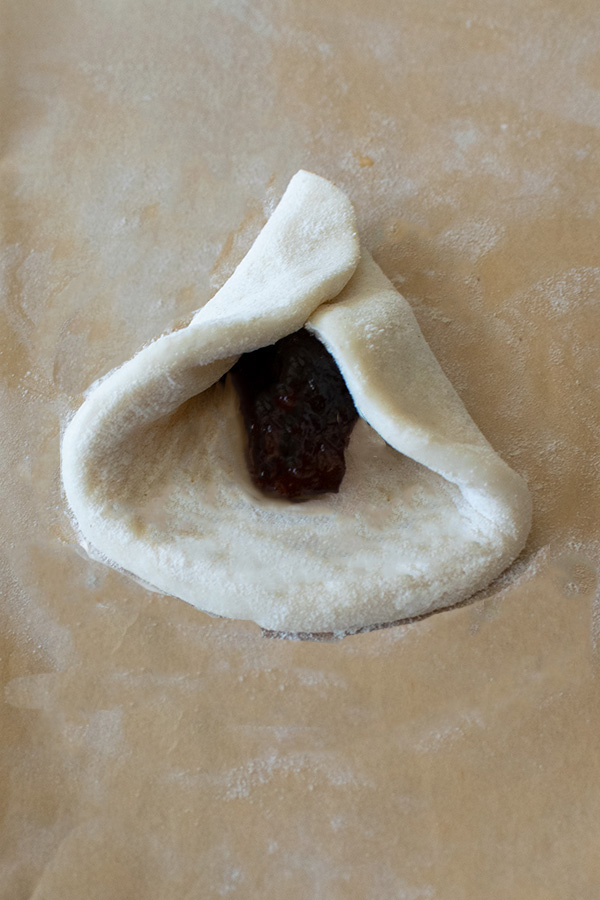
Then fold the last ⅓ toward the middle and tuck one side under, so each fold has one side exposed and one side under another.
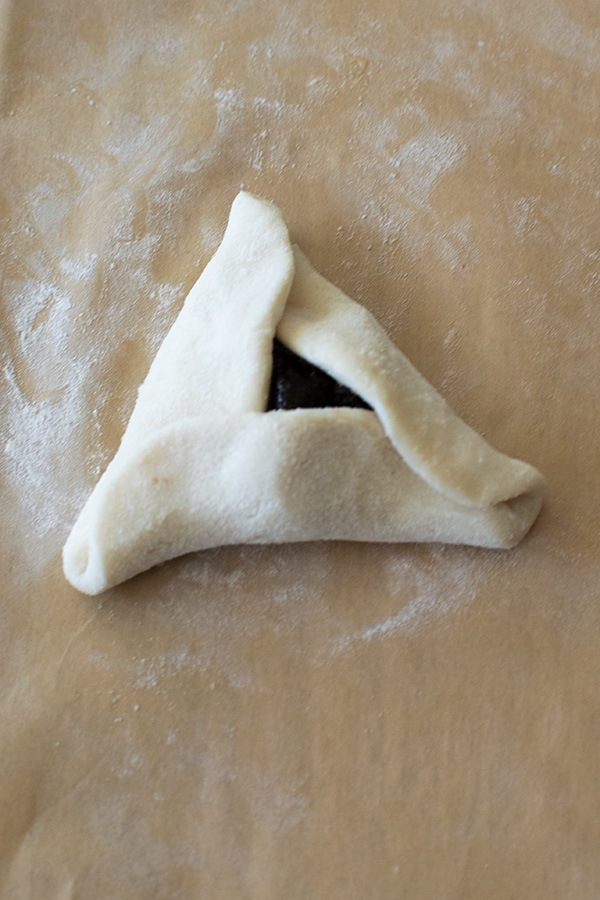
...and voila! That's it!
Baking and Dessert Pantry Essentials
I never know when someone in my family is going to want a dessert at home, to bring it to a friend's house, or for an event, so I like to make sure I can bake anything with very short notice. To that end, I keep a variety of supplies and ingredients in the house that will allow me to do just that.
Besides equipment, such as a mixer, mixing bowls, utensils, etc., I always keep these ingredients in my kitchen:
- flour
- white granulated sugar
- brown sugar (light/dark-I usually keep dark)
- confectioners' sugar (powdered sugar)
- salt
- baking powder
- baking soda
- cocoa powder
- ground cinnamon
- ground nutmeg
- ground ginger
- ground cloves
- baking chocolate
- chocolate chips
- instant dry yeast
- vanilla and/or vanilla sugar
- cooking oil/cooking spray
- margarine or butter
- eggs
- honey
- instant coffee
- various extracts (real or imitation)
I also make sure that I have the following on hand to be able to make a variety of fillings, frostings, and toppings:
- whipping cream
- powdered pudding mix
- powdered sugar
- a good chocolate spread
Then, there is the following to make last-minute quick desserts:
- packaged pie dough or ready-made pie crusts
- puff pastry dough
Lastly, it's not a bad idea to keep fun toppings, such as chopped walnuts, raisins, and the oh-so-important container of sprinkles.
Frequently Asked Questions (FAQs)
What is the difference between dairy-free margarine and vegan butter?
Vegan butter and margarine have similarities. In fact, all vegan butter is a type of dairy-free margarine. The difference between them is in the content and the baking performance.
Vegan butter is made from fats such as coconut oil, shea butter, or cocoa butter and behaves like butter in that it creates more flaky and crisp textures and has a toasted nutty flavor, while margarine is typically made with the less expensive vegetable oils.
What is the difference in using oil vs butter or margarine?
Both margarine and butter are solid fats at room temperature, and both contain more saturated fats than oil.
While margarine and butter will change from a solid to a liquid when heated, they will change back to solids when cooled again. Oil stays liquid at all temperatures. Oil also coats flour better in the preparation process before baking.
Butter "creams" better than margarine, but one cannot cream oil at all.
When converting a recipe from butter or margarine to oil, the general conversion rate is 1 to ¾ (although if you are doing more than one batch, you might need to reduce the oil because I have found that baked goods come out oily in this case).
And when converting from oil to margarine or butter, typically the ratio is 1 to 1¼.
What is the difference between real vanilla extract and imitation vanilla?
Real vanilla is made from soaking vanilla beans in alcohol, imitation vanilla is synthetic, and real vanilla costs quite a bit more than imitation. Whether or not there will be a taste difference in your baking depends on the baked good, so do some research before you decide.
I personally always use the imitation as long as I have a really good brand because it's not worth it to me to spend the extra money.
What do eggs do in baking?
Eggs are made up of two parts: the whites and the yolks (the yellow).
Egg whites are made up of protein that sets when heated and helps baked goods hold their structure. The yolks are made up of fats and vitamins and help ingredients bond.
Eggs also help baked goods rise as well as keep them moist.
It is important to have the right amount of eggs when baking, because if there are too many eggs in a recipe, this can cause a rubbery, dense texture, and if there are too few eggs, this can cause a crumbly, dry texture.
The different parts of the egg will provide different textures to baked goods; using the entire egg in baking will provide moisture and help the baked good rise evenly, using extra yolks will create richer, denser textures, and extra whites will add fluffiness but may create a drier texture.
Easy Oil-Based Hamantaschen Recipe
Easy and delicious, dairy-free hamantaschen.
Ingredients
- 3 cups all-purpose flour
- 1 cup white sugar
- 1 teaspoon baking powder
- ½ teaspoon salt
- 3 eggs
- ⅓ cup oil
- 1 tablespoon vanilla
- filling of your choice
Instructions
- Whisk together flour, sugar, baking powder, and salt together in a mixing bowl.
- Add eggs, oil, and vanilla.
- Mix or need until the dough is soft but not sticky similar to Play-Doh (if it is too sticky, add a little more flour at a time until you reach the proper consistency).
- Roll out the dough to a thickness of approximately ⅛ inch.
- Using a cookie cutter or other round object (like a glass), cut out 3" circles (you can cut larger ciricles - the larger the circle, the larger the Hamentashen and the more filling you will need for each one).
- Place ½ teaspoons to 1 teaspoon of your filling of choice in the center (note that if the filling does not have a thick consistency - such as jelly--it will run over the sides if you overfill it).
- Fold the circle over ⅓ at a time to create a triangle. *
- Place the hamantaschen on a baking sheet that has been well greased or lined with parchment paper.
- Place in an oven that has been preheated to 350°F or 175°C.
- Bake at 350°F or until they turn a light gold color.
- Let cool (if any of your filling doesn't have a thick consistency, it will be loose when you take it out of the oven, but will solidify as it cools).
Notes
* To fold, take one third of the circle's edge and fold it toward the middle. Then, take another third and do the same (they should overlap a bit). Then, take the last third, fold it toward the middle and tuck one side under, so each of the thirds has one side in the open and one side tucked under another side. The amount of fold will depend on how much filling you want showing.
(see the photos in the post)
Nutrition Information:
Yield:
12Serving Size:
1Amount Per Serving: Calories: 335Total Fat: 17gSaturated Fat: 3gTrans Fat: 3gUnsaturated Fat: 13gCholesterol: 47mgSodium: 148mgCarbohydrates: 41gFiber: 1gSugar: 17gProtein: 5g