Easy Beef Chow Mein is a budget-friendly recipe of tender beef strips and stir-fried noodles in a flavorful, savory sauce without pork, dairy, or oyster sauce (so, no shellfish).
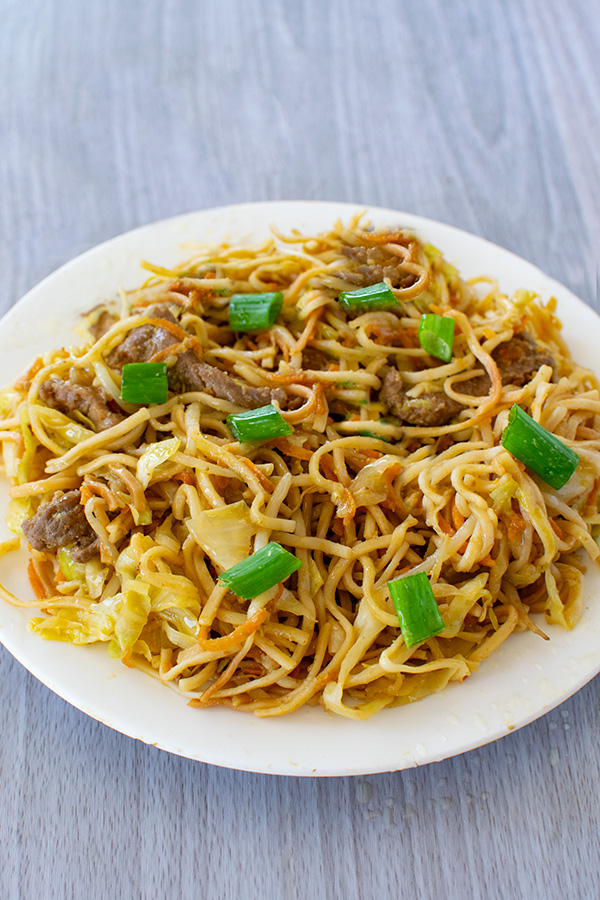
Chinese-American homemade takout!
Beef chow mein is a delicious Chinese-American beef dinner, and this is a simple dish that takes less time than normal takeout delivery.
And this budget-friendly recipe doesn't use any pork, dairy, or even oyster sauce (so no shellfish) in the ingredients. So, it makes a quick and flavorful meal for a variety of diets, including kosher, on busy weeknights.
Also, beef has health benefits!
What do you need to make this beef chow mein recipe?
I hardly ever meal plan, so I like to keep a cupboard full of seasonings, spices, veggies, and canned goods in my kitchen to use whenever the mood strikes.
And this is certainly true for Chinese-American homemade takeout recipes and these the ingredients you need to have on hand to make this recipe even last minute!
steak beef
coleslaw mix
soy sauce
granulated garlic
brown sugar
chow mein or ramen noodles
bean sprouts (optional)
oil for frying
Frequently Asked Questions (FAQs) for Beef Chow Mein
1. Does this recipe contain dairy, fish, or pork?
No. This recipe is strictly dairy-free, fish-free, and pork-free, making it perfectly suited for those who don't eat those foods or for people who follow kosher dietary laws.
2. What is the difference between Chow Mein and Lo Mein?
While both use similar sauces, Chow Mein typically features stir-fried vegetables (like the coleslaw mix used here), which provide a distinct crunch.
3. Can I use a bagged coleslaw mix for the vegetables?
Yes, it is a perfect time-saver. The pre-shredded cabbage and carrots in a coleslaw mix hold their texture well during the quick stir-fry process, providing an authentic look and crunch without the need for extensive chopping.
4. What is the secret to getting the noodles perfectly textured?
If using ramen or chow mein noodles, do not overcook them in the boiling water. If you toss them with a little oil it will help prevent them from sticking together.
5. Can I add extra crunch to this dish?
Absolutely. Adding fresh bean sprouts right at the end of the cooking process adds a signature, crisp finish that pairs perfectly with the tender beef and the soft, savory noodles.
6. Can I freeze leftovers of this dish?
Yes, you can freeze beef chow mein in an airtight, freezer-safe container for up to 2 months. Note that the noodles will soften during the freezing and reheating process.
While you can reheat it in an oven at 350°F (175°C) until heated through-covering it with foil to prevent the noodles from drying out-a wok or frying pan is generally preferred to better maintain the texture and crispness of the dish.
So, for the best results, reheat the dish in a wok or frying pan over medium heat with a splash of water or oil to help loosen the noodles and may restore some of their original texture.
A little about Chinese-American Food
Chinese-American cuisine is a style of Chinese cuisine that was developed by Chinese immigrants.
These dishes significantly differ from traditional Chinese dishes because Chinese-American dishes were adapted to suit American tastes.
Chinese immigrants arrived in the United States in large numbers in the mid-19th century in order to escape the economic difficulties in China, hoping to find work during the California Gold Rush and on the Central Pacific Railroad.
They mostly settled together in ghettos, individually known as Chinatowns, and-since there were laws preventing them from owning their own land-they opened their own businesses, such as laundry services and restaurants.
Initially, the family-owned businesses catered to miners and railroad workers, and restaurants were set up in places where Chinese food was unknown. Food was based on the requests of the customers, and recipes were created to suit American tastes using whatever ingredients were available.
One major difference between traditional Chinese cuisine and Chinese-American cuisine is in the use of vegetables. Chinese-American recipes will use raw or uncooked ingredients and those not native to China. Traditional Chinese cuisine, on the other hand, rarely contains raw or uncooked ingredients and often uses Asian leaf vegetables.
While the new dishes were not traditional Chinese, these restaurants were responsible for the development of the ever-popular Chinese-American cuisine.
The little history of kosher Chinese-American Food
It is well known that Jews (especially those with ties to New York) love Chinese food. You can find at least one and, more often than not, several kosher Chinese restaurants in predominantly Jewish cities. In the town of Cedarhurst, New York, for example, there are TWO within a couple of blocks that have been around for years!
Jews as a group were probably first introduced to Chinese food in the Lower East Side of Manhattan, where immigrants of various cultures settled in their own neighborhoods in the late 1800s and early 1900s.
By the early 1900s, approximately one million Jews from Eastern Europe shared the Lower East Side of Manhattan with around half a million Italians, but only approximately 7,000 Cantonese Chinese, most of whom had moved from California after the gold rush.
Due to anti-Chinese laws and acts in the US at the time, which prevented them from competing with whites, many Chinese opened restaurants. Many started by providing food to miners and then took their businesses with them when they moved across the country.
The majority of Jewish immigrants at that time were observant in their religion and ate only kosher food when they arrived in New York. But, over time, many assimilated and would eat at the Chinese restaurants, especially on Sundays when these restaurants were open.
Having been raised with what is forbidden, these Jews seemed to feel that if they couldn't tell it was non-kosher, it wasn't that bad, even if it contained pork or non-kosher seafood. The attitude seemed to be, if I can't see it, it won't kill me.
But the Jews who did keep kosher had to wait until one created Jewish, kosher deli owner-Sol Bernstein-found a solution. Using Cantonese Chinese recipes, Sol substituted kosher veal, beef, and chicken livers for pork and began selling the first kosher Chinese food at his deli-Shmulka Bernstein's, named after his father's butcher shop.
The food-and thus the deli-became very popular and everyone knew Schmulka's deli. The deli continued to prosper until he died in 1992, when it was sold.
Homemade takeout recipes!
If you love Chinese-American food, but can't find it kosher or otherwise just pork free, you should try these homemade takout recipes!
- Duck Sauce Chicken
- Pepper Steak
- Mongolian Beef
- Corned Beef & Cabbage Egg Rolls
- Vegetarian Fried Rice
- Beef Lo Mein
- Beef and Broccoli
- Beef Chop Suey
Easy Beef Chow Mein Recipe
Delicious and simple Chinese-American beef and noodles dish made without pork, dairy, or oyster sauce!
Ingredients
- 12 ounces steak beef (such as ribeye, sirloin, or meat that cooks quickly), sliced into thin strips
- 6 cups coleslaw mix*
- ¼-1/3 cup soy sauce, to taste (based on desired level of flavor)**
- 1 tablespoon granulated garlic
- 1 tablespoon brown sugar
- 6 ounces chow mein or ramen noodles
- 6 ounces bean sprouts (optional)
- oil for frying
- water
Instructions
- Coat the bottom of a frying pan with 2-3 tablespoons of oil and heat on medium-low.
- Add noodles to the pan and lightly fry.
- Add soy sauce, beef strips, granulated garlic, brown sugar, coleslaw mix, and bean spouts, if using, and mix.
- Slowly mix in one cup of water. Cook for several minutes, until the noodles, shredded coleslaw (and bean sprouts) have softened. Add a little more water if needed to keep from drying out before the mixture is cooked.
Notes
*You can use the equivalent of freshly shredded cabbage and carrots.
**Add ¼ cup and then add more as needed. If you add too much, even out with a little more water.
Nutrition Information:
Yield:
4Serving Size:
1Amount Per Serving: Calories: 483Total Fat: 25gSaturated Fat: 8gTrans Fat: 1gUnsaturated Fat: 14gCholesterol: 88mgSodium: 1485mgCarbohydrates: 33gFiber: 5gSugar: 8gProtein: 33g