Classic Cholent, made with beef, beans, barley, and potatoes, is a simple recipe for the traditional and delicious Sabbath stew.
With 7 ingredients, this one-pot meal is easy to make using those 5 main staples plus a little tomato paste for color and chicken soup powder for that perfect savory flavor.
Whether you call it cholent, chulnt, or hamin there’s nothing like the aroma of this warm and inviting dish that has been warming overnight and has filled your home.
While this is a simple and basic recipe, cholent itself has many variations based on culture and personal or family preferences, including adding kishke, hard-boiled eggs, jachnun, various spices, and much more.
So, feel free to add what you like and make it your own.
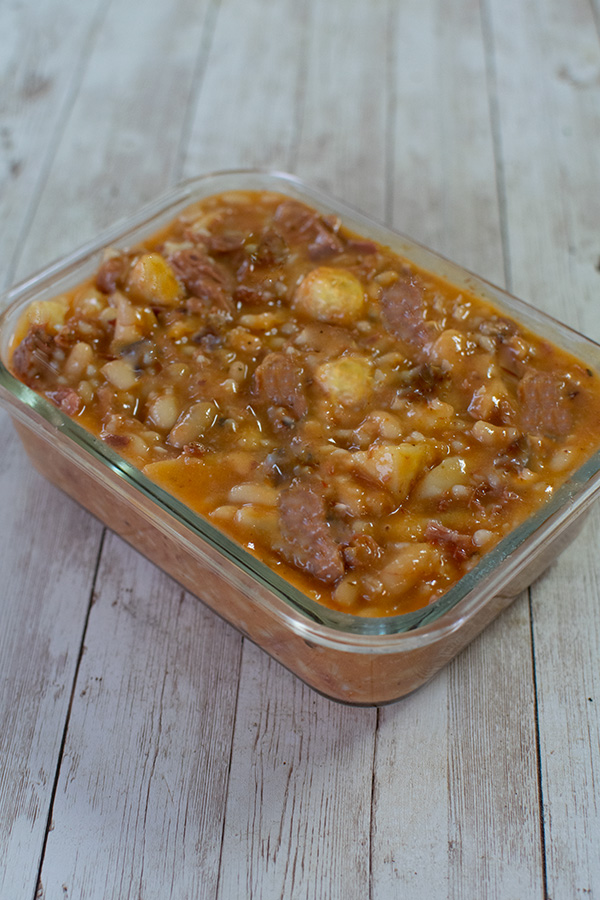
Cholent is believed to have been developed centuries ago and possibly as far back as the Second Temple period and is a favorite at shabbat lunch in many Jewish homes, no matter what the season.
Since cooking is forbidden on the Sabbath, the stew must be fully cooked before the Sabbath begins on friday late afternoon or evening (depending on the time of year) but it then sits in a slow cooker or oven or on a hotplate overnight to soften as the juices and flavors combine into a delicious stew that is eaten on Shabbat afternoon.
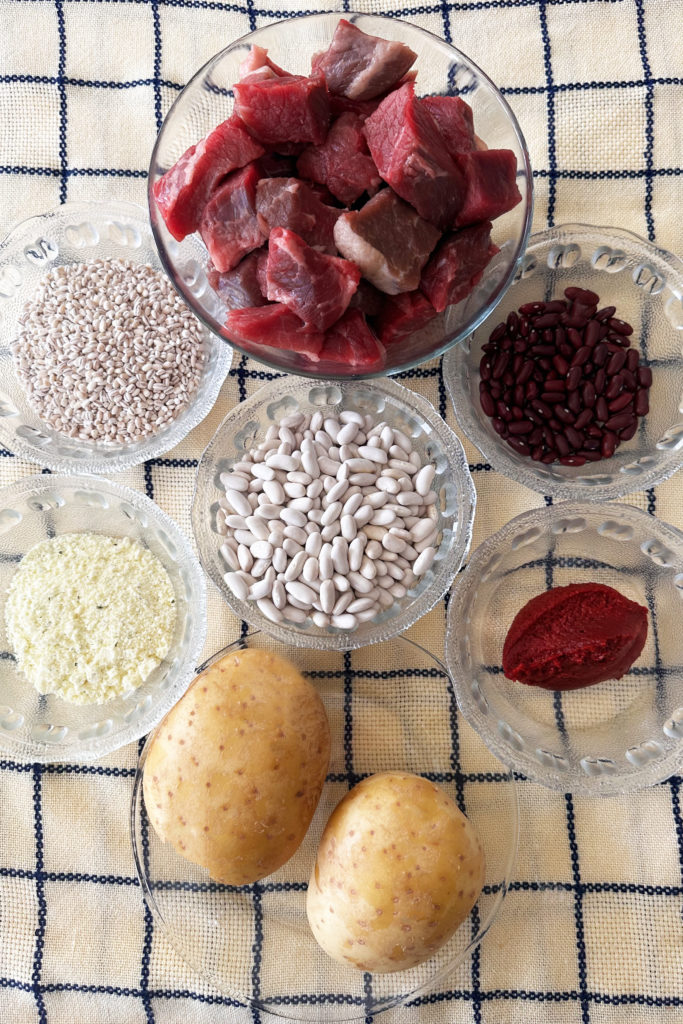
This classic cholent recipe is simple and basic, with only the 5 main ingredients: meat, 2 types of beans, barley, and potatoes.
And, while MY family eats it this way (except that in recent years one of my sons has been asking me to add pieces of jachnun, so I do), you can just use it as a guide, if you wish.
Most families have their own variation base on culture or personal preferences and will add ingredients or flavor that others won’t. Also, some like it thick and some like it more saucey – like my family does.
While I only flavor my cholent with chicken soup powder to make it deliciously savory and I add little tomato paste mostly for color, others use a variety of spices.
Some people include TONS of ingredients in their cholent recipes (I counted 16 ingredients in the recipe of one blogger!). However, just because a recipe may be one family’s tradition doesn’t make it a “traditional” Jewish recipe.
Sephardim or Mizrahim often use rice or wheat kernels and chickpeas instead of the beans and barley. Some people use chicken instead of beef or sweet potatoes instead of regular (or both). Many add hard-boiled eggs (which turn a shade of brown overnight) or kishe.
Sometimes, cholent will stick to the bottom of the pot and get dark and a little hard, and for some people it’s their favorite part.
Two of my sons add hot sauce to spice it up and two others like it with black pepper (it’s not the way I make it but they’ve had it elsewhere).
One interesting thing about cholent is that no matter how you like to eat it, it’s specifically a shabbat food. No one seems to ever make it to be eaten during the week. My family won’t even eat it after shabbos (as leftovers), even thought it’s still perfecty fine, because it just doesn’t have that “shabbat” taste.
Those who don’t want to make it, buy it in Jewish/kosher eateries (at least in NY). Those same places will often put it on their menus on Thursday nights and many people will make it a point to go out to eat it.
There seems to be an ongoing argument about whether or not cholent (Yiddish) and hamin (Hebrew) are the same or if one must have (or can’t have) certain ingredients for it to be one or the other. Or that one is Ashkenazi and the other is Mizrahi.
First of all, especially in Israel, people from different cultures adopt food ideas from one another, so there can be quite a bit of overlap in ingredients and second, I make my cholent in a way that some would call Ashkenazi, however I got my recipe a long time ago from my ex-mother-in-law who is of Syrian descent.
So, that should settle it.
Besides being simple and delicious, the ingredients (meat, barley, kidney beans and navy beans, and potatoes) in Classic Cholent have nutritional benefits.
I kind of wing it at this point since I have been making cholent for many years, however here are some of things you should take note of (they are also on the recipe card).
1) If you use less water while heating overnight, then your cholent will be thicker. If it gets too thick, you can add water from your urn (that has been plugged in from before shabbat), but ask your own rabbinic authority regarding how to do this.
2) The ingredients need to be “just cooked” and not soft (that will happen overnight).
3) Many people soak the beans overnight or at least for several hours, but I don’t bother. I just boil them until I can stick a fork through. Mostly, though, I use a pressure cooker to cook my beans, barley, and meat. It usually takes me around an hour and a quarter.
4) I like to wash off my ingredients after cooking to remove the starch, but you can skip this part. The important thing is to have enough water for the cholent ingredients to get soft over night.
5) The heat overnight should be enough to keep it hot (warm isn’t enough), but not burn. I keep my cholent on the edge of my hotplate (where it is hot, but less than the middle) or on low in my slow cooker, but not all of them work the same. You have to know yours.
Can I freeze classic cholent?
I would say yes, definitely.
However, when I froze it with the potatoes, I found that they got mushy. This may not be a problem for everyone, but my family certainly didn’t like them.
Since I make cholent regularly in the winter, to save time I make a couple of recipes ahead of time without the potatoes (ie meat, beans, and barley), and freeze (in freezer bags, normally 1/2 of a recipe per bag). Then, on Friday, I defrost the quantity I am going to need, add chunks of cooked potato, and then place in my slow cooker or on my hotplate before shabbat.
So, the bottom line is that this cholent can be frozen, but I personally wouldn’t do it with the potatoes.
Some clarification about cooking terms:
What does it mean when recipes say “to taste” about an ingredient?
When recipes say “to taste,” it means that you can put in as little or as much as you like to your own taste. Some recipes have many ingredients that a cook can adjust to their own taste when cooking (not so much when baking though).
The best way to calculate what your taste is with a recipe that you are not yet familiar with is to first taste the dish and then add the “to taste” ingredient GRADUALLY, a little at a time—a splash of this or a pinch of that—until the dish is just the way you like it. Make sure to stir the ingredient after each time you add it so that the flavor will distribute evenly and become part of the dish. Then taste again. Repeat until you reach your personal preference.
Note: If you plan on using the recipe again, it is highly recommended to make a note of what and how much you added so that you can refer to it next time.
What does it mean when a recipe says that an ingredient is “optional”?
If an ingredient is “optional,” it means that you can add it in or not based on your own preference. An optional ingredient can be flavor related (i.e., salty, sweet, spicy, etc.), appearance related (garnish), or even something like nuts or chocolate chips in baking.
What does “savory” mean?
“Savory” refers to foods that are not sweet, such as foods that taste salty, spicy, or herbal.
Everyday pantry essentials to keep in your kitchen (suggested)
While not all of these essentials will be relevant to this particula recipe, I have found that this list of “essentials” are great to always have on hand in my kitchen and have saved me numerous sudden trips to the store or having to borrow from a neighbor.
While this is my comprehensive list based on my cooking needs, you should definitely make your own based on yours.
Utensils:
- Measuring cups for liquid
- Measuring cups for solids (flour, sugar, etc.)
- Measuring spoons
- Mixing bowls
- Kitchen scale
NOTE: When using measuring cups and spoons, make sure that the measurements are comparable to one another (example: that 4 tablespoons equals 1/4 of your measuring cup). You’d be surprised to know that not all measuring cups are the same, and this can throw your measurements off.
Seasoning and flavoring:
- salt (my recipes use regular table salt)
- ground black or white pepper
- granulated garlic or garlic powder (I prefer granulated)
- onion powder
- sweet paprika and/or sweet pepper flakes (paprika is ground dried red pepper, pepper flakes are crushed dried red pepper)
- hot paprika, hot pepper flakes, or cayenne pepper (moderately spicy dried ground chili pepper) for those occasional spicy dishes
- ground turmeric
- ground cumin
- ground cinnamon
- ground ginger
- ground nutmeg
- ground cloves (for pumpkin flavors)
- sugar (granulated)
- brown sugar
- chicken consommé powder / beef bouillon powder (regular or vegetarian)
- onion soup mix
- onion flakes (substitute for fresh onion—3 tablespoons for 1 medium onion).
- various herbs
- additional spices to adapt taste to preference
Misc:
- oil / margarine / butter / cooking spray
- coconut cream as a dairy-free cream substitute
- flavorless milk substitute as a dairy-free milk alternative
- cornstarch as a thickening agent
- flour
- baking powder
- baking soda
- bread crumbs or cornflake crumbs (you can make these with your blender or food processor) for coating
- condiments, such as ketchup, mustard, barbecue sauce
- tomato sauce/tomato paste/canned tomatoes—diced or crushed/pasta sauce
- soy sauce (makes a great flavoring for savory foods)
- ready-made pie crusts and dough (to just add filling)
We always have eggs in the fridge and onions, rice, and potatoes on our shelves, as well as pasta.
In addition, having some fresh vegetables in the fridge, such as carrots, celery, tomatoes, bell peppers (various colors), etc., can be very useful when putting together a quick but delicious meal.
It is also a good idea to have some ground meat or chicken (breast, ground, or in parts) in the freezer for anyone who likes meat dishes in a snap.
Weather can have an effect on some of the spices and on the chicken consommé powder, so I keep as many of the seasonings in the refrigerator or freezer as I can, and I keep everything tightly closed in containers (you will be surprised to know just how determined moths are at getting into sealed bags and how hot red pepper powder can attract little black bugs—YUCK!).
Therefore, store your items properly.
Want to try another popular Shabbat dish? Try Easy Jerusalem Kugel
And don’t forget the challah! Easy Fluffy Challah Bread and Fluffy Water Challah Bread (which contains no eggs).
Easy Classic Cholent (Traditional Jewish Sabbath Stew)
Classic, simple, warm, and delicious Sabbath stew in basic form.
Ingredients
- 1 1/2 - 2 pounds stew beef, cut into 1 1/2" x 1 1/2" pieces or as desired
- 1 1/4 cups white/navy beans
- 1/4 cup red/kidney beans
- 3/4 cup barley
- 2 large (or equivalent) potatoes, peeled (or not), cut into approximately 1 - 1 1/2 inch chunks)
- 3 tablespoons tomato paste
- 3 tablespoons chicken soup powder or to taste
- Other spices to taste (pepper, hot pepper, etc.)—optional.
Instructions
- Place beans, barley, and beef in a suitable size pot.
- Cover with enough water so that it is 3-4 inches above the contents (ie enough water to cook everything without boiling out).
- Boil beans, barley, and stew beef for around 2 hours (add more water if needed) or until you can just stick a fork through the beans.
- Add the potato chunks and cook (add water if need be) for approximately 15 minutes or until you can just stick a fork through.
- Pour out excess water, rinse, and refill with fresh water that is approximately 3 inches above the ingredients in the pot.
- Mix in tomato paste, and chicken consume powder (and other spices if desired).
- Bring to a boil before you are ready to place on the hotplate or in the slow cooker.
- Leave on hot plate or in covered slow cooker overnight.
- If the top gets a little dry, mix before serving.
- (SEE NOTES)
Notes
1) Feel free to change the ratios of the beans or barley or add more potatoes, as desired.
2) If you use less water while heating overnight, then your cholent will be thicker. If it gets too thick, you can add water from your urn (that has been plugged in from before shabbat), but ask your own rabbinic authority regarding how to do this.
3) The ingredients need to be "just cooked" and not soft (that will happen overnight).
4) I use a pressure cooker to cook my beans, barley, and meat. It usually takes me around an hour and a quarter.
5) I like to wash off my ingredients after cooking to remove the starch, but you can skip this part. The important thing is to have enough water for the cholent ingredients to get soft over night.
6) The heat overnight should be enough to keep it hot (warm isn't enough), but not burn. I keep my cholent on the edge of my hotplate (where it is hot, but less than the middle) or on low in my slow cooker, but not all of them work the same. You have to know yours.
Nutrition Information:
Yield:
8Serving Size:
1Amount Per Serving: Calories: 193Total Fat: 5gSaturated Fat: 2gTrans Fat: 0gUnsaturated Fat: 3gCholesterol: 75mgSodium: 64mgCarbohydrates: 9gFiber: 2gSugar: 1gProtein: 27g