Easy Dairy-Free Chewy Brownies is a simple recipe for delicious chewy brownies, made with basic pantry ingredients, without butter, milk, or margarine, and with zero dairy.
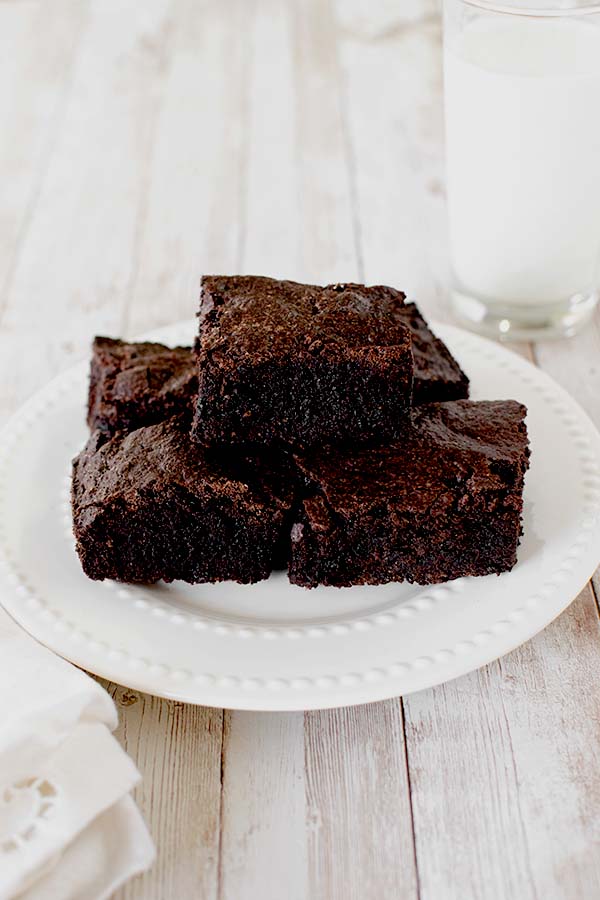
Easy Dairy-Free Chewy Brownies are simple to make and deliciously chewy.
Made with basic pantry ingredients, you just mix, pour, and bake.
This recipe uses oil, so it's made without butter or margarine.
They make a terrific dessert to bring to a summer picnic, backyard barbecue, or potluck with friends, and they make a cozy snack anytime.
Have them with your favorite cold drink when it's hot out or with coffee or cocoa on a cold day while you're wrapped in a blanket.
Plus, they're customizable, so feel free to fold in dairy-free chocolate chips or chopped walnuts for an extra layer of texture and rich flavor.
And cocoa powder has nutritional benefits!
Frequently Asked Questions (FAQs) for baking:
Why do recipes have salt in the ingredients of baked goods?
Even though salt tends to make foods, well, salty, it actually plays other roles in baking as well.
For example, the right amount of salt balances flavors in baked goods; it can bring out the sweetness of sugar and, at the same time, prevent them from tasting overly sweet. It also can help dull the bitterness of cocoa.
Salt prevents baked goods from tasting bland, while it balances the richness of the fats. It also helps develop flavor in yeast breads and works with proteins to strengthen gluten and make it more elastic.
Salt also slows down yeast fermentation because it prevents the yeast from eating up the sugars too quickly, which otherwise would cause the dough to rise too fast and then ultimately collapse, causing bread to come out flat instead of fluffy.
Salt helps baked goods stay a little fresher for a little longer and helps delay mold from growing on them.
What is the difference between white granulated sugar and brown sugar?
The short answer is that while white granulated sugar is just pure sweetness, brown sugar is white sugar with molasses mixed into it.
Here is how that change affects your baking:
- White sugar is neutrally sweet. Brown sugar tastes like rich caramel or toffee.
- White sugar makes things crisp and light. Brown sugar traps moisture, making baked goods (like brownies) dense, soft, and extra chewy.
- Brown sugar is dark and wet; white sugar is dry and clear.
Tip: If a recipe calls for brown sugar and you're completely out, you can make your own by thoroughly mixing a tablespoon of molasses into a cup of regular white granulated sugar, and that will give you light-brown sugar. If you want dark brown sugar, you need to mix in more molasses.
Can I substitute honey for white granulated sugar in baking?
The short answer to this question is yes.
However, there are some things to consider, because the substitution is not 1:1.
Honey is denser and contains more fructose than white granulated sugar, so it is sweeter. Also, honey contains almost 20% liquid, so adjustments must be made for these differences.
First of all, the glucose and fructose in honey make it sweeter than granulated sugar, so you would use only ¾ of the amount of sugar in the recipe's ingredients. Second, since honey already contains liquid, you should reduce the amount of liquid that the recipe calls for by 25% to maintain consistency.
Honey is also naturally acidic, whereas granulated sugar is not, so in order to neutralize the acidity you will be adding to your baking, you can add ¼ teaspoon of baking soda per cup of honey to the ingredients.
Lastly, since honey contains simple sugars that caramelize and burn at lower temperatures than granulated sugar does, you should lower the temperature by 25 degrees from that required in the recipe. This is to help prevent the outside from baking quicker than the inside of your baked goods.
Note:
There are a few additional things to note about substituting honey for sugar, though.
First, if you use honey rather than granulated sugar for baked goods that are supposed to be crispy, they will come out softer.
Second, you cannot "cream" if you replace granulated sugar with honey, so recipes that are meant to come out light because of creaming butter with sugar will come out denser.
Lastly, honey is still a sugar, and it has approximately 30% more calories than granulated sugar does (but this will be somewhat compensated by the fact that you will be reducing the quantity of honey versus sugar in the recipe).
What is the difference between baking soda and baking powder?
Baking soda and baking powder are both synthetic leavens that help baked goods rise, but there is a difference between them.
Baking soda is pure sodium bicarbonate, which needs another ingredient that is acidic in order to be activated. When the baking soda touches the acid, it creates a carbon dioxide gas, which helps the baked good rise. Baking soda is between 3 and 4 times stronger than baking powder, and if too much baking soda is used, your baked good will end up with a metallic flavor.
Baking powder is baking soda that is already mixed with an acid and a stabilizer and will be activated by moisture and heat. Nowadays, baking powder is called double-acting because it activates twice-once when it gets wet (when you mix the ingredients together) and again when it heats in the oven.
Replacing one with the other can be tricky, and it's not recommended. However, if you have no choice, then do solid research for substituting one for the other for the baked good you are preparing so you don't ruin it.
What do eggs do in baking?
Eggs are made up of two parts: the whites and the yolks (the yellow).
Egg whites are made up of protein that sets when heated and helps baked goods hold their structure. The yolks are made up of fats and vitamins and help ingredients bond.
Eggs also help baked goods rise as well as keep them moist.
It is important to have the right amount of eggs when baking, because if there are too many eggs in a recipe, this can cause a rubbery, dense texture, and if there are too few eggs, this can cause a crumbly, dry texture.
The different parts of the egg will provide different textures to baked goods; using the entire egg in baking will provide moisture and help the baked good rise evenly, using extra yolks will create richer, denser textures, and extra whites will add fluffiness but may create a drier texture.
What is the difference in using oil vs. butter or margarine?
Both margarine and butter are solid fats at room temperature, and both contain more saturated fats than oil.
While margarine and butter will change from a solid to a liquid when heated, they will change back to solids when cooled again. Oil stays liquid at all temperatures. Oil also coats flour better in the preparation process before baking.
Butter "creams" better than margarine, but one cannot cream oil at all.
When converting a recipe from butter or margarine to oil, the general conversion rate is 1 to ¾ (although if you are doing more than one batch, you might need to reduce the oil because I have found that baked goods come out oily in this case).
And when converting from oil to margarine or butter, typically the ratio is 1 to 1¼.
What is the difference between real vanilla extract and imitation vanilla?
Real vanilla is made from soaking vanilla beans in alcohol, imitation vanilla is synthetic, and real vanilla costs quite a bit more than imitation. Whether or not there will be a taste difference in your baking depends on the baked good, so do some research before you decide.
I personally always use the imitation as long as I have a really good brand because it's not worth it to me to spend the extra money.
Frequently Asked Questions (FAQs) for chewy brownies
Why do these dairy-free brownies use oil instead of butter?
Using oil instead of butter or margarine keeps these brownies dairy-free while ensuring a wonderfully moist texture. Oil stays liquid at room temperature, which contributes to a dense, fudgy, and chewy crumb without needing any dairy fats.
Can I add mix-ins to the batter?
Yes, this recipe is fully customizable. You can easily fold in dairy-free chocolate chips for extra pockets of richness or chopped walnuts for a satisfying, crunchy texture.
How should I store leftover chewy brownies?
Store your brownies in an airtight container at room temperature for up to 3 days, or keep them in the refrigerator for up to a week to maintain their moisture and chewy texture.
Can I freeze these dairy-free chewy brownies?
Yes, these brownies freeze very well. Wrap individual squares tightly in plastic wrap and place them in a freezer-safe container or bag for up to three months. Thaw them at room temperature for a couple of hours before enjoying.
Why did my brownies turn out cakey instead of chewy?
Cakiness usually happens when you over-mix the batter after adding the flour, which creates excess gluten, or if you bake them too long. To keep them chewy, mix the dry ingredients just until combined and take them out of the oven when the center is still slightly set.
Can I use coconut oil in this recipe?
You can use refined coconut oil for a completely neutral flavor. If you use unrefined (virgin) coconut oil, your brownies will have a distinct coconut taste and aroma.
Will using coconut oil add a coconutty taste to the brownies?
If you use unrefined (virgin) coconut oil, it will impart a distinct coconut flavor and aroma to your brownies.
To keep the flavor purely chocolate, try using refined coconut oil, which goes through a process to remove the coconut taste and smell while maintaining the same baking properties.
Want to try other brownie recipes?
Try:
Dairy-Free Chocolate Fudge Brownies
Dairy-Free Chewy Fudge Brownies Recipe
I eventually got the hang of baking cakes, but whether or not that is something you can do, these Easy Dairy Free Chewy Brownies are so simple, it won't even matter!
Suggested baking equipment
- a stand mixer, which I use mostly for dough and sometimes for whipping
- a hand mixer (for things that aren't dough, and I don't want to mix manually)
- a kitchen scale
- different sizes and shapes of baking pans, including loaf pans
- mixing bowls (or just large bowls-I have plastic, glass, and metal)
- cookie sheets
- pie dishes
- dry measuring cups
- liquid measuring cups
- measuring spoons
- whisks
- rubber spatulas (really good for when you don't want to leave anything in the bowl)
- rolling pins
- a baking mat for rolling out dough
- baking strips
- a good supply of baking (or parchment) paper (also round for layer cakes)
Suggested baking ingredients
- flour
- white granulated sugar
- brown sugar (light/dark-I usually keep dark)
- confectioners' sugar (powdered sugar)
- salt
- baking powder
- baking soda
- cocoa powder
- ground cinnamon
- ground nutmeg
- ground ginger
- ground cloves
- baking chocolate
- chocolate chips
- instant dry yeast
- vanilla and/or vanilla sugar
- cooking oil/cooking spray
- margarine or butter
- eggs
- honey
- instant coffee
- various extracts (real or imitation)
- whipping cream
- powdered pudding mix
- powdered sugar
- a good chocolate spread
- packaged pie dough or ready-made pie crusts
- puff pastry dough
Lastly, it's not a bad idea to keep fun toppings, such as chopped walnuts, raisins, and the oh-so-important container of sprinkles.
If you like this recipe, try these!


Is someone in your family avoiding chocolate?
Try?
Easy Dairy-Free Blondies!
Easy Dairy-Free Chewy Brownies Recipe
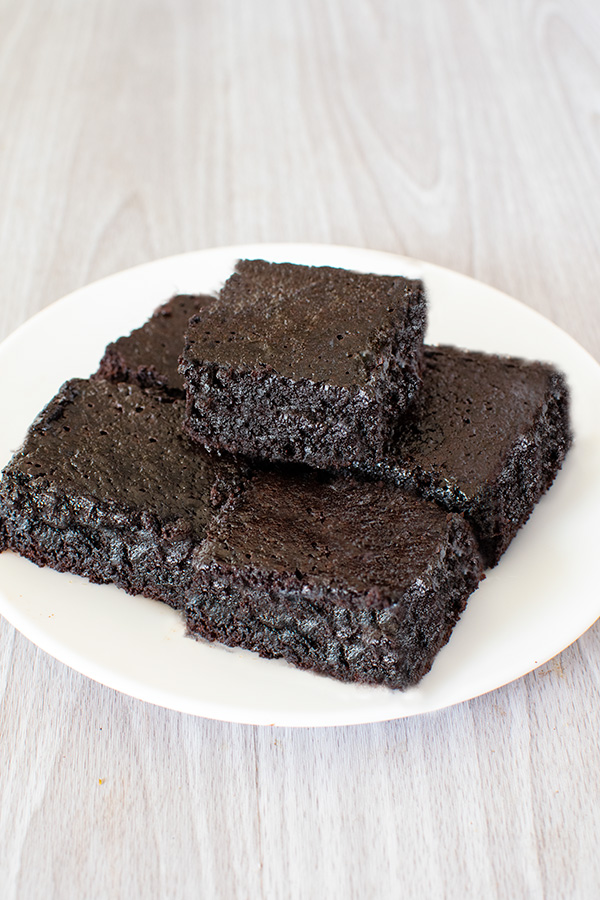
Easy and dairy-free, chocolatey chewy brownies made without milk or butter.
Ingredients
- 1 cup of all purpose flour
- ¾ cup cocoa powder
- 1 ¾ cups granulated sugar
- 3 eggs
- ¾ cup oil
- 1 tablespoon vanilla flavoring (vanilla extract - real or imitation, as long as the flavor is not weak).
- ½ teaspoon salt
- chopped walnuts (optional)
Instructions
- Whisk flour, cocoa, sugar, and salt together in a bowl.
- Add oil and vanilla flavoring and mix well.
- Add walnuts (if desired) and mix well.
- Pour into an 8" x 8" square pan that is lined with baking paper or greased well.
- Place in an oven that has been preheated to 350°F.
- Bake for approximately 35-40 minutes or until a toothpick comes out clean and the top is just firm all over.
- Let cool and cut into squares.
Nutrition Information:
Yield:
16Serving Size:
1Amount Per Serving: Calories: 240Total Fat: 12gSaturated Fat: 1gTrans Fat: 0gUnsaturated Fat: 10gCholesterol: 35mgSodium: 80mgCarbohydrates: 30gFiber: 1gSugar: 22gProtein: 3g