Moroccan-Israeli Meatballs and Olives for Passover is a flavorful and savory dish that is popular in Israeli cuisine.
Moroccan Jews brought this dish to Israel when they fled persecution in Morocco and it was integrated into Israeli food culture.
This dish is not only delicious, it's very simple to make with only 4-ingredients and one pot!
So, if you want to shake your Passover menu up a bit, this unique dish is something you'll want to try!
It's a basic recipe, so feel free to customize it!
Have it alone or over mashed potatoes. Or, if you eat kitniyot, it's fantastic over rice!
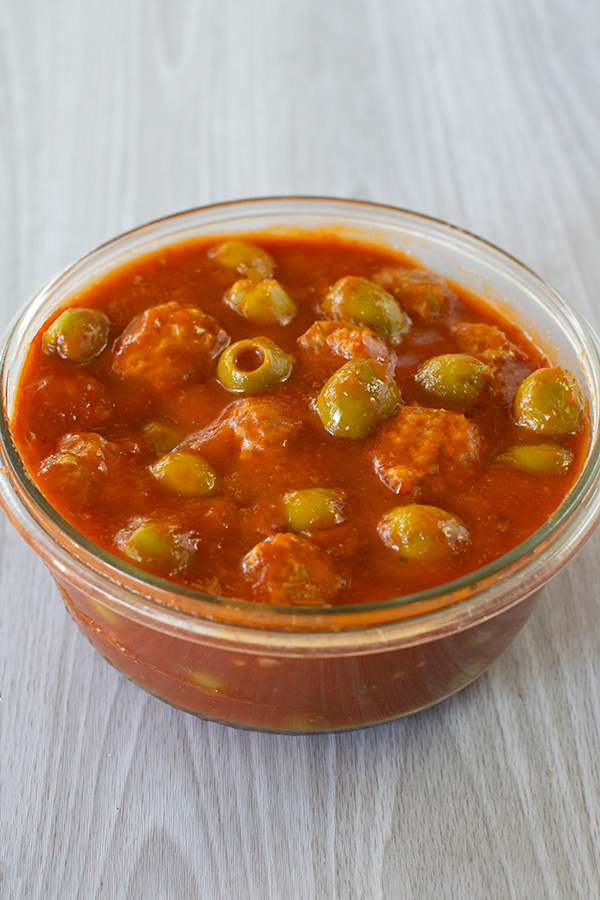
Moroccan-Israeli food is incredible and this dish is no different!
The flavors of meat, sauce, and briny olives come together in a delicious and savory dish.
It's so easy to make with only 4-ingredients in one pot!
And it refrigerates well, so you can make ahead.
This dish will bring some uniqueness to any Passover table!
And since there is no matzo in the dish, you can eat it on the day of the seder!
Eating on the day of the seder
Jews who keep the laws of Passover do not eat matzo or any foods that contain anything from matzo (such as matzo meal or matzo cake meal) the entire day before the seder, which is in the evening.
Some people even have the custom of not eating such foods for two weeks before, beginning on Rosh Chodesh Nissan or even as far back as Purim, which is a month before.
Keeping essential ingredients in your pantry
As I learned to prepare more and more recipes for Passover, I also learned which basics and seasonings are good to have on hand to have the ability to make a dish on short notice-especially during the holiday-and not have to run out to the store or borrow from a neighbor.
While I will admit that I am not always prepared when one of my kids will ask for eggplant parmesan or something at the drop of a hat (which they have done), I dislike having to postpone making something just because the ingredients needed to make a reasonable meal were not readily available.
So, I maintain a selection of what I consider "kosher for Passover pantry essentials" in my refrigerator and on my shelves during the week of Passover (some of the dry goods I keep from year to year, stored well).
While, of course, most of the essentials will not be needed just for any one recipe, at least some of them are needed for most recipes, and you would be surprised how many recipes can be made just with this list. So, if you make sure to have whatever you use regularly on hand, it can really save you time and effort.
Everyone has their favorite recipes, preferred seasoning, and just whatever they like to use to cook. Your own list should certainly reflect your own cooking tastes and style. Just make sure that everything is Kosher for Passover (or KLP-Kasher L'Pesach, in Hebrew) and if you are Ashkenazi, that list will be shorter than if you are not.
Make sure to check with a qualified rabbi if you have any questions.
Example of seasonings to have on hand
- salt
- ground black or white pepper
- granulated garlic or garlic powder
- onion powder
- paprika
- ground cinnamon
- sugar (granulated)
- brown sugar
- chicken consommé powder
- onion soup mix
- various herbs
- additional spices to adapt taste to preference
Food on Passover
Torah-observant Jews do not eat chametz (the fermented products of five grains: wheat, spelt, barley, oats, and rye).
In addition, Torah-observant Ashkenazi Jews do not eat kitniyot (or kitniyos as pronounced in Ashkenazi Hebrew). These include legumes, corn, rice, and similar foods that were deemed forbidden to eat by rabbis in the medieval period and are still not eaten today. Sephardi and Mizrachi Jews do not follow this tradition.
Many observant Ashkenazi Jews will not even eat the derivatives of these kitniyot, while others do (each family holds their own traditions regarding this).
Then, there are Ashkenazim who don't eat "gebrokts" (or gebrochts).
Gebrokts (gebrochts) means "broken" in Yiddish, and in this case refers to matzo that has absorbed liquid. Not eating gebrokts is observed by many in the Hasidic Jewish community and Ashkenazim who have taken on this tradition, where they basically don't mix anything wet with matzo.
So, things like matzo sandwiches, fried matzo, and even matzo balls are a no-no for them.
There is a joke that sums it all up:
On Passover, we should remember people who have little to eat on this holiday. They are called Ashkenazim.
Over the years, I have learned to adapt "normal" food for Passover so that my family won't complain about boring, tasteless, or repetitive meals.
I find that having good food and variety makes the week of Passover a very pleasant experience, and I hope this recipe will help make yours just that!
What does it mean when recipes say "to taste" about an ingredient?
When recipes say "to taste," it means that you can put in as little or as much as you like to your own taste. Some recipes have many ingredients that a cook can adjust to their own taste when cooking (not so much when baking though).
The best way to calculate what your taste is with a recipe that you are not yet familiar with is to first taste the dish and then add the "to taste" ingredient GRADUALLY, a little at a time-a splash of this or a pinch of that-until the dish is just the way you like it.
Make sure to stir the ingredient after each time you add it so that the flavor will distribute evenly and become part of the dish. Then taste again. Repeat until you reach your personal preference.
Note: If you plan on using the recipe again, it is highly recommended to make a note of what and how much you added so that you can refer to it next time.
What does "savory" mean?
"Savory" refers to foods that are not sweet, such as foods that taste salty, spicy, or herbal.
A little about Israeli cuisine
Some people complain about cultural appropriation in cuisine when food from one country is attributed to another country.
However, national cuisine in itself is often a mingling of food from a variety of cultures, often due to a change of ruling countries and a shifting of borders.
When people move from country to country, they will take their cultures with them, and their descendants may adapt their traditional cuisine with that of their new home.
Recipes are passed from generation to generation, and although decades have come and gone, the foods are still known by the culture they came from, and everyone seems to have their own way of making them.
When one lives in a melting pot, such as the US or Israel, it is just unrealistic to expect that food from a particular culture won't mingle with that of other cultures.
"Israeli cuisine" is mostly Middle Eastern (as opposed to Eastern European food) that was brought to Israel by Jews when they fled or were expelled from Muslim countries and moved to Israel mostly after the declaration of the State of Israel (collectively known as Mizrahi Jews).
That said, there are many variations of pretty much any "Israeli" recipe because of background, custom, or even just taste. When choosing a recipe, one has to know what actually constitutes a main ingredient-what makes the dish what it is-and what is left up to individual taste.
Moroccan immigration (aliyah) to Israel
Jews were never considered equal citizens in Arab countries and violence against them was familiar and feared.
With the establishment of the State of Israel in 1948, the Jews of Morocco had even more to fear and in the mid-1950s the violence and terror from the local population intensified as Moroccan independence from France was drawing nearer (Morocco declared independence from France in March 1956).
So, from 1948 to 1956 there was a large wave of immigration from Morocco to Israel via transit camps in Casablanca during which almost 35,000 Moroccan Jews immigrated to the newly formed Jewish state.
Once Morocco declared its independence from France, Jews had to immigrate to Israel clandestinely and another 30,000 or so immigrated from 1956-1961.
During a tragic night in January 1961, a ship smuggling 43 Moroccan Jews, and the Israeli representative helping them, sunk and the disaster caused the plight of Moroccan Jewry to make headlines worldwide.
Under international pressure, Moroccan King Hassan II stopped preventing the emigration of Jews from Morocco and, from 1961-1964, 80,000 more Moroccan Jews immigrated to Israel.
Moroccans are the largest group of immigrants to Israel from an Arab country and, over the years, more than 250,000 Jews made aliyah to Israel.
Israel is fortunate to have the wonderful Jewish-Moroccan dishes as part of "Israeli cuisine" and just to give an example of how cultural cuisine is shared, I learned to make this dish from my ex-mother-in-law, who was of Syrian descent. Go figure.
A little about olives
Olives are grown throughout the world, in places such as the Mediterranean, South America, South Africa, India, China, Australia, New Zealand, Mexico, and the United States and areused either sliced or whole in salads, sandwiches, and a variety of cooked dishes as well as being pressed into olive oil.
And olives have nutritional value! They contain antioxidants (which are believed to help reduce the risk of cancer, diabetes, stroke, and heart disease) and vitamins (such as vitamin E, which is good for the skin and immune system).
Moroccan-Israeli dishes are amazing!
Try these!
Moroccan-Israeli Eggplant Salad for Passover
Moroccan-Israeli Fish for Passover
Moroccan-Israeli Meatballs and Olives for Passover
Meatballs and green olives in a savory tomato sauce, kosher for Passover
Ingredients
- 2 cups pitted whole olives
- 1 pound ground beef
- 28 oz tomato sauce or canned crushed or diced tomatoes
- 2 tablespoons chicken consume powder or to taste
Instructions
- Roll meat into 1-inch balls.
- Place olives in pot, cover with twice the amount of water, bring to a boil, then lower heat to medium.
- Cook until you can easily push a fork through the olives (approximately 45 minutes to 1 hour), then drain water.
- Add tomato sauce and chicken consommé powder, bring to a boil, then lower heat to medium.
- Add meatballs one at a time and cook for approximately 10 minutes until meatballs have cooked through.
Notes
MAKE SURE ALL INGREDIENTS ARE KOSHER FOR PASSOVER.
Nutrition Information:
Yield:
8Serving Size:
1Amount Per Serving: Calories: 371Total Fat: 22gSaturated Fat: 7gTrans Fat: 1gUnsaturated Fat: 12gCholesterol: 78mgSodium: 549mgCarbohydrates: 20gFiber: 5gSugar: 10gProtein: 28g