Israeli-Style Moussaka is a delicious and simple recipe for the warm and hearty Mediterranean eggplant dish without milk, cream, or butter!
While Greek moussaka is made with béchamel (pronounced bay-sha-mel), a classic French white sauce that’s dairy, Israeli-style moussaka is dairy-free!
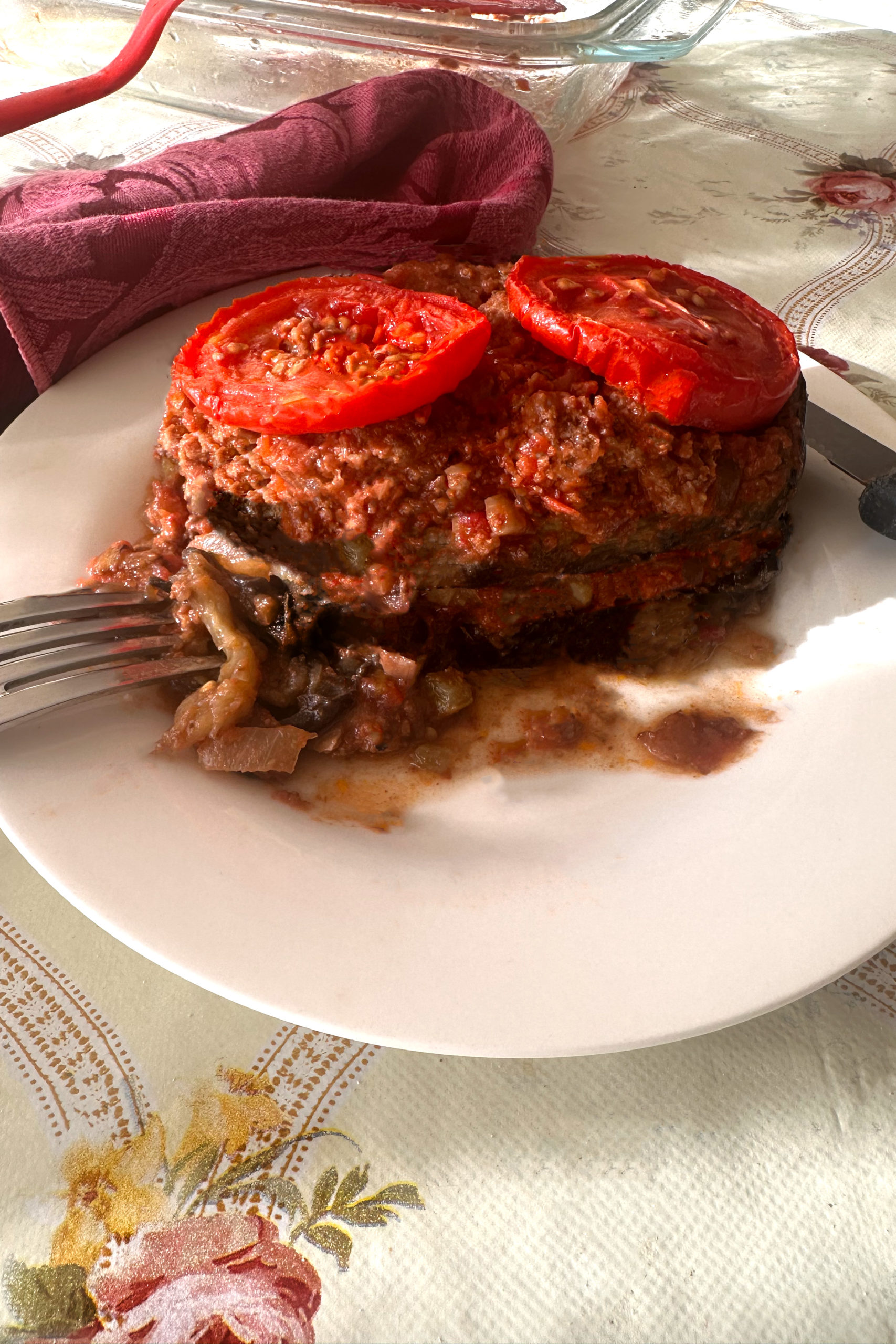
Israeli-style moussaka is simple to make and it refrigerates well and warms up well.
Make ahead and have ready when you get home for dinner.
Or take to work or school and save your lunch money!
And it makes great leftovers!
Don’t know what to bring for that potluck dinner? Well, now you do!
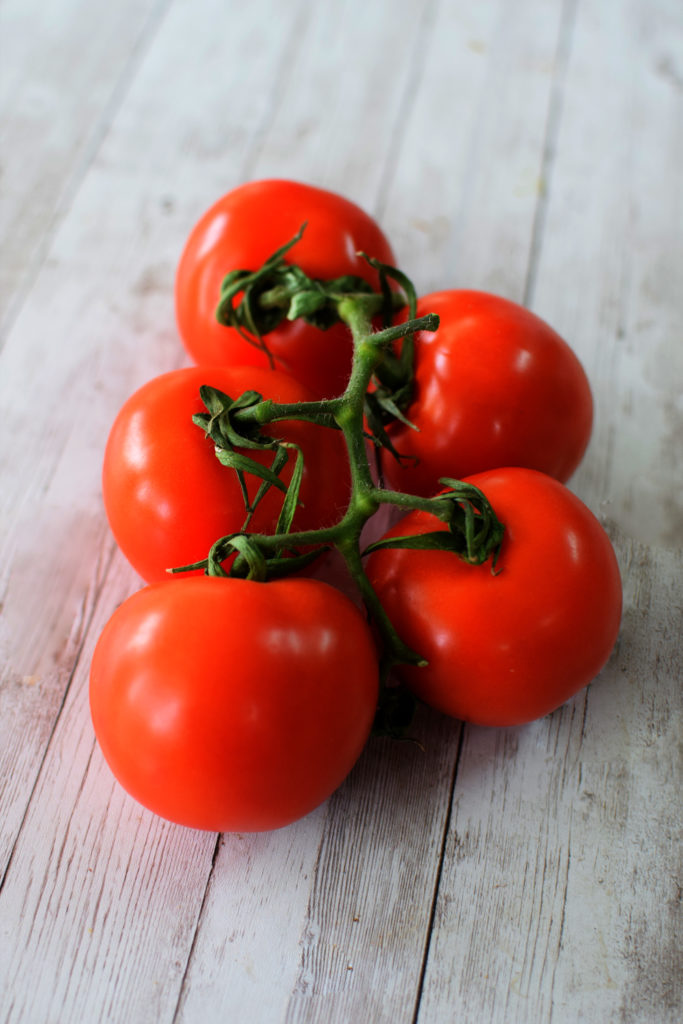
And tomatoes have nutritional value!
And so does eggplant!
A little about eggplants
The eggplant is native to India and Asia, where it can be found growing wild, and it is believed that eggplants were brought to Europe sometime during the 7th or 8th century.
Australians and Americans call the vegetable eggplant, while in England it is called an aubergine, from the French word for this vegetable.
Because of its meaty texture, eggplant is used instead of meat in some vegetarian versions of meat recipes.
While there are a variety of types of eggplants, the one for this recipe is the large, egg-shaped (or teardrop-shaped), blackish-purple one with the meaty inside.
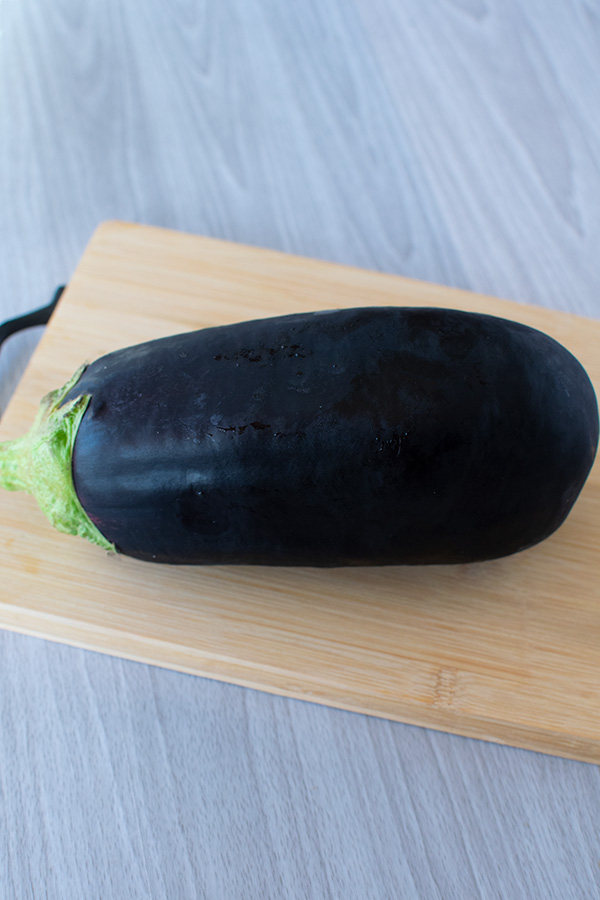
Eggplants have health benefits, as they contain antioxidants like vitamins A and C, which help protect your cells against damage, and are low in calories.
About cooking eggplant
Eggplants can be roasted, baked, steamed, deep-fried, or sautéed.
Before cooking an eggplant, cut off the top part where the green is (called a calyx). The bottom tip should also be removed, but this is not imperative. The skin is perfectly fine to eat, but it must be cooked well. Otherwise it may come out chewy.
This recipe can use either peeled eggplants or eggplants with the skin (having the skin on will not ruin the recipe).
Eggplant is naturally a little bitter. If you find that to be the case, you can draw out the bitterness by sprinkling it with salt and letting it sit awhile. If you are using slices or pieces, slightly salt after cutting. I have personally never found this to be a problem when cooking with eggplants
Using salt before cooking can help prevent the eggplant from absorbing too much oil and becoming greasy if using oil with the eggplant recipe (I normally just pat the pieces with a paper towel if need be).
If you do use salt, MAKE SURE to rinse it off before cooking the eggplant, or the salt will become a part of your dish!
Personally, I have never salted my eggplants before using them (and I have used eggplants in two countries) and have never had any problem with bitterness, but if you have any concern, please do.
If a recipe calls for frying, but you prefer not to do so because of the calories the oil will add to the recipe, you can spray with cooking oil and bake instead.
A little about Moussaka
Moussaka is a Middle Eastern/Mediterranean dish that is eggplant-based. It’s popular across the Balkans, the Middle East, and the Mediterranean.
The most well-known type of moussaka internationally is the Greek version, which normally includes 3 layers.
The bottom layer is made up of fried slices of eggplant, the middle layer is a flavorful ground lamb (or beef) with onion, garlic, crushed tomatoes, herbs and spices, and the top layer is béchamel sauce (a classic French dairy white sauce).
The dish baked for a short while until the top is a golden brown.
Other Mediterranean countries use different sauces or may sprinkle grated cheese or breadcrumbs.
There are also versions that use zucchini, carrots, and potatoes.
Places such as Bulgaria, Serbia, Bosnia, and others, potatoes are used instead of eggplant.
In Turkey, moussaka is made in a pan with chunks of eggplant and tomato.
Note for cooking the fill:
Most Israeli moussaka recipes include breadcrumbs to soak up the excess liquid. My family prefers it a little looser, so I don’t use breadcrumbs.
What I do is to lightly bake the eggplant before preparing the layers, make sure that the liquid is minimal (you can cook it longer to let it evaporate, drain, or use some breadcrumbs).
Then, I create the layers (one layer of eggplant, one of the fill, and repeat) and let the eggplant soak up as much as it can.
The dish won’t be stiff as in many recipes, but my family feels that the breadcrumbs somewhat dull the flavor.
A little about Israeli cuisine
Some people complain about cultural appropriation in cuisine when food from one country is attributed to another country.
However, national cuisine in itself is often a mingling of food from a variety of cultures, often due to a change of ruling countries and a shifting of borders.
When one lives in a melting pot, such as the US or Israel, it is just unrealistic to expect that food from a particular culture won’t mingle with that of other cultures.
That being said, “Israeli cuisine” is basically Middle Eastern (as opposed to Eastern European food) that was brought to Israel by Jews when they fled or were expelled from Muslim countries and moved to Israel mostly after the declaration of the State of Israel (collectively known as Mizrahi Jews).
Recipes were passed from generation to generation, and although decades have passed, the foods are still known by the culture they came from, and everyone seems to have their own way of making them.
That said, there are many variations of pretty much any “Israeli” recipe because of background, custom, or even just taste.
When choosing a recipe, one has to know what actually constitutes a main ingredient—what makes the dish what it is—and what is left up to individual taste.
Different oils used in cooking
“High-heat” oils have neutral flavors and have been processed in order to handle high temperatures and are good for sautéing, searing, and frying. These include canola oil, vegetable oil, avocado oil, and grapeseed oil, each with its own “best for” with chefs.
Some oils have their own flavor and are good for sautéing and roasting and add a little extra to the dish. These include extra virgin olive oil, coconut oil, and peanut oil. Extra virgin olive oil works well with roasting or sautéing, but not for deep frying.
Coconut oil is good in dishes where a slightly coconut flavor enhances the dish, and peanut oil is good for deep frying and will add a subtle nutty taste and smell. Many Asian dishes call for peanut oil in the ingredients.
Then there are oils that are not used with heat but rather for dressing up foods, such as sesame oil, flaxseed oil, and walnut oil, among others.
What does it mean when recipes say “to taste” about an ingredient?
When recipes say “to taste,” it means that you can put in as little or as much as you like to your own taste. Some recipes have many ingredients that a cook can adjust to their own taste when cooking (not so much when baking though).
The best way to calculate what your taste is with a recipe that you are not yet familiar with is to first taste the dish and then add the “to taste” ingredient GRADUALLY, a little at a time—a splash of this or a pinch of that—until the dish is just the way you like it.
Make sure to stir the ingredient after each time you add it so that the flavor will distribute evenly and become part of the dish. Then taste again. Repeat until you reach your personal preference.
Note: If you plan on using the recipe again, it is highly recommended to make a note of what and how much you added so that you can refer to it next time.
What does it mean when a recipe says that an ingredient is “optional”?
If an ingredient is “optional,” it means that you can add it in or not based on your own preference. An optional ingredient can be flavor related (i.e., salty, sweet, spicy, etc.), appearance related (garnish), or even something like nuts or chocolate chips in baking.
What does “savory” mean?
“Savory” refers to foods that are not sweet, such as foods that taste salty, spicy, or herbal.
What is needed for this recipe?
I hardly ever meal plan, so I like to keep a cupboard full of seasonings, spices, veggies, and canned goods in my kitchen to use whenever the mood strikes.
But these are all you need to have on hand to make this recipe even last minute!
eggplants
onion
celery
can diced tomatoes or equivalent
ground beef (or other ground meat)
chicken consommé powder or beef bouillon powder
white granulated sugar
tomato paste
black pepper
breadcrumbs (to use if needed)
tomatoes
oil for frying
Want to try some more recipes that are popular in the Middle East and Mediterranean? Try these!
- Moroccan-Israeli Eggplant Salad
- Moroccan-Israeli Meatballs and Olives
- Israeli-Style Rice and Beans with Meat
- Israeli-Style Rice and Beans (vegan)
Easy Israeli-Style Moussaka
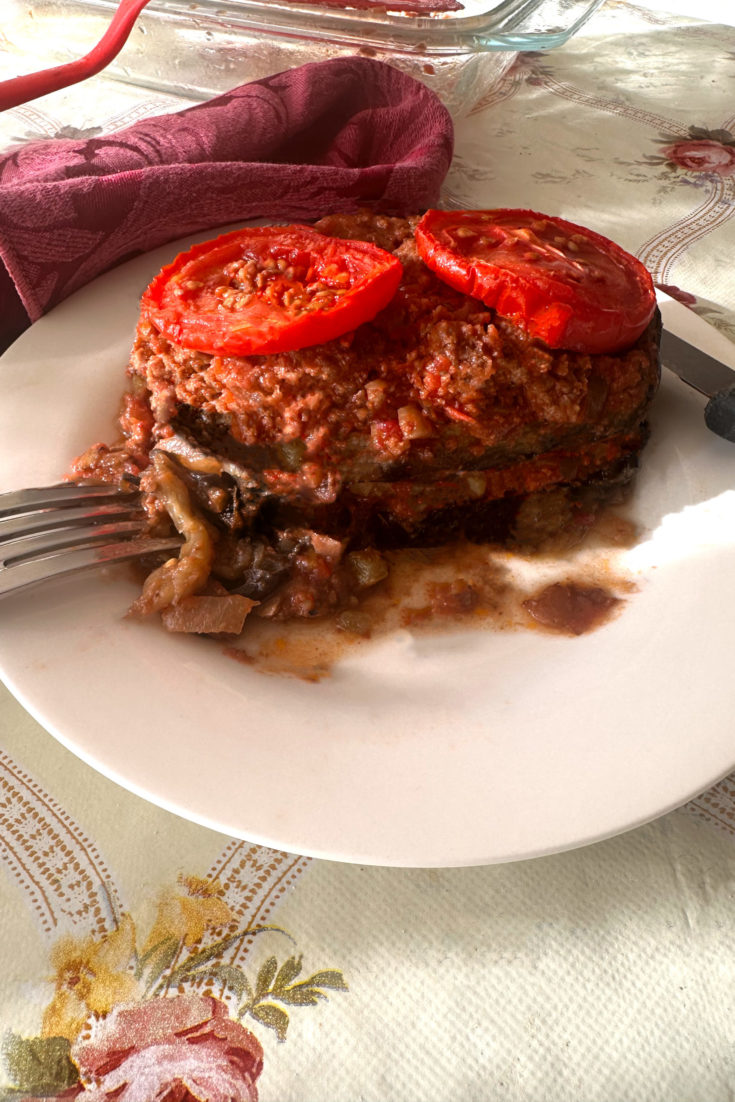
Delicious Middle Eastern dish of savory meat filling in between layers of soft sliced eggplant.
Ingredients
- 2 medium eggplants (approximately 9 inches long)
- 1 medium onion, diced or chopped
- 2-3 celery stalks diced or chopped very small
- 1 - 28 oz can diced tomatoes or equivalent, drained
- 1 1/2 pounds ground beef (or other ground meat)
- 2 tbsp chicken consommé powder or beef bouillon powder
- 1 1/2 tablespoons white granulated sugar
- 1/4 cup tomato paste
- 1 tsp black pepper or to taste
- 1 cup breadcrumbs (to use if needed)
- 1-2 tomatoes, sliced (or other topping)
- oil for frying
Instructions
Eggplant
- Cut off the ends of the eggplant and then slice lengthwise into 6 slices each (you should have a total of 12 slices).*
- Place evenly on a baking sheet covered with baking paper and lightly spray with cooking spray.
- Place in a preheated oven at 350°F for 15-20 minutes or until slices have softened, slightly dehydrated and browned a little.**
- Let cool.
Meat Mixture
- Pour enough oil into a large saucepan to just cover the bottom.
- On medium heat, sauté diced onions and celery until mostly clear.
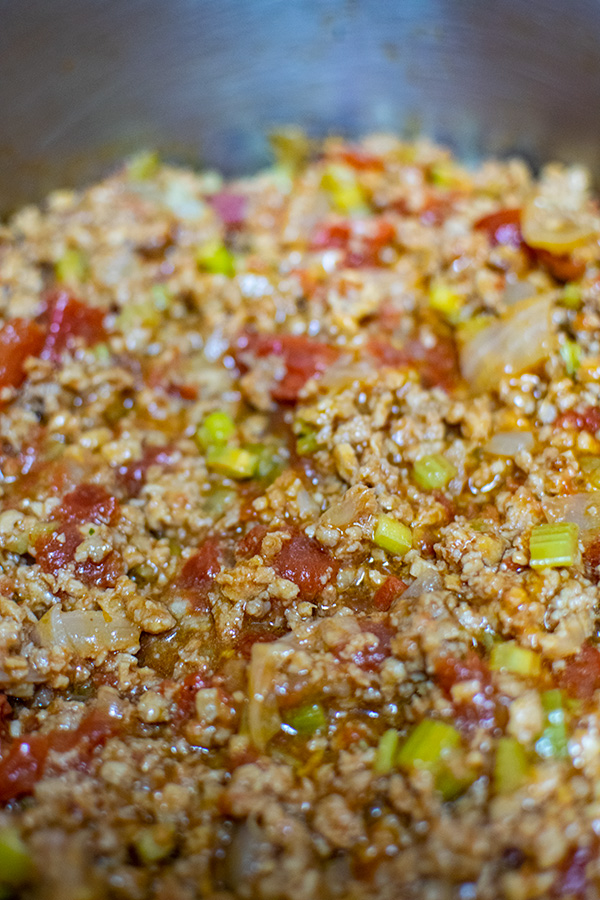
- Add diced tomatoes, ground beef, chicken consommé powder, tomato paste, and pepper.
- Mix well and cook on medium heat until the meat and tomatoes are thoroughly cooked and the liquid has mostly evaporated and is just wet (if need be, pour out additional liquid or add some breadcrumbs a little at a time and mix).***
Preparing the dish
- Lay three slices of eggplant on the bottom of a 9" x 9" baking pan
- Cover with a layer of the meat mixture, then another layer of eggplant. Repeat until the eggplant and meat mixture are done (if you use 3 slices of eggplant per layer, then you will use 1/4 of the meat mixture in between each layer, and if you use 4 slices of eggplant per layer, then you will use 1/3 of the meat mixture in between each layer).
- Cover the top with slices of tomato or other topping.
- Bake at 400° for approximately 20 - 30 minutes (or you can bake longer at 350°) until the topping has cooked.
Notes
* You can slice into disks, if you prefer.
** Or you can LIGHTLY fry them instead of baking.
***If you prefer the way that this dish is typically made, then just add breadcrumbs a little at a time until the liquid has soaked up. I don't like this method because my family feels that it dulls the flavor as opposed to just using the fill with minimal liquid.
Nutrition Information:
Yield:
9Serving Size:
1Amount Per Serving: Calories: 352Total Fat: 16gSaturated Fat: 5gTrans Fat: 1gUnsaturated Fat: 8gCholesterol: 69mgSodium: 277mgCarbohydrates: 28gFiber: 6gSugar: 11gProtein: 25g