Turkish-Style Moussaka is a delicious and savory stovetop recipe of chunks of eggplant, tomatoes, and ground beef.
It’s a warm and hearty Mediterranean dish, it’s like Israeli-Style Moussaka, but even simpler because it’s made in one pan.
Also, it contains no milk, butter, or cream because it doesn’t use béchamel, the classic French white sauce, like Greek moussaka does. So this recipe is dairy-free!
Eat it as is or try it over a bed of rice!
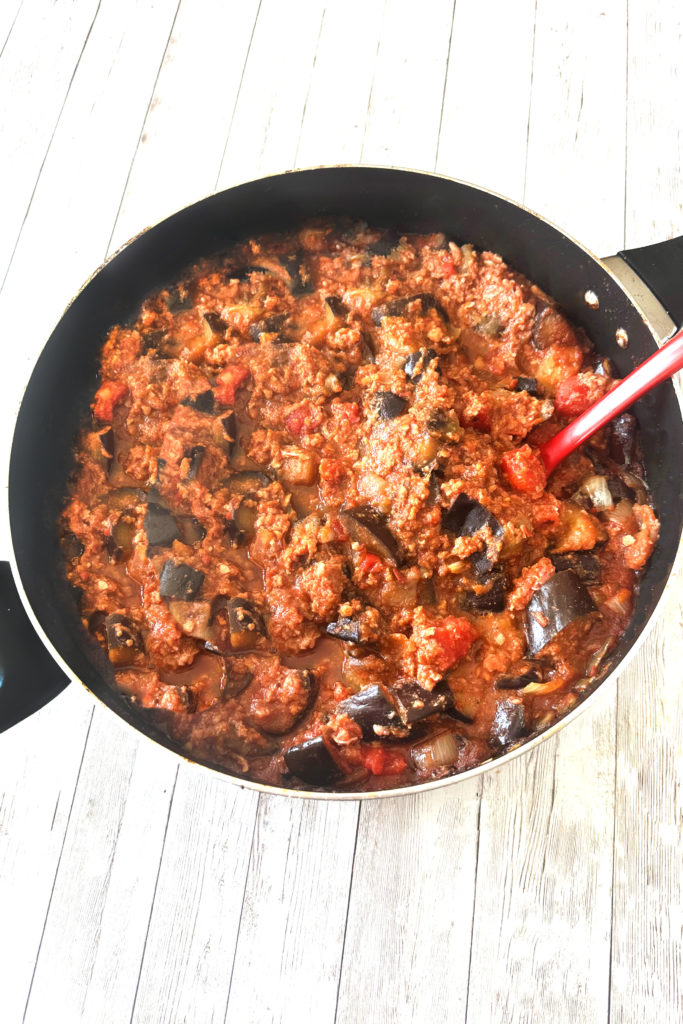
This Turkish-style moussaka may be the simplest version of moussaka to make.
Perfect for a family dinner or when having guests.
Need a dish for potluck? Look no further!
It refrigerates well, so make ahead and have it ready and waiting for when you come home from work or school. Just warm it up!
A little about Moussaka
Moussaka is a Middle Eastern/Mediterranean dish that is eggplant-based. It’s popular across the Balkans, the Middle East, and the Mediterranean.
The most well-known type of moussaka internationally is the Greek version, which normally includes a baking dish of 3 layers of fried sliced eggplant, ground lamb or beef with onion, tomatoes, herbs and spices.
The top layer is cheese béchamel sauce (a classic French dairy white sauce).
Then, the moussaka is baked for a short while until the top is a golden brown.
Other Mediterranean countries use different sauces or may sprinkle grated cheese or breadcrumbs.
There are also versions that use zucchini, carrots, and potatoes.
Bulgaria, Serbia, Bosnia, and others, use potatoes instead of eggplant.
In Turkey, moussaka is made in a single pan with chunks of eggplant and tomato and cooked on the stovetop.
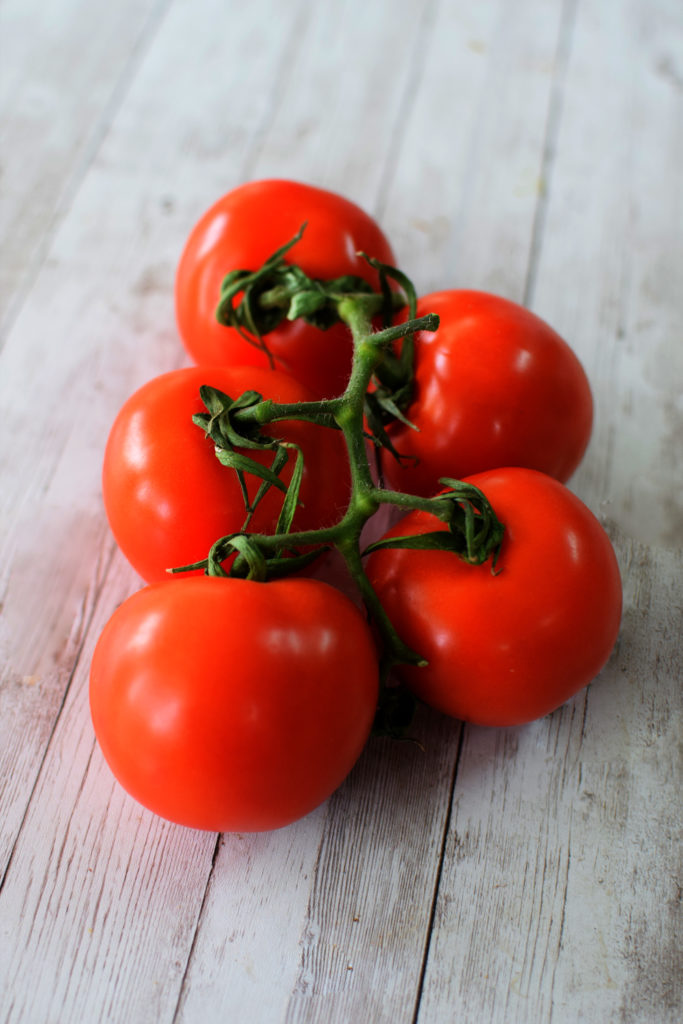
And tomatoes have nutritional value!
And so do eggplant!
A little about eggplants
The eggplant is native to India and Asia, where it can be found growing wild, and it is believed that eggplants were brought to Europe sometime during the 7th or 8th century.
Australians and Americans call the vegetable eggplant, while in England it is called an aubergine, from the French word for this vegetable.
Because of its meaty texture, eggplant is used instead of meat in some vegetarian versions of meat recipes.
While there are a variety of types of eggplants, the one for this recipe is the large, egg-shaped (or teardrop-shaped), blackish-purple one with the meaty inside.
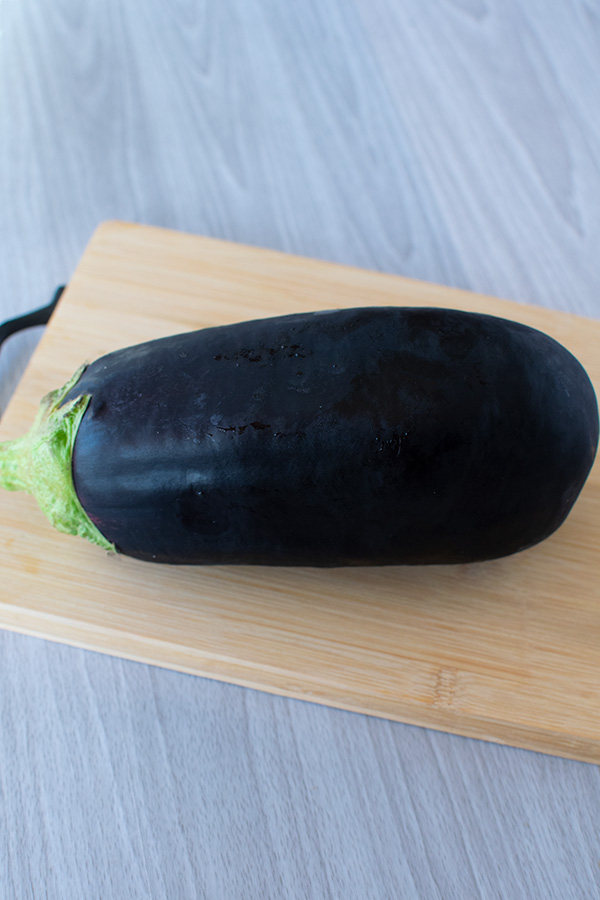
Eggplants have health benefits, as they contain antioxidants like vitamins A and C, which help protect your cells against damage, and are low in calories.
About cooking eggplant
Eggplants can be roasted, baked, steamed, deep-fried, or sautéed.
Before cooking an eggplant, cut off the top part where the green is (called a calyx). The bottom tip can also be removed.
This recipe can use either peeled eggplants or eggplants with the skin. Having the skin on will not ruin the recipe but it must be cooked well. Otherwise it may come out chewy.
Eggplant is naturally a little bitter. If you find that to be the case, you can draw out the bitterness by sprinkling it with salt and letting it sit awhile. If you are using slices or pieces, slightly salt after cutting.
Using salt before cooking can help prevent the eggplant from absorbing too much oil and becoming greasy if using oil with the eggplant recipe (I normally just pat the pieces with a paper towel if need be).
If you do use salt, MAKE SURE to rinse it off before cooking the eggplant, or the salt will become a part of your dish!
Personally, I never bother with this.
Different oils used in cooking
“High-heat” oils have neutral flavors and have been processed in order to handle high temperatures and are good for sautéing, searing, and frying. These include canola oil, vegetable oil, avocado oil, and grapeseed oil, each with its own “best for” with chefs.
Some oils have their own flavor and are good for sautéing and roasting and add a little extra to the dish. These include extra virgin olive oil, coconut oil, and peanut oil. Extra virgin olive oil works well with roasting or sautéing, but not for deep frying.
Coconut oil is good in dishes where a slightly coconut flavor enhances the dish, and peanut oil is good for deep frying and will add a subtle nutty taste and smell. Many Asian dishes call for peanut oil in the ingredients.
Then there are oils that are not used with heat but rather for dressing up foods, such as sesame oil, flaxseed oil, and walnut oil, among others.
What does it mean when recipes say “to taste” about an ingredient?
When recipes say “to taste,” it means that you can put in as little or as much as you like to your own taste. Some recipes have many ingredients that a cook can adjust to their own taste when cooking (not so much when baking though).
The best way to calculate what your taste is with a recipe that you are not yet familiar with is to first taste the dish and then add the “to taste” ingredient GRADUALLY, a little at a time—a splash of this or a pinch of that—until the dish is just the way you like it.
Make sure to stir the ingredient after each time you add it so that the flavor will distribute evenly and become part of the dish. Then taste again. Repeat until you reach your personal preference.
Note: If you plan on using the recipe again, it is highly recommended to make a note of what and how much you added so that you can refer to it next time.
What does it mean when a recipe says that an ingredient is “optional”?
If an ingredient is “optional,” it means that you can add it in or not based on your own preference. An optional ingredient can be flavor related (i.e., salty, sweet, spicy, etc.), appearance related (garnish), or even something like nuts or chocolate chips in baking.
What does “savory” mean?
“Savory” refers to foods that are not sweet, such as foods that taste salty, spicy, or herbal.
A little about Moussaka
A little about Moussaka
Moussaka is a Middle Eastern/Mediterranean dish that is eggplant-based. It’s popular across the Balkans, the Middle East, and the Mediterranean.
The most well-known type of moussaka internationally is the Greek version, which normally includes 3 layers.
The bottom layer is made up of fried slices of eggplant, the middle layer is a flavorful ground lamb (or beef) with onion, garlic, crushed tomatoes, herbs and spices, and the top layer is béchamel sauce (a classic French dairy white sauce).
The dish baked for a short while until the top is a golden brown.
Other Mediterranean countries use different sauces or may sprinkle grated cheese or breadcrumbs.
There are also versions that use zucchini, carrots, and potatoes.
Places such as Bulgaria, Serbia, Bosnia, and others, potatoes are used instead of eggplant.
In Turkey, moussaka is made in a pan with chunks of eggplant and tomato.
What is needed for this recipe?
I hardly ever meal plan, so I like to keep a cupboard full of seasonings, spices, veggies, and canned goods in my kitchen to use whenever the mood strikes.
But these are all you need to have on hand to make this recipe even last minute!
eggplant
onion
diced tomatoes or equivalent
green pepper (optional)
ground beef (or other ground meat)
chicken consommé powder or beef bouillon powder
white granulated sugar
black pepper
oil
Want to try some more recipes that are popular in the Middle East and Mediterranean? Try these!
- Moroccan-Israeli Eggplant Salad
- Moroccan-Israeli Meatballs and Olives
- Israeli-Style Rice and Beans with Meat
- Israeli-Style Rice and Beans (vegan)
Easy Turkish-Style Moussaka
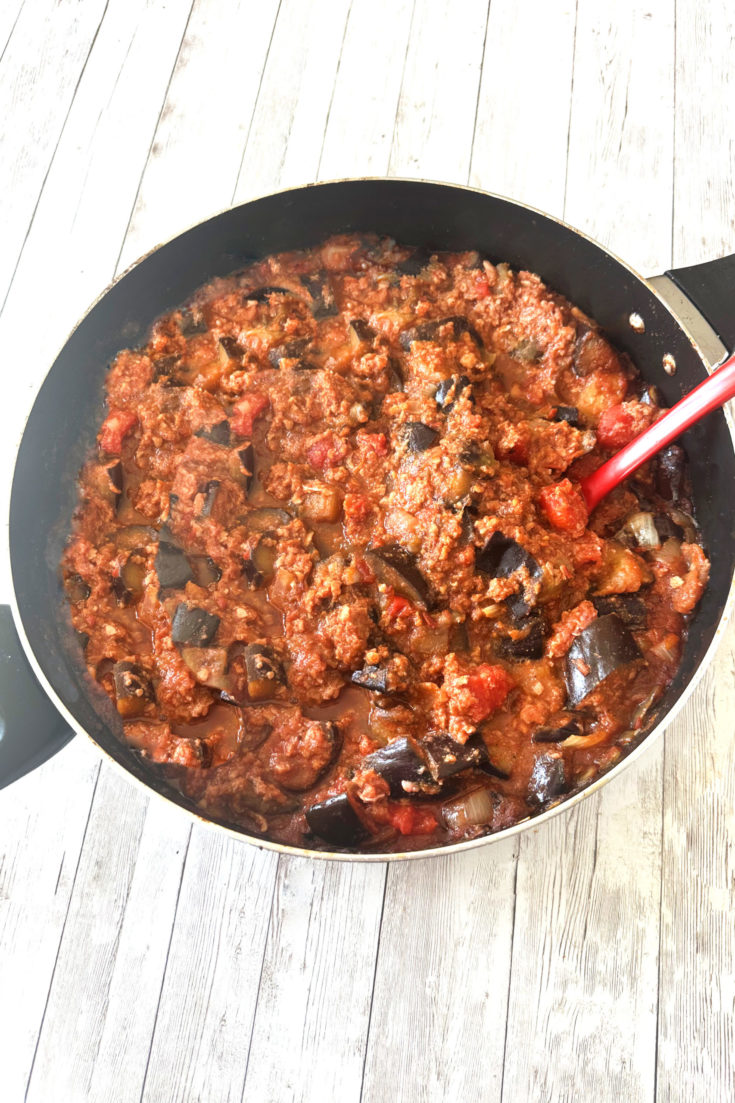
Delicious and savory Middle Eastern dish of eggplant and ground beef in a delicious tomato sauce.
Ingredients
- 2 medium eggplants (approximately 9 inches long)
- 1 medium onion, diced or chopped
- 1 - 28 oz can diced tomatoes or equivalent, drained
- 1 small green pepper (optional)*
- 1 1/2 pounds ground beef (or other ground meat)
- 2 tbsp chicken consommé powder or beef bouillon powder
- 1 1/2 tablespoons white granulated sugar
- 1/2 tsp black pepper
- oil for frying
Instructions
- Dice the eggplant into approximately 1" pieces (you can peel first or not, as desired).
- Dice or chop the onion and the pepper (if you are using - see the notes).*
- Pour oil to approximately 1/8" high in a large pan and heat on medium.**
- Add the eggplant and onion (and pepper) to the pan and sauté them together, mixing occasionally, until they turn a light brown.
- Add the diced tomatoes, ground beef, consommé or bouillon powder, sugar, and pepper and mix well.
- Continue to cook on medium heat until the meat has cooked and all the vegetables are soft (approximately 20 minutes). Add water, a little at a time, if needed.***
Notes
*Chopped green peppers are traditionally part of this dish, but you can leave them out if you want to. Bell pepper is often overpowering, so use a small one or a half of a larger one, diced small. The traditional peppers used are usually mild sivri or çarliston peppers, which are smaller with thinner skins, so you would use 3-4 of those.
** Toss a piece of onion into the oil, and the oil will be ready when the onion begins to fry.
***The mixture should be thick, but if it becomes thick before the vegetables are completely cooked, then add water, a little at a time as needed.
Nutrition Information:
Yield:
6Serving Size:
1Amount Per Serving: Calories: 433Total Fat: 23gSaturated Fat: 9gUnsaturated Fat: 14gCholesterol: 104mgSodium: 79mgCarbohydrates: 23gFiber: 5gSugar: 11gProtein: 33g