Moroccan-Israeli Vegetable Soup with couscous is a delicious, savory, and vegetarian Middle Eastern dish.
While this hearty dish originated in Moroccan cuisine, it was brought to Israel by Moroccan Jews and adapted into Israeli food culture where it is very popular.
This soup is packed with tender chunks of a variety of vegetables (such as zucchini, carrots, onions, potatoes, sweet potato, pumpkin, celery, onions, cabbage, and chickpeas) cooked in a flavorful broth and poured over Moroccan couscous (semolina couscous).
And it’s customizable, with a lot of the vegetables being optional and “to taste,” so you can add (or leave out) whatever you want to!
It’s the ultimate healthy comfort food year round and can make a terrific addition to any table.
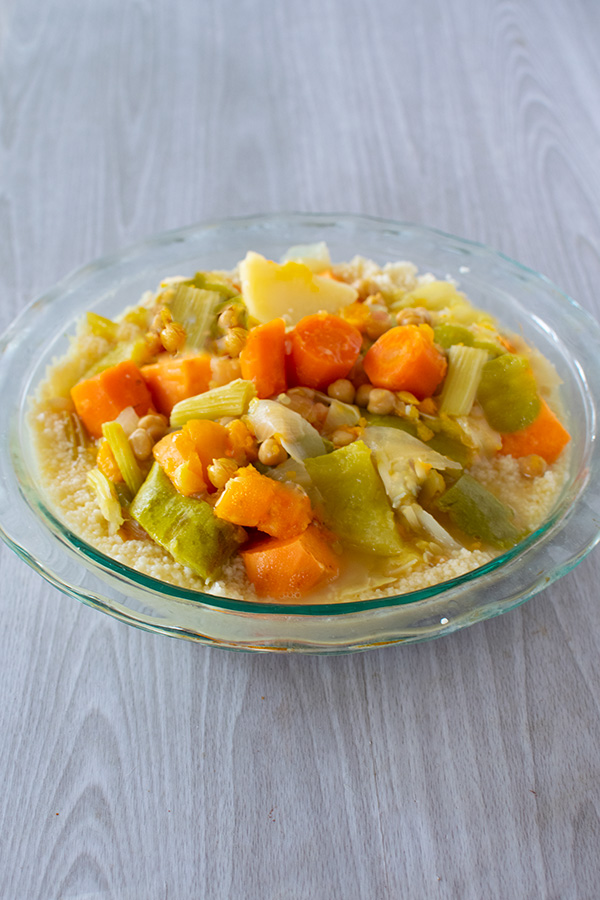
While this healthy soup in this recipe is popular in Israel, it’s customizable and some of the vegetables and quantities vary from person to person.
However, these five vegetables that seem to be basic, while others seem to vary:
zucchini (Israelis typically use the lighter green zucchini for this soup), celery, carrots, potatoes, and onions, which are all nutritious.
Others are pumpkin (or butternut squash), cabbage, sweet potato, and chickpeas, which all also have nutritional benefits.
I’ve also seen a recipe that calls for turnips and another one that calls for grated tomato.
Spices also vary and some include ground cumin, paprika, or granulated garlic.
While you certainly can eat this delicious soup on it’s own, it’s very popular to pour it over couscous and serve it that way.
I started making it when my son came home from elementary school and said that there is this “really good” lunch that they were all served. So, I had to figure out what it was.
Note that what Israelis call couscous is also called Moroccan couscous and it’s made from small to medium size semolina (or farina) and not what one normally finds on the shelves of grocery stores.
What one typically finds on US grocery store shelves that is labeled “Israeli couscous” is actually called ptitim (pronounced ptee-teem with the accent on the second syllable) in Israel.
Ptitim are little balls of dough made of wheat flour and water.
Ptitim were created by Osem in 1951 (during the period of austerity at the beginning of Israel’s statehood) at the request of David Ben Gurion—because there was a shortage of rice in the country—and they were called Ben Gurion rice!
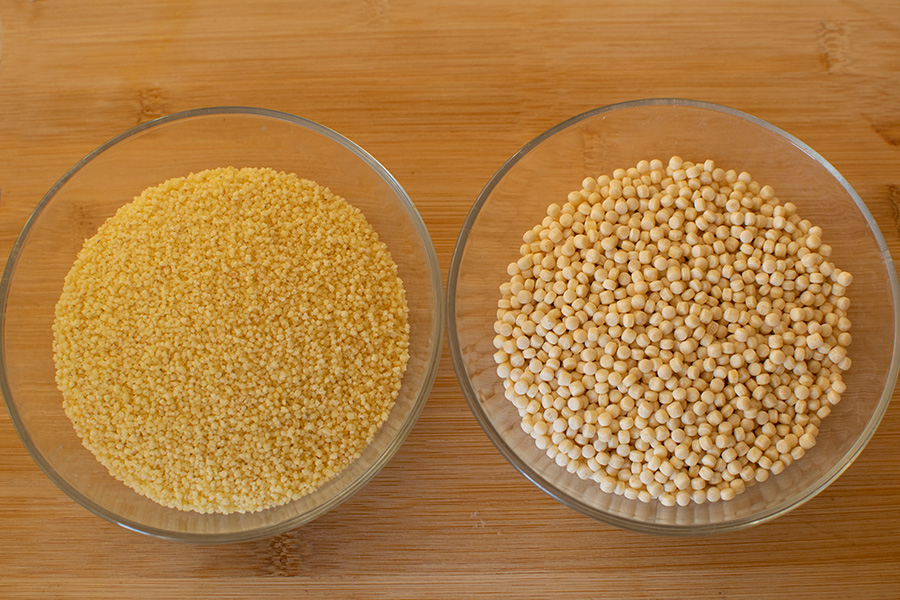
The bowl on the left contains medium size semolina, which is what Israelis call couscous (Moroccan couscous) while the bowl on the right is what is sold in the US as “Israeli couscous,” but in Israel, they are called ptitim.
What is the origin?
Couscous is a Moroccan dish made of steamed semolina (farina) that is typically served with something else (just like one might use rice), such as fish, meat, or vegetables. Moroccan Jews introduced this dish to Israel when they immigrated from Morocco. And, just like the vegetable soup, it became a popular part of Israeli food culture.
Moroccan Jews in Israel
The majority of Moroccan Jews in Israel are the descendants of Jews that immigrated to Israel from Morocco.
Before the establishment of the State of Israel, the British put a quota on the amount of Jews that could immigrate to Israel, so most of the immigration was considered “illegal.” However, many Jews risked their lives to flee their countries of origin, including Arab and Muslim countries, such as Morocco.
Because the Muslims were against the establishment of the State of Israel, after the declaration of the state and the civil war that followed, life became more difficult for the Jews of Morocco, because the Muslims would attack Jews as a result. This brought about a wave of immigrants to Israel from Morocco, as did every Arab-Israeli war that followed.
So, during the 1950s and for decades afterward, waves of Moroccan Jews immigrated to Israel.
Morocco was once the home of the largest Jewish community in the Muslim world. However, by the time of the Yom Kippur war, the majority of Morocco’s Jews had immigrated to Israel, and they brought their delicious cuisine with them.
A little about Israeli cuisine
Some people complain about cultural appropriation in cuisine when food from one country is attributed to another country.
However, national cuisine in itself is often a mingling of food from a variety of cultures, often due to a change of ruling countries and a shifting of borders.
Turkish cuisine, for example, goes back to the Ottoman Empire and was a combination of several cultures under Ottoman rule.
When one lives in a melting pot, such as the US or Israel, it is just unrealistic to expect that food from a particular culture won’t mingle with that of other cultures.
That being said, “Israeli cuisine” is basically Middle Eastern (as opposed to Eastern European food) that was brought to Israel by Jews when they fled or were expelled from Muslim countries and moved to Israel mostly after the declaration of the State of Israel (collectively known as Mizrahi Jews).
Recipes were passed from generation to generation, and although decades have passed, the foods are still known by the culture they came from, and everyone seems to have their own way of making them.
What does it mean when recipes say “to taste” about an ingredient?
When recipes say “to taste,” it means that you can put in as little or as much as you like to your own taste. Some recipes have many ingredients that a cook can adjust to their own taste when cooking (not so much when baking though).
The best way to calculate what your taste is with a recipe that you are not yet familiar with is to first taste the dish and then add the “to taste” ingredient GRADUALLY, a little at a time—a splash of this or a pinch of that—until the dish is just the way you like it. Make sure to stir the ingredient after each time you add it so that the flavor will distribute evenly and become part of the dish. Then taste again. Repeat until you reach your personal preference.
Note: If you plan on using the recipe again, it is highly recommended to make a note of what and how much you added so that you can refer to it next time.
What does it mean when a recipe says that an ingredient is “optional”?
If an ingredient is “optional,” it means that you can add it in or not based on your own preference. An optional ingredient can be flavor related (i.e., salty, sweet, spicy, etc.), appearance related (garnish), or even something like nuts or chocolate chips in baking.
What does “savory” mean?
“Savory” refers to foods that are not sweet, such as foods that taste salty, spicy, or herbal.
Recommended seasonings essentials to keep in your pantry:
I hardly ever meal plan, so I like to keep a cupboard full of seasonings, spices, veggies, and canned goods in my kitchen to use whenever the mood strikes.
- salt (my recipes use regular table salt)
- ground black or white pepper
- granulated garlic or garlic powder (I prefer granulated)
- onion powder
- sweet paprika and/or sweet pepper flakes (paprika is ground dried red pepper, pepper flakes are crushed dried red pepper)
- hot paprika, hot pepper flakes, or cayenne pepper (moderately spicy dried ground chili pepper) for those occasional spicy dishes
- ground turmeric
- ground cumin
- ground cinnamon
- ground ginger
- ground nutmeg
- ground cloves (for pumpkin flavors)
- sugar (granulated)
- brown sugar
- chicken consommé powder / beef bouillon powder (regular or vegetarian)
- onion soup mix
- onion flakes (substitute for fresh onion—3 tablespoons for 1 medium onion).
- various herbs
- additional spices to adapt taste to preference
Weather can have an effect on some of the spices and on the chicken consommé powder, so I keep as many of the seasonings in the refrigerator or freezer as I can, and I keep everything tightly closed in containers (you will be surprised to know just how determined moths are at getting into sealed bags and how hot red pepper powder can attract little black bugs—YUCK!).
Therefore, store your items properly.
What is needed for this recipe?
This is a list of a variety of vegetables that typically go into this soup. Choose whichever you like! Or use all of them!
potatoes
onion
carrot
zucchini (preferably light green)
sweet potato
butternut squash or pumpkin
cabbage
chickpeas(canned or cooked)
celery
vegetarian chicken consommé powder
turmeric
pepper and other spices, if desired
oil for frying
Moroccan-style couscous
Want to try another Moroccan-Israeli dish? Try Easy Moroccan-Israeli Meatballs with Olives!
Moroccan-Israeli Vegetable Soup with Couscous
Delicious and flavorful, hearty and savory vegetable soup poured over Moroccan couscous.
Ingredients
- 2 medium-large potatoes, peeled and cut into chunks
- 1 medium onion, chopped into chunks
- 1 large carrot, cut into large chunks *
- 1 large zucchini (preferably light green), cut into large chunks
- 1 small-medium sweet potato, peeled and chopped into large chunks *
- 1/2 pound butternut squash or pumpkin, chopped into large chunks *
- 1/2 small head of cabbage, chopped (optional—some recipes include it) *
- 1 cup chickpeas(canned or cooked) *
- 1 large celery stick, cut into pieces
- 3 tablespoons of vegetarian chicken consommé powder or to taste
- 1 teaspoon of turmeric, for color, if desired
- pepper to taste, if desired
- other spices to taste, if desired
- oil for frying
- 4-6 cups cooked Moroccan-style couscous**
Instructions
- Heat 2-3 tablespoons of oil in a pot.
- Add onions and celery and lightly fry.
- Add carrots, zucchini, sweet potato, butternut squash or pumpkin, cabbage and chickpeas to the pot.
- Cover with water and bring to a boil.
- Turn down the heat to medium and continue to cook until the vegetables have cooked through (will depend on the size of the pieces you used), but are not mushy (where you can just slide a fork through).
- Pour over the couscous.
Notes
While the list of ingredients for this soup may seem daunting, the soup itself is VERY easy to make, and one does NOT have to include all of the vegetables listed here. Overall, the Moroccan version has pumpkin or butternut squash, while the Israeli version uses carrot, and many people use both.
* This recipe includes a variety of vegetables that can be added to this soup. However, everyone has their own variation, and not everyone includes all of them, so you can feel free to include or exclude whatever you like. Also, the quantity of each vegetable varies from recipe to recipe.
**Couscous in Israeli is Moroccan-style couscous can be found in ethnic Israeli stores. What one normally finds in stores (the large balls) is not what Israelis call couscous (they actually call that ptitim—pronounced p'tee-teem with the accent on the second syllable). Moroccan-style couscous is made from semolina (fine or medium-grain) and is much smaller. You can pour the soup over as much couscous as desired.
Nutrition Information:
Yield:
6Serving Size:
1Amount Per Serving: Calories: 219Total Fat: 4gSaturated Fat: 0gTrans Fat: 0gUnsaturated Fat: 3gCholesterol: 0mgSodium: 68mgCarbohydrates: 40gFiber: 8gSugar: 7gProtein: 8g
will
Tuesday 28th of May 2024
this was a really good explanation!