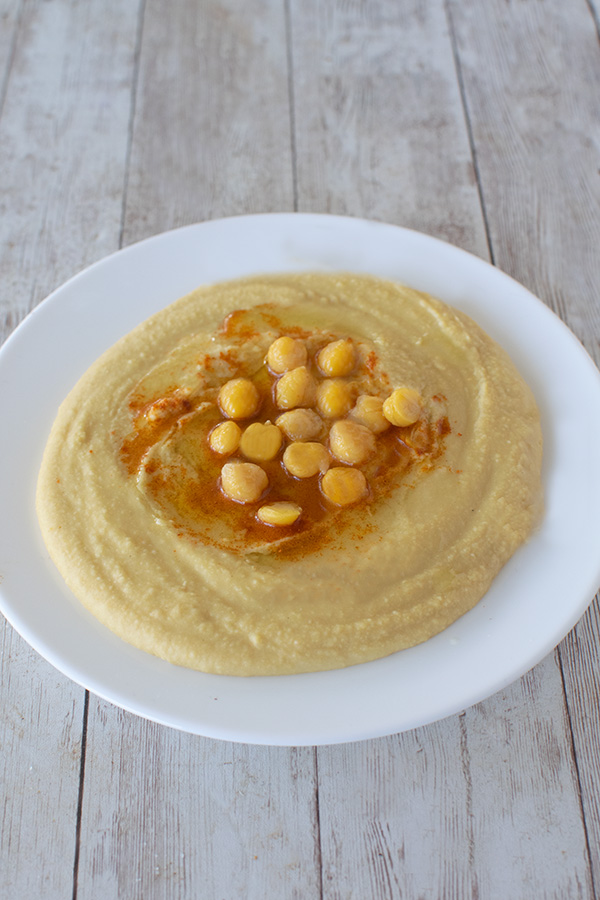
10-Minute Israeli-Style Hummus is a delicious, 5-ingredient recipe, based on the authentic Mediterranean version but without the hours it takes to soak and boil the chickpeas!
Whether you prefer your hummus natural or fast, it’s a great dip or you can use it as a spread in a pita or lafa (Iraqi pita) for a falafel or shawarma.
And, as always, hummus is dairy-free!
Not to mention that hummus is protein-packed and vegan!
I’ve never been a fan of making something at home than I can just buy in the store.
But, every once in a while, however, I will get a bug in my head and decide I just have to try something. I will try and try again until I get it or fail so badly that I accept defeat.
This Easy Israeli Hummus recipe such a good homemade hummus recipe that I didn’t mess it up, not even the first time I made it!
Hummus is simply made from chickpeas, raw tahini, lemon juice, garlic, and a little salt. That’s it!
In fact, this recipe uses canned chickpeas, so you don’t even have to soak, drain, boil, drain. It can literally be made in minutes!
I made it the way that my family likes it, but of course you can adjust the ingredients to your own taste.
Like a little more garlic – add a little more garlic. Like a little more tangy? Add a little more lemon. Like more of a tehini flavor? Add a little more raw tehini.
This recipe makes approximately 1.25 pounds of hummus (it is half of the original recipe that made around 2.5 pounds). Don’t need so much? Make less so it won’t spoil before you can use it up.
Hummus (pronounced choomoos – with the ch sounding like you are clearing your throat) is very popular in the Middle East and I was introduced to it while in Israel.
Israelis eat it with a variety of things, but it is a favorite in pita sandwiches, such as felafel, shawarma, and Sabich (which is a sandwich named after its creator).
They will also take a pita, break off a piece and scoop up a dollop of hummus right out of the dish!
So, however you like it, try this Easy Israel Hummus recipe and enjoy!
Here’s a little more about food in Israel….
A little about Israeli cuisine
Some people complain about cultural appropriation in cuisine when food from one country is attributed to another country.
However, national cuisine in itself is often a mingling of food from a variety of cultures, often due to a change of ruling countries and a shifting of borders.
Turkish cuisine, for example, goes back to the Ottoman Empire and was a combination of several cultures under Ottoman rule.
When people move from country to country, they will take their cultures with them, and their descendants may adapt their traditional cuisine with that of their new home, and if they don’t, others might.
Americans have created a whole variety of types and styles of pizza, yet, everyone still calls them all “pizza,” which originated in Italy.
Spaghetti is thought to be an Italian food, but many historians believe that it was brought back to Italy from China by Marco Polo.
Apparently, battered fried fish was from the Portuguese Jewish community as a Sabbath food and ended up in England via Holland during the Spanish Inquisition, yet everyone attributes the food to the British.
…and don’t get me started on Hummus.
When one lives in a melting pot, such as the US or Israel, it is just unrealistic to expect that food from a particular culture won’t mingle with that of other cultures.
Recipes were passed from generation to generation, and although decades have passed, the foods are still known by the culture they came from, and everyone seems to have their own way of making them.
What does it mean when recipes say “to taste” about an ingredient?
When recipes say “to taste,” it means that you can put in as little or as much as you like to your own taste. Some recipes have many ingredients that a cook can adjust to their own taste when cooking (not so much when baking though).
The best way to calculate what your taste is with a recipe that you are not yet familiar with is to first taste the dish and then add the “to taste” ingredient GRADUALLY, a little at a time—a splash of this or a pinch of that—until the dish is just the way you like it.
Make sure to stir the ingredient after each time you add it so that the flavor will distribute evenly and become part of the dish. Then taste again. Repeat until you reach your personal preference.
Note: If you plan on using the recipe again, it is highly recommended to make a note of what and how much you added so that you can refer to it next time.
What does it mean when a recipe says that an ingredient is “optional”?
If an ingredient is “optional,” it means that you can add it in or not based on your own preference. An optional ingredient can be flavor related (i.e., salty, sweet, spicy, etc.), appearance related (garnish), or even something like nuts or chocolate chips in baking.
What is needed for this recipe?
I hardly ever meal plan, so I like to keep a cupboard full of seasonings, spices, veggies, and canned goods in my kitchen to use whenever the mood strikes.
But these are all you need to have on hand to make this recipe even last minute!
canned chick peas
raw tehini
salt
granulated garlic
lemon juice
Want to make hummus from scratch with raw chickpeas? Try Israeli-Style Hummus
Easy 10-Minute Israeli-Style Hummus
10-minute, 5-ingredient homemade hummus.
Ingredients
- 18 ounces canned chick peas, drained (around 2 1/2 cups)
- 1/4 cup raw tehini (ground sesame seeds)
- 1 teaspoons salt
- 1/8 (a pinch) teaspoon granulated garlic
- 2 1/4 tablespoons lemon juice
Instructions
- Pour out water from can of chickpeas and set aside in case your hummus is too dry.
- Remove loose skins (not terrible if you don't).
- Place chickpeas in food processor or blender and run for approximately two minutes until the chickpeas have become a paste (If you are going to want to decorate your hummus plate with chickpeas, set some aside first).
- Add the raw tehini, lemon juice, granulated garlic and salt (if your canned chickpeas already have salt, then add a little less salt to the mixture (add to taste).
- Blend again for another two minutes.
- If the hummus is too thick, add a little of the water you set aside and blend again until you reach the desired consistency (be very careful not to add too much).
Nutrition Information:
Yield:
5Serving Size:
1Amount Per Serving: Calories: 311Total Fat: 15gSaturated Fat: 2gTrans Fat: 0gUnsaturated Fat: 12gCholesterol: 0mgSodium: 863mgCarbohydrates: 34gFiber: 9gSugar: 5gProtein: 13g