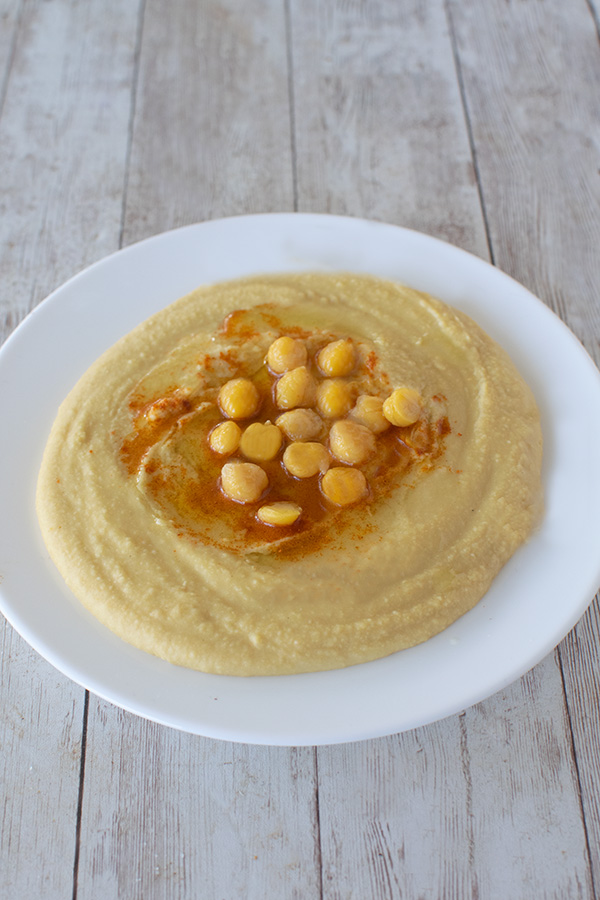
Easy 10-Minute Hummus is a delicious, 5-ingredient recipe for homemade protein-packed, vegan Middle Eastern/Israeli hummus, but without all the hours it takes to soak and boil the chickpeas!
About this hummus...
Authentic Middle Eastern hummus made simply from chickpeas, raw tahini, lemon juice, garlic, and a little salt. That's it. It's always vegan.
This recipe is made with canned chickpeas, so you get to skip the hours of soaking and boiling raw chickpeas until they are soft.
Of course, you can flavor to your own taste and add a little more or a little less seasoning. Like a little more garlic-add a little more garlic. Like a little more tangy? Add a little more lemon. Like more of a tahini flavor? Add a little more raw tahini.
Hummus (actually, pronounced choomoos-with the ch sounding like you are clearing your throat).
In Israel, hummus is eaten with a variety of things, but it is a favorite in pita sandwiches, such as falafel, shawarma, and Sabich (which is a sandwich named after its creator).
It's a terrific spread, and it's also used as a dip, especially for pieces of fresh pita.
In fact, Israelis love to break off a piece of fresh pita and scoop up a dollop of hummus right out of their dish!
It's frequently found on mezze spread platters with Israeli salads.
And chickpeas have nutritional value!
This recipe makes approximately 1.25 pounds of hummus, but if you don't need so much, make less so it won't spoil before you can use it up.
A little about Israeli cuisine
Some people complain about cultural appropriation in cuisine when food from one country is attributed to another country.
However, national cuisine in itself is often a mingling of food from a variety of cultures, often due to a change of ruling countries and a shifting of borders.
Turkish cuisine, for example, goes back to the Ottoman Empire and was a combination of several cultures under Ottoman rule.
When people move from country to country, they will take their cultures with them, and their descendants may adapt their traditional cuisine with that of their new home, and if they don't, others might.
Americans have created a whole variety of types and styles of pizza, yet, everyone still calls them all "pizza," which originated in Italy.
Spaghetti is thought to be an Italian food, but many historians believe that it was brought back to Italy from China by Marco Polo.
Apparently, battered fried fish was from the Portuguese Jewish community as a Sabbath food and ended up in England via Holland during the Spanish Inquisition, yet everyone attributes the food to the British.
...and don't get me started on Hummus.
When one lives in a melting pot, such as the US or Israel, it is just unrealistic to expect that food from a particular culture won't mingle with that of other cultures.
Recipes were passed from generation to generation, and although decades have passed, the foods are still known by the culture they came from, and everyone seems to have their own way of making them.
Some cooking terms
What does it mean when recipes say "to taste" about an ingredient?
When recipes say "to taste," it means that you can put in as little or as much as you like to your own taste. Some recipes have many ingredients that a cook can adjust to their own taste when cooking (not so much when baking though).
The best way to calculate what your taste is with a recipe that you are not yet familiar with is to first taste the dish and then add the "to taste" ingredient GRADUALLY, a little at a time-a splash of this or a pinch of that-until the dish is just the way you like it.
Make sure to stir the ingredient after each time you add it so that the flavor will distribute evenly and become part of the dish. Then taste again. Repeat until you reach your personal preference.
Note: If you plan on using the recipe again, it is highly recommended to make a note of what and how much you added so that you can refer to it next time.
What does it mean when a recipe says that an ingredient is "optional"?
If an ingredient is "optional," it means that you can add it in or not based on your own preference. An optional ingredient can be flavor-related (i.e., salty, sweet, spicy, etc.), appearance-related (a garnish), or even something like nuts or chocolate chips in baking.
Frequently Asked Questions (FAQs)
Can I use dried chickpeas instead of canned?
Yes, but you will need to soak them overnight and boil them for 1 to 2 hours until completely soft before blending. Using canned chickpeas is a quick shortcut to skip this process.
How do I make my hummus extra smooth and creamy?
Blending the tahini and lemon juice together for a minute before adding the chickpeas may help whip air into the mixture, creating an ultra-smooth texture.
How long does homemade hummus last in the fridge?
Store it in an airtight container for up to 3 to 4 days.
Is this hummus recipe vegan and kosher?
Yes, it is plant-based, vegan, and pareve (kosher), made with simple ingredients like chickpeas, tahini, lemon, and garlic.
Can I freeze homemade hummus?
Yes, you can freeze hummus for up to 3 months. Store it in a freezer-safe container with a thin layer of olive oil on top to prevent drying out, and thaw it overnight in the refrigerator before serving.
What should I do if my hummus is too thick or too watery?
If it is too thick, blend in a little water one tablespoon at a time to achieve a light, fluffy consistency. If it is too thin, let it chill in the fridge for an hour to firm up, or try blending in a small extra spoonful of tahini.
What is the best type of tahini to use?
Always use 100% pure sesame paste (raw tahini) with no added oils or salt for the most authentic flavor and creamy texture.
Can I add olive oil directly into the hummus blend?
Traditional Middle Eastern hummus usually keeps the olive oil for drizzling on top rather than blending it in, which helps maintain a clean, authentic flavor profile.
What is needed to make this 10-minute hummus recipe?
I hardly ever meal plan, so I like to keep a cupboard full of seasonings, spices, veggies, and canned goods in my kitchen to use whenever the mood strikes.
But these are all you need to have on hand to make this recipe even last-minute!
canned chick peas
raw tehini
salt
granulated garlic
lemon juice
Want to make hummus from scratch with raw chickpeas? Try Israeli-Style Hummus
Easy 10-Minute Hummus Recipe
Easy and quick, homemade hummus. No soaking or boiling the chickpeas!
Ingredients
- 18 ounces canned chick peas, drained (around 2 ½ cups)
- ¼ cup raw tehini (ground sesame seeds)
- 1 teaspoons salt
- ⅛ (a pinch) teaspoon granulated garlic
- 2 ¼ tablespoons lemon juice
Instructions
- Pour out water from can of chickpeas and set aside in case your hummus is too dry.
- Remove loose skins (not terrible if you don't).
- Place chickpeas in food processor or blender and run for approximately two minutes until the chickpeas have become a paste (If you are going to want to decorate your hummus plate with chickpeas, set some aside first).
- Add the raw tehini, lemon juice, granulated garlic and salt (if your canned chickpeas already have salt, then add a little less salt to the mixture (add to taste).
- Blend again for another two minutes.
- If the hummus is too thick, add a little of the water you set aside and blend again until you reach the desired consistency (be very careful not to add too much).
Nutrition Information:
Yield:
4Serving Size:
1Amount Per Serving: Calories: 211Total Fat: 3gSaturated Fat: 0gUnsaturated Fat: 3gSodium: 859mgCarbohydrates: 36gFiber: 10gSugar: 6gProtein: 11g