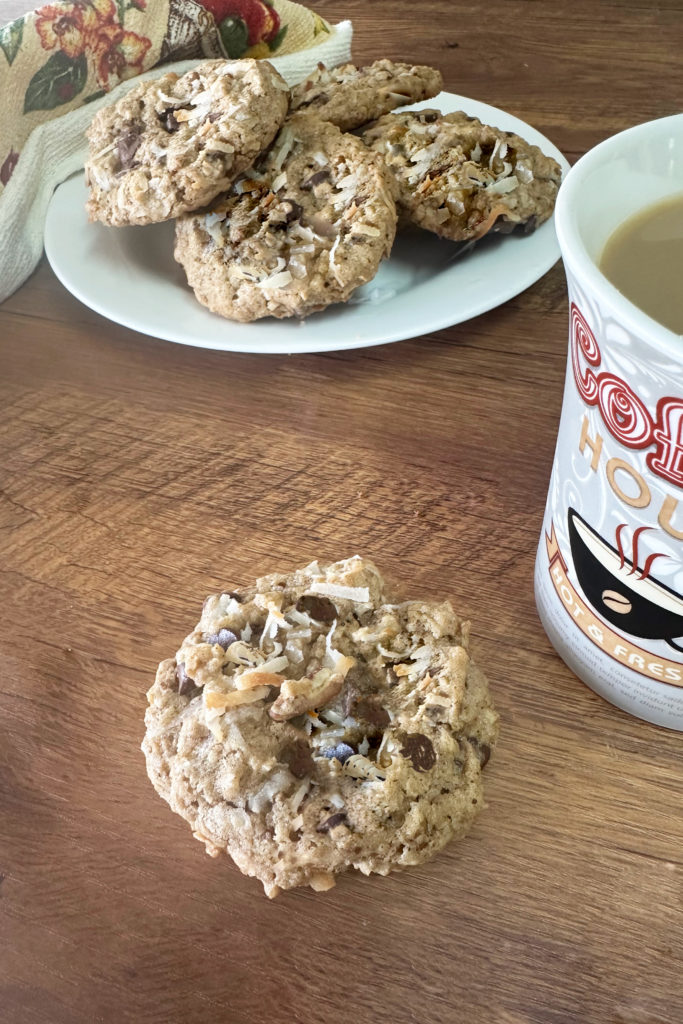
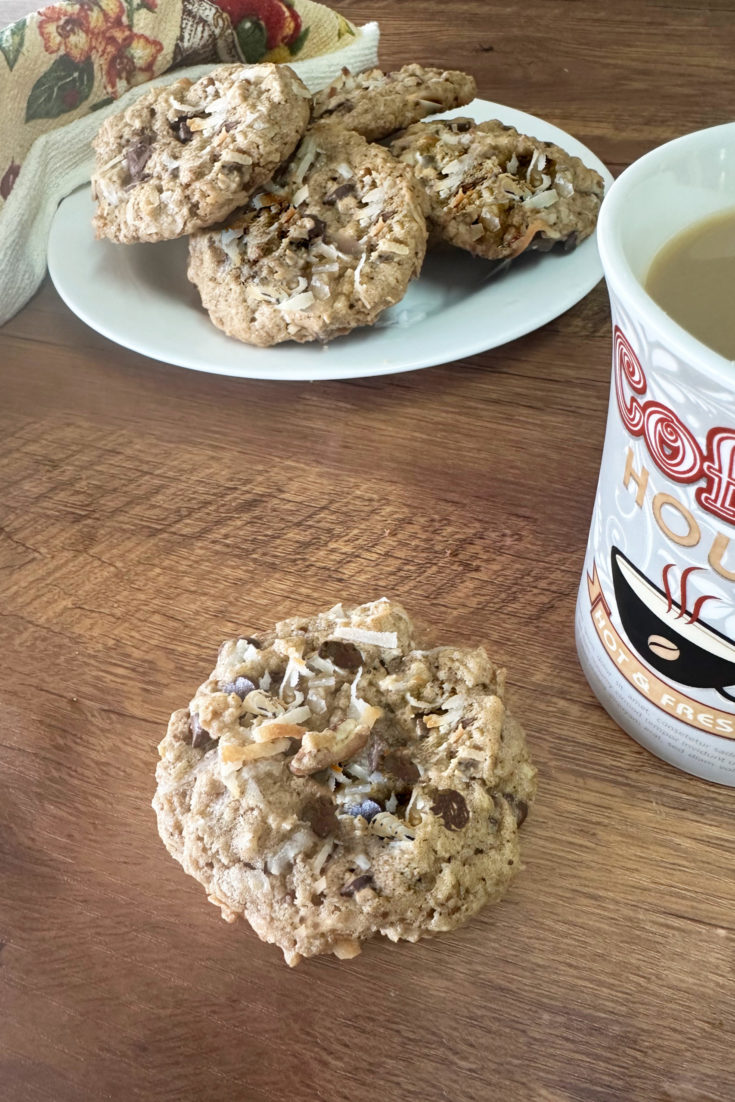
Easy Dairy-Free Cowboy Cookies loaded with oats, chocolate chips, crunchy pecans, shredded coconut, and lots of flavor. A hearty snack that’s almost like an energy bar in a cookie! And this recipe is made without milk or butter.

Loaded with hearty oats, sweet chocolate chips, crunchy pecans, and shredded coconut, this Easy Dairy-Free Cowboy Cookies Recipe makes a wonderfully rustic, unique, and filling treat.
Serve them up at your next casual gathering, pack them for a family hike, have one as an energizing afternoon pick-me-up snack, or grab one on the go.
Or just have them as a comforting treat with your favorite coffee, tea, or cold drink.
No one seems to know where cowboy cookies originated, but of course the assumption is that they were eaten by cowboys as a high-energy and easy-to-carry snack (not completely unlike our energy bars of today).
Frequently Asked Questions (FAQs) for dairy-free cowboy cookies
Can I use a different type of nut other than pecans?
Yes, while pecans add a classic crunch, you can easily substitute chopped walnuts or almonds depending on what you have on hand.
Are cowboy cookies normally dairy-free?
Traditional cowboy cookies are often made with butter, but this recipe uses dairy-free alternatives so they are completely free of milk and butter while keeping that rich, delicious flavor.
How should I store cowboy cookies?
Store them in an airtight container at room temperature for up to 4 days, or freeze them for up to 3 months for long-term freshness.
Can I add dried fruit to these cookies?
Yes, you can easily mix in dried cranberries, raisins, or chopped dates alongside the chocolate chips and coconut for extra texture and flavor.
Can I make the dough ahead of time?
Yes, you can prepare the cookie dough and keep it covered in the refrigerator for around 2 days, or scoop the dough balls and freeze them to bake fresh whenever a craving strikes.
Are these cookies healthy?
While these cookies are packed with wholesome, hearty ingredients like oats, pecans, and shredded coconut, they are still a sweet treat containing sugar and chocolate chips.
However, because they are made with oats and nuts, they provide a bit more fiber and substance compared to traditional cookies, making them a great energizing snack!
Frequently Asked Questions (FAQs) for baking
Why do recipes have salt in the ingredients of baked goods?
Even though salt tends to make foods, well, salty, it actually plays other roles in baking as well.
For example, the right amount of salt balances flavors in baked goods; it can bring out the sweetness of sugar and, at the same time, prevent them from tasting overly sweet. It also can help dull the bitterness of cocoa.
Salt prevents baked goods from tasting bland, while it balances the richness of the fats. It also helps develop flavor in yeast breads and works with proteins to strengthen gluten and make it more elastic.
Salt also slows down yeast fermentation because it prevents the yeast from eating up the sugars too quickly, which otherwise would cause the dough to rise too fast and then ultimately collapse, causing bread to come out flat instead of fluffy.
Salt helps baked goods stay a little fresher for a little longer and helps delay mold from growing on them.
What is the difference between white granulated sugar and brown sugar?
The short answer is that while white granulated sugar is just pure sweetness, brown sugar is white sugar with molasses mixed into it.
Here is how that change affects your baking:
- White sugar is neutrally sweet. Brown sugar tastes like rich caramel or toffee.
- White sugar makes things crisp and light. Brown sugar traps moisture, making baked goods (like brownies) dense, soft, and extra chewy.
- Brown sugar is dark and wet; white sugar is dry and clear.
Tip: If a recipe calls for brown sugar and you’re completely out, you can make your own by thoroughly mixing a tablespoon of molasses into a cup of regular white granulated sugar, and that will give you light-brown sugar. If you want dark brown sugar, you need to mix in more molasses.
What is the difference between baking soda and baking powder?
Baking soda and baking powder are both synthetic leavens that help baked goods rise, but there is a difference between them.
Baking soda is pure sodium bicarbonate, which needs another ingredient that is acidic in order to be activated. When the baking soda touches the acid, it creates a carbon dioxide gas, which helps the baked good rise. Baking soda is between 3 and 4 times stronger than baking powder, and if too much baking soda is used, your baked good will end up with a metallic flavor.
Baking powder is baking soda that is already mixed with an acid and a stabilizer and will be activated by moisture and heat. Nowadays, baking powder is called double-acting because it activates twice—once when it gets wet (when you mix the ingredients together) and again when it heats in the oven.
Replacing one with the other can be tricky, and it’s not recommended. However, if you have no choice, then do solid research for substituting one for the other for the baked good you are preparing so you don’t ruin it.
What do eggs do in baking?
Eggs are made up of two parts: the whites and the yolks (the yellow).
Egg whites are made up of protein that sets when heated and helps baked goods hold their structure. The yolks are made up of fats and vitamins and help ingredients bond.
Eggs also help baked goods rise as well as keep them moist.
It is important to have the right amount of eggs when baking, because if there are too many eggs in a recipe, this can cause a rubbery, dense texture, and if there are too few eggs, this can cause a crumbly, dry texture.
The different parts of the egg will provide different textures to baked goods; using the entire egg in baking will provide moisture and help the baked good rise evenly, using extra yolks will create richer, denser textures, and extra whites will add fluffiness but may create a drier texture.
What is the difference between butter and margarine?
Butter is a dairy product that is made by churning heavy cream until the fats separate from the milk (i.e., buttermilk). Margarine, however, is made from vegetable oil. Butter generally has a lower melting point than margarine as well as a lower water content (and the soft tub margarines have a higher water content than bar margarines).
Using butter in baking cookies can create a crisper, more flaky cookie, while cookies will come out softer and more cakey when made with margarine. It is also generally believed to be better to “cream” using butter rather than margarine.
Using butter adds a kind of toasted nut flavor to baked goods, while margarine doesn’t add flavor (however, sometimes with margarine, one might have a waxy feel on the roof of one’s mouth after eating something with a high margarine content).
If one wants to make a dairy-free baked good that calls for butter, a dairy-free margarine is a good substitute.
What is the difference between real vanilla extract and imitation vanilla?
Real vanilla is made from soaking vanilla beans in alcohol, imitation vanilla is synthetic, and real vanilla costs quite a bit more than imitation. Whether or not there will be a taste difference in your baking depends on the baked good, so do some research before you decide.
I personally always use the imitation as long as I have a really good brand because it’s not worth it to me to spend the extra money.
Kitchen equipment for baking
- a stand mixer, which I use mostly for dough and sometimes for whipping
- a hand mixer (for things that aren’t dough, and I don’t want to mix manually)
- a kitchen scale
- different sizes and shapes of baking pans, including loaf pans
- mixing bowls (or just large bowls—I have plastic, glass, and metal)
- cookie sheets
- pie dishes
- dry measuring cups
- liquid measuring cups
- measuring spoons
- whisks
- rubber spatulas (really good for when you don’t want to leave anything in the bowl)
- rolling pins
- a baking mat for rolling out dough
- baking strips
- a good supply of baking (or parchment) paper (also round for layer cakes)
Basic baking ingredients
- flour
- white granulated sugar
- brown sugar (light/dark—I usually keep dark)
- confectioners’ sugar (powdered sugar)
- salt
- baking powder
- baking soda
- cocoa powder
- ground cinnamon
- ground nutmeg
- ground ginger
- ground cloves
- baking chocolate
- chocolate chips
- instant dry yeast
- vanilla and/or vanilla sugar
- cooking oil/cooking spray
- margarine or butter
- eggs
- honey
- instant coffee
- various extracts (real or imitation)
Extras for “just in case”
- whipping cream
- powdered pudding mix
- powdered sugar
- a good chocolate spread
- shredded coconut
- toppings such as chopped walnuts, raisins, sprinkles, etc.
- packaged pie dough or ready-made pie crusts
- puff pastry dough
Easy Dairy-Free Cowboy Cookies Recipe

Dairy-Free Cowboy Cookies are almost like an energy bar in a cookie! Made without milk or butter.
Ingredients
- 1 cup all-purpose flour, not packed
- 1 cup rolled oats (whole oats)
- 1 cup semisweet dairy-free chocolate chips
- ¾-1 cup sweetened coconut flakes, as desired (or you can substitute shredded coconut)
- ¾ cup chopped pecans
- ⅔ cup brown sugar, packed
- ⅓ cup white granulated sugar
- 1 teaspoon ground cinnamon
- ¾ teaspoon salt
- ½ teaspoon baking soda
- ½ cup soft unsalted diary-free margarine or other dairy-free butter alternative
- 2 teaspoons vanilla extract, real or imitation
- 1 large egg
Instructions
- Combine the flour, oats, brown sugar, white sugar, cinnamon, salt, and baking soda in a mixing bowl.
- Add the butter alternative or margarine, vanilla, and egg, and mix thoroughly.
- Gently fold in the chocolate chips, pecans, and coconut flakes until they have spread throughout the dough.*
- Refrigerate dough for at least an hour.**
- Make balls of dough (you can use an ice cream scoop) and place them on baking sheets that have been lined with baking paper (leave double the with of the ball of dough in between each of them i.e. if you have 1" balls, then leave 2" in between them).
- Place the baking sheets in an oven that has been preheated to 375°F and bake for 8-10 minutes or until the cookies are showing a golden brown around the edges and are no longer wet to the touch.
- Remove from the oven and let cool completely (best on a cooling rack).
Notes
* The coconut flakes may get buried in the dough, so I like to roll some on the outside of the ball of dough before baking so that they are visible.
** It's best to let chill, but I don't always do this if I don't have time. They still come out great.